After a dramatic confrontation between U.S. and Russian ambassadors over the future of international mediation in Western Sahara, the UN Security Council reached an impasse on Oct. 30 and failed to renew the mandate of the UN Mission for the Referendum in Western Sahara (MINURSO). Since Nov. 1, UN personnel have been withdrawing from the region, ending the 35-year pursuit of a referendum on self-determination for the Sahrawi people.
With support from Moroccan diplomats, U.S. representatives had circulated a proposal among Security Council members intended to legitimize the Moroccan occupation of the territory under the UN’s banner. While the U.S.-Moroccan proposal also intended to shut down MINURSO, its implementation would have first required the Security Council to agree to Morocco’s annexation plan—and with it, the Trump administration’s absurd, hypocritical interpretation of international law and “humanitarian needs.”
A set of superficial amendments to the U.S. draft proposal did not sway Russian or Chinese delegates, who allegedly signaled their opposition in negotiations on Oct. 28. In the moments before the Security Council’s deliberations, Russian delegates publicized a short counter-proposal to renew the UN mandate for another year without modification, which they described as “the last opportunity to extend the life of MINURSO.”
The U.S. proposal received 11 votes in favor, including the United Kingdom and France as permanent Security Council members. China, Pakistan, and Somalia abstained, while Russia used its veto. The vote was inverted for the Russian document, as 11 delegations abstained while the U.S. vetoed. With neither resolution passing the Security Council, MINURSO’s mandate lapsed the following day.
As MINURSO representatives withdraw, the Moroccan military has amassed its forces along the berm which acts as a de facto border with the Sahrawi Arab Democratic Republic (SADR). In response, Polisario issued a call for the emergency mobilization of the Sahrawi people and armed forces on Nov. 10.
Peace forces mobilize
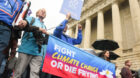
In the days leading up to the Security Council’s vote, supporters of the Polisario Front took to the streets around the world to assert their right to self-determination. Small groups of Sahrawis in Moroccan-occupied cities risked arrest with spontaneous protests, while thousands marched in Tindouf and in European cities like Bilbao. Chants and slogans united around Polisario as the representative of the Sahrawi people, rejecting Moroccan attempts to legitimize “alternative” organizations.
While thanking the delegations that opposed or abstained from the U.S. resolution, Polisario representatives emphasized the responsibility of U.S. and Moroccan diplomatic authorities in undermining MINURSO and the peace process.
“Morocco, the occupying state, and its allies bear full responsibility for undermining the mandate of MINURSO and for the consequences that may result from the cessation of the Mission’s operations in Western Sahara,” said Sidi Omar, the Polisario’s lead UN representative, in a Nov. 1 statement. “As the UN Secretary-General has underscored, the departure of MINURSO does not abrogate the inalienable rights of the Sahrawi people.”
The French Communist Party (PCF) responded quickly, condemning the Macron government’s endorsement of the U.S.-led resolution and voicing its solidarity with Polisario and the Sahrawi people. The PCF’s statement calls for an “urgent initiative by the United Nations to ensure the continuity of MINURSO” and to “relaunch a credible political process—under UN auspices—that involves all parties and fully respects the right of the Sahrawi people to freely determine their own future.”
Oxfam and other international nonprofit organizations have also sounded the alarm.
“After five decades of displacement, Sahrawi resilience must never become an excuse for international inaction, or for them to be asked to surrender their rights,” read a statement from Marco Di Cecco, director of Oxfam’s Algeria division. The statement stressed the urgency of continued international support for Sahrawi refugees “without discrimination or political conditionality.”
Imminent threat of war
While Sahrawi and Moroccan forces have engaged in intermittent, low-level armed conflict since 2020, the collapse of MINURSO—a cornerstone of the 1991 ceasefire—has rapidly escalated tensions. Though Polisario’s National Secretariat hailed the defeat of the U.S.-led Security Council resolution as a major political victory, its Nov. 10 call for general mobilization emphasized the dangers of the Moroccan military presence in the occupied territory.
Brahim Ghali, secretary-general of Polisario and president of the SADR, urged all Sahrawi people to remain “fully prepared to confront any threats” to the SADR’s territory and sovereignty. Polisario leaders have further noted that the threat of Moroccan military aggression is inconsistent with its stated commitment to continuing the ceasefire.
During the 1975-91 period, known as the Western Sahara War, Moroccan forces committed numerous crimes against humanity, including targeting civilians with white phosphorus and napalm. In 2015, Spanish courts found sufficient evidence to charge 11 former Moroccan officials with genocide.
As with the Israeli occupation of Palestine, the U.S. arms industry is responsible for a majority of weapons used by the Moroccan military in Western Sahara. The recent series of agreements between U.S., Israeli and Moroccan governments—such as a trilateral statement to the UN in September—include joint military activities and expanding Morocco’s access to the U.S.-Israeli arms trade.
U.S. weapons manufacturers and agricultural monopolies, two leading forces of the MAGA movement, seek to profit from the escalation of war and to corner the world’s supply of phosphate rock. The Security Council vote follows the Trump administration’s unprecedented abuse of UN proceedings to establish a pretext for a military invasion of Cuba and further expands the theater of MAGA’s imperialist aggression.
No paywalls at People’s World
At People’s World, we believe news and information should be free and accessible to all, but we need your help. Our journalism is free of corporate influence and paywalls because we are totally reader-supported. Only you, our readers and supporters, make this possible. If you enjoy reading People’s World and the stories we bring you, please support our work by donating or becoming a monthly sustainer today. Thank you!
CONTRIBUTOR