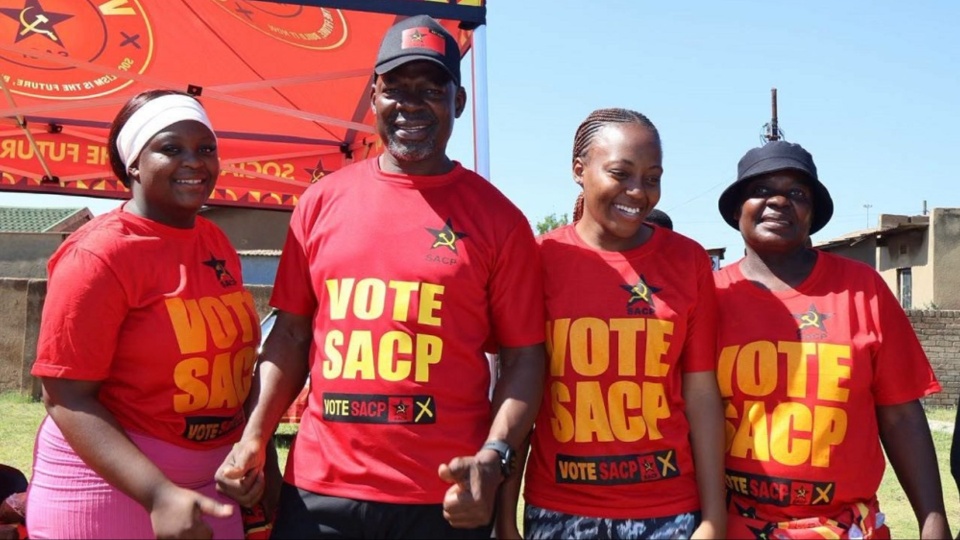
Running under its own banner for the first time since the end of apartheid, the South African Communist Party (SACP) won 271 municipal council seats and roughly 2.4% of the national vote in the country’s Nov. 4 local elections. Party leaders say the result shows working-class voters want a left alternative in local government, and they insist it does not end the SACP’s decades-long partnership with the African National Congress (ANC).
The SACP finished eighth nationally, ahead of several better-funded parties, and won seats in all nine of the country’s provinces. Its best showing came in the Eastern Cape, where it placed third with 6.2% and took 89 seats. Other significant totals came with 45 seats in Limpopo, 26 in Mpumalanga, and 20 in North West.
General Secretary Solly Mapaila credited grassroots organizing on a shoestring budget and noted that the party’s electoral path had been interrupted for 76 years, ever since apartheid’s Suppression of Communism Act outlawed it in 1950.
Mapaila said the party was most proud of “how our comrades have humbled themselves in communities, worked together to find solutions of their problems.”
The ANC saw its national support fall to a record low of about 31%, a result Secretary-General Fikile Mbalula called “catastrophic.” He acknowledged that some longtime supporters had moved to other parties while others simply stayed home.
The ANC’s slide has been years in the making, and much of it traces back to splits within the liberation movement itself.
In 2008, after the ANC recalled President Thabo Mbeki, a group of his allies broke away to form the Congress of the People (COPE). In 2013, expelled ANC Youth League leader Julius Malema launched the Economic Freedom Fighters (EFF), which took just over 6% in this year’s local vote.
Most damaging of all has been former President Jacob Zuma’s uMkhonto weSizwe (MK) Party, formed in late 2023, which drew heavily on ANC strongholds in KwaZulu-Natal and helped cost the ANC its parliamentary majority in 2024. Each split has carried away a share of the ANC’s base.
With elections in more than 120 municipal councils giving no party majority status, the Communists’ new councillors could really matter when it comes to shaping policies. One analysis found the SACP holds enough seats to give the ANC a governing majority in 18 municipalities if the two parties cooperate.
Why run alone?
The decision to run independently of the ANC was adopted at the SACP’s 15th National Congress in 2022 and reaffirmed at a special congress in December 2024. But the debate inside the party goes back more than two decades.
At the heart of the decision is the gap between the promise of 1994 and what working people actually got. As one essay in the party journal Umsebenzi Online put it, the past three decades have been, for workers, “a catalog of unmet promises.”
Unemployment stands at about a third of the workforce and far higher among the young. Wealth remains concentrated much as it was under apartheid. Water and power cuts are routine in many towns.

The SACP is clear, though, that the ANC does not carry the blame alone. The party has long pointed out that the negotiated settlement of the early 1990s left mining, banking, agriculture, and other commanding heights of the economy in the same private, largely white hands that held them under apartheid. Those interests, along with the “private monopoly capital” Mapaila regularly denounces, have fought redistribution at every step.
Pressure also comes from abroad. Mapaila has accused “imperialist forces” of spending money to build new parties and push the ANC toward the right-wing Democratic Alliance (DA). The Trump administration has slapped South Africa with 30% tariffs, expelled its ambassador, and boycotted the G20 summit Johannesburg hosted last year, all while backing the DA’s opposition to land reform and Black economic empowerment.
Domestically, however, the “state capture” scandal of Zuma’s presidency looms large in many voters’ assessments of the ANC. During that period, politically connected businesspeople like the Gupta family, whose business empire spanned media, mining, and energy, bent government agencies and state-owned companies toward private enrichment, gutting public institutions and draining money meant for the poor.
For years, the SACP and its labor allies in the Congress of South African Trade Unions (COSATU) pressed for a “reconfigured” Tripartite Alliance in which all three partners would jointly shape policy, rather than the ANC handing down decisions. Those proposals went nowhere, the party says.
The breaking point came after the 2024 elections, when the ANC formed a “Government of National Unity” with the DA without meaningfully consulting its partners. To the SACP, the move showed that the ANC saw its working-class allies as junior partners to be informed after the fact rather than consulted.
COSATU, which is the country’s largest labor federation, refused to choose between its two allies. At its October congress, delegates adopted a “super resolution” supporting both the ANC and the SACP to keep the 1.5-million-member federation united. General Secretary Zingiswa Losi described a vote for either party as a vote for the alliance. “Those that want to vote for the SACP will vote for the SACP,” she said.
Some COSATU affiliates were openly enthusiastic about the Communists’ result. The National Education, Health, and Allied Workers’ Union (NEHAWU), the federation’s largest union with nearly 283,000 members, called the outcome an outstanding performance and saluted SACP members for pressing ahead “amidst the noise of doomsayers.” The union said the vote proved the party’s manifesto had resonated with workers and the poor.
Not walking out on the ANC
Still, the SACP has been firm that it is not walking out of its alliance with the ANC. It sees its decision to run independently as a way to force the reconfiguration that years of talks failed to deliver.
The party frames this in class terms. As the working-class party in an alliance that also includes Black middle-class and business interests, it says its job is to make sure the interests of workers, and Black workers in particular, are not swallowed up in the broader liberation project.

“We are not leaving the relationship, but we are freeing ourselves from the abuse,” Mapaila said when the decision to run was announced in 2024.
The SACP calls itself the ANC’s natural ally and argues that a Communist ticket can win back disillusioned working-class voters who had been staying home, people who belong to the liberation movement’s base rather than to the right. The party sees itself as the working-class conscience of the National Democratic Revolution, the liberation movement’s long-term program for turning the political freedom won in 1994 into economic and social transformation.
A different kind of critique
For Americans accustomed to hearing attacks on South Africa from the Trump administration and in the corporate media, it’s important to see the distinction between the former and the SACP’s criticism of the post-apartheid record.
Elon Musk and the U.S. president have spent the past few years promoting false claims of a “white genocide,” denouncing land reform and Black economic empowerment, and offering refugee status to white Afrikaners. Their message is that Black majority rule itself is the problem.
The SACP argues the opposite: Transformation has not gone far enough. Party writers note that mining, agriculture, finance, and other key sectors remain largely in private and mostly white hands, and that the richest 0.1% of the population owns about a quarter of the country’s wealth. The SACP regards the DA as the political home of those interests.
Mapaila has ruled out any coalition with the DA. “No, no, certainly not. I mean, we are a party of the working people,” he told reporters Sunday.
Ending the “tender economy”
A central plank of the SACP election manifesto, “Build People’s Power Where We Live,” was what activists call de-tenderization. South African municipalities farm out much of their work, from security to cleaning to construction, to private firms through competitive bids known as tenders.
That system became a pipeline for corruption, producing a class of politically connected “tenderpreneurs” who grew rich on inflated contracts while services fell apart.

The SACP wants to ban tendering for routine purchases and bring outsourced work back in-house, hiring municipal workers directly. The party argues that officials should be personally accountable when they overpay, and that rebuilding the public workforce would create jobs and give local government the capacity to deliver.
The party also pledged to keep municipal land and infrastructure in public hands, using land for housing, cooperative farming, and clinics. It treats water, electricity, and sanitation as rights, priced by ability to pay.
An unemployed grandmother in the Khayelitsha township, party veteran Phillip Dexter told Cape Town radio station CapeTalk, “shouldn’t pay the same for water as a billionaire who lives in Constantia,” a wealthy Cape Town suburb. Other promises included rapid repair teams for leaks and sewage spills and an end to the bucket toilets some communities still use.
On safety, the platform calls for community safety forums, working streetlights, and services for survivors of gender-based violence. To keep councillors honest, the SACP promised open ward assemblies, participatory budgeting, and the power to recall representatives who break their word.
The fight for unity continues
Some in the South African press have rushed to write an obituary for the ANC-SACP-COSATU partnership. Daily Maverick, a business-friendly news outlet in South Africa, ran an article arguing that the SACP’s run “marks the effective end of the Tripartite Alliance” and lumping the party in with COPE, the EFF, and other breakaways from the ANC.
The SACP rejects that reading. Unlike those parties, it has not left the alliance or set itself up as the ANC’s rival for leadership of the movement. National spokesperson Mbulelo Mandlana said the independent run does not signal the end of the relationship. The strains are real, though, as the ANC demanded that members of both organizations pick a side.
Now comes coalition bargaining. The SACP’s Political Bureau met Monday to finalize a negotiating framework. “There is no automatic support for any single party,” Mapaila said, naming reliable services and direct budgeting for communities as non-negotiable. He has said the party is ready to work with the ANC if it reconsiders its past neoliberal economic policies.
Whichever municipal councils it helps govern, the SACP says that it—just like the ANC, the DA, or any other party—should be judged on whether it delivers clean water, working lights, honest contracts, and councillors who answer to the people who elected them.
No paywalls at People’s World
At People’s World, we believe news and information should be free and accessible to all, but we need your help. Our journalism is free of corporate influence and paywalls because we are totally reader-supported. Only you, our readers and supporters, make this possible. If you enjoy reading People’s World and the stories we bring you, please support our work by donating or becoming a monthly sustainer today. Thank you!
CONTRIBUTOR