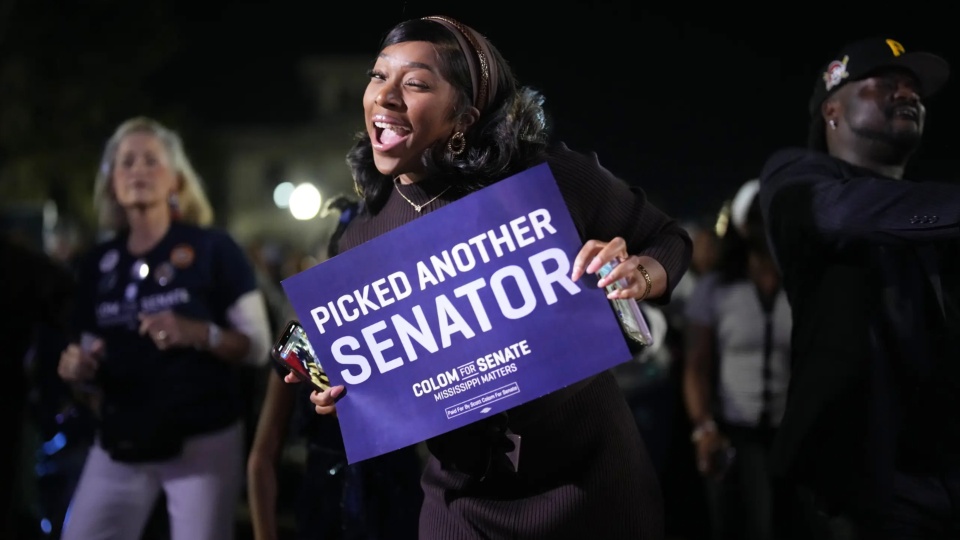
JACKSON, Miss.—Democrat Scott Colom has won Mississippi’s U.S. Senate race, becoming the first Black senator from the state since Reconstruction and the first Democrat it has sent to the Senate since 1982.
With 99% of the vote counted, he led Republican Sen. Cindy Hyde-Smith 49.2% to 48.7%, a margin of 4,669 votes out of more than 960,000 cast. Hyde-Smith conceded Wednesday evening, saying she respected “the decision of Mississippi voters.”
The last Black senator from Mississippi was Blanche K. Bruce, who was born into slavery in Virginia. The state legislature elected him in 1874, and he served from 1875 to 1881, the first Black senator to serve a full term. Before him came Hiram Revels, also of Mississippi, who in 1870 became the first Black person ever seated in the Senate.
How Colom won
Colom’s victory rested on a massive turnout of Black voters, who make up about 38% of the state’s population, the highest share of any state. Black Mississippians backed him 91% to 7%, according to New York Times estimates.
Political analysts had long said a Democrat could win statewide only by pairing strong Black turnout with roughly a quarter of the white vote, and Colom’s numbers proved that formula works.

His base lay in Hinds County, home to Jackson, and in the majority-Black counties of the Mississippi Delta, where Black organizers registered voters, drove residents to the polls, and helped them fix ballot problems. In Holmes County, which includes the small town of Tchula, one team of canvassers registered 283 new voters.
Hyde-Smith, meanwhile, came across as a candidate of the comfortable. Asked in a February TV interview what Republicans would do about soaring beef prices, she replied that consumers have “so many proteins to choose from.”
Colom’s campaign turned the remark into a viral ad in which a man grilling a burger scoffs, “Pick another protein? I’d rather pick another senator instead.” The line became a rallying cry, and Colom hammered “Cindy High-Prices” over tariffs, Medicaid cuts, and the cost of living through the campaign’s final weeks.
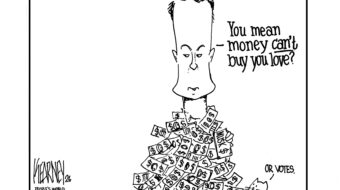
National Democrats were slow to take the race seriously. The Democratic Senatorial Campaign Committee left Mississippi out of a $40 million battleground investment in August. Only in late October, with two weeks to go, did the Schumer-aligned Senate Majority PAC put $1.2 million into television ads for Colom—a significant sum in a race that had seen only about $8 million in total ad spending to that point.
Part of a national wave
Colom’s win was part of a string of Democratic victories on Nov. 3 that will bring profound changes to Washington and several state capitals.
In California, Xavier Becerra was elected governor, becoming the state’s first Latino governor chosen by voters. In Texas, Gina Hinojosa ousted Greg Abbott to become the state’s first Latina governor and its first Democratic governor since Ann Richards. In Michigan, Abdul El-Sayed won the Senate race, becoming the first Muslim elected to the U.S. Senate. Keisha Lance Bottoms won to become the next governor of Georgia, making history as the first Black woman elected governor not only in the state but the United States ever.
“The Mississippi way”
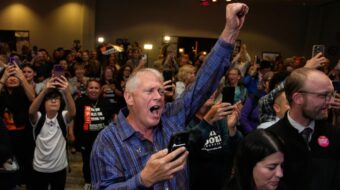
Colom celebrated his win Wednesday night before a crowd of more than 1,000 at Tougaloo College, the historically Black school near Jackson that was a hub of the civil rights movement. He was introduced by Rep. Bennie Thompson, who has been the only Black member of Mississippi’s congressional delegation since 1993.
Thompson told the crowd, “I now have a partner in Washington.” The state will now have one Black representative in the House and one in the Senate.
Colom opened his speech by honoring Revels and the state’s civil rights heroes. “God didn’t want us to get it the easy way,” he said. “He wanted us to get it the Mississippi way.”
Colom’s victory stands on generations of struggle, including the fight for Black voting rights inside the Democratic Party itself. That history ran through Tougaloo, where Thompson, as a student, organized for Fannie Lou Hamer’s 1964 congressional campaign.
Fannie Lou Hamer, a former sharecropper, helped found the Mississippi Freedom Democratic Party in 1964 and became its vice chair. The MFDP was created as an alternative to the state’s all-white, segregationist Democratic Party, which shut Black Mississippians out of the vote and out of the party.
At the 1964 Democratic National Convention, Hamer told the credentials committee how she had been jailed and nearly beaten to death in Winona, Miss., the year before for trying to register Black voters. The brutal assault would result in permanent physical damage for Hamer, including permanent kidney injury, impaired vision, and severe damage to her back and legs.
Her testimony, broadcast nationwide, forced party leaders to respond. They offered the MFDP two at-large seats and a pledge to bar discriminatory delegations from future conventions.
The Freedom Democrats rejected the deal—“We didn’t come all this way for no two seats,” Hamer said—but the pledge changed the party, and by 1968 an integrated Mississippi delegation was seated.
Mississippi was also the home ground of Medgar Evers, the NAACP’s first field secretary in the state. Evers was turned away when he applied to the University of Mississippi’s law school in 1954, and he later helped James Meredith win the court fight that integrated Ole Miss in 1962. He was assassinated in the driveway of his Jackson home in June 1963.
From Tchula to the Senate
The Delta has made history before. In 1977, Eddie Carthan was elected mayor of Tchula, the first Black mayor of the town since Reconstruction.
Carthan used federal funds to build public housing and a day care center, hiring Black workers who otherwise spent half the year in low-paid labor on the cotton plantations. To the local white power structure, which depended on that cheap seasonal labor, it was an intolerable challenge.
The backlash was swift. Carthan was forced from office in 1980 on an assault charge. When Roosevelt Granderson, a political rival whom the board of aldermen had installed as mayor, was killed in a 1981 robbery of the store where he worked, prosecutors charged Carthan with capital murder, claiming he had hired the killers.
After a nationwide campaign for his freedom, a jury acquitted him in 1982.
This November, the overwhelmingly Black communities along that same stretch of the Delta turned out again, as they had for Carthan nearly half a century ago—and this time they helped send one of their own to the U.S. Senate.
“That’s the Mississippi way. We did it again, and we don’t give up,” Colom said of his historic win.
C.J. Atkins and Chauncey K. Robinson contributed to this article.
No paywalls at People’s World
At People’s World, we believe news and information should be free and accessible to all, but we need your help. Our journalism is free of corporate influence and paywalls because we are totally reader-supported. Only you, our readers and supporters, make this possible. If you enjoy reading People’s World and the stories we bring you, please support our work by donating or becoming a monthly sustainer today. Thank you!
CONTRIBUTOR