

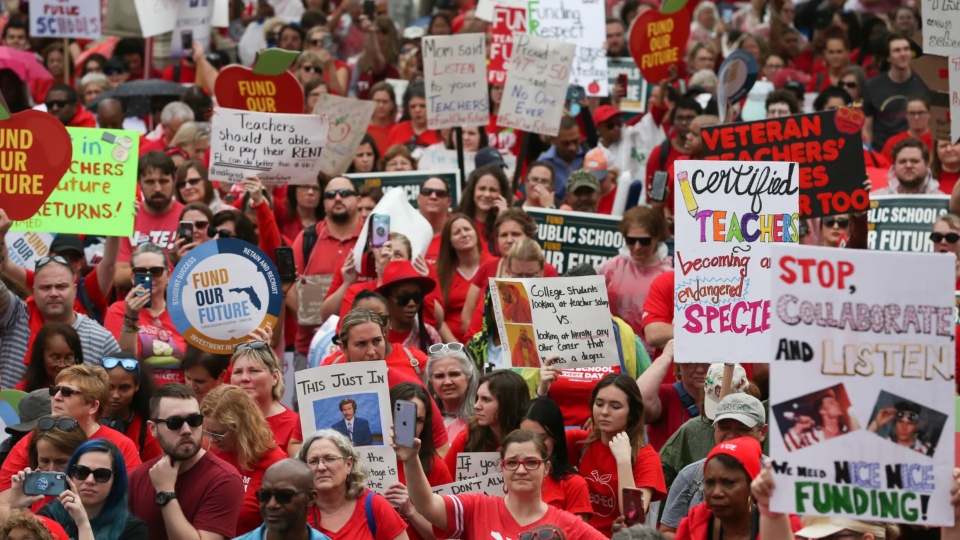
Editor’s Note: Florida’s public school educators and staff are locked in an existential fight to save their unions against state laws and regulations designed to dismantle their collective bargaining rights. Under strict state mandates, local unions must maintain at least 60% membership or face repeated recertification elections that threaten to strip away union contracts for entire school districts. Amid aggressive state backing for private and charter schools, Florida teacher John Meeks lays out what is at stake—and why solidarity among educators is essential to defending their profession, their contracts, and public education itself.
What has the union done for me?
This is a common question among non-members who have either left the union or choose not to join at all. My answer to this question is simple: We are the union, whether we are members or not.
I liken our work to that of a series of Christmas lights. We shine brightly when we are all working in unison toward a common goal, and that is to create an environment in which all educators and education staff professionals—all workers in any industry—are treated with respect and dignity.
When we assume that solidarity is work for others to do, we dim our lights and present to the public that we do not present a unified front, and we can thus be easily divided.
Lost along the way, however, are tangible threats to our work to serve our students, our schools, and our communities every day. Lost along the way is the simple math behind the influence of the union.
Ask yourself which local union has more say in the working conditions of the men and women who serve our students—a union with 100% of the membership walking up to the table with real density to advocate for better pay, benefits, and security versus a union barely surviving on 50% membership and being reduced to begging for scraps from the community table?
This brings me to where I extend my most sincere gratitude: to our members who are the dues-paying, load bearing structures who are carrying the weight of not just yourselves, but the weight of those who are not members.
But, before any of you leave the union to save a few dollars, remember that the more members we have, the more influence we have and the dues burden will be alleviated for everyone.
But, what of the politics? “I don’t want my dues to support causes I oppose,” some say. I believe this to be the greatest misconception about our teachers’ unions.
Not one cent of our dues go toward partisan politics. It is true that our national organizations have political action committees, but it is also true that member contributions are solely voluntary and must abide by federal elections regulations. This applies to any professional organization that engages in policy that affects them.
For us to pretend that unilaterally stepping away from political discourse would be to give a hand up to those who do not have the best interests of public education in mind.
But don’t the teachers’ unions line up behind candidates to influence elections?
This is one of the greatest misconceptions about our union movement and public education. It matters not if a politician is “blue” or “red,” it always comes down to whether or not our elected and appointed officials supported public education.
We can look no farther than President Dwight D. Eisenhower, who said, “Only a fool would try to deprive working men and women of the right to join the union of their choice.” And, on the state level, we had a former teachers’ union president as our governor, Bob Martinez, who worked to build a stronger Florida Education Association in the 1970s.
On the local level, we have always had allies on both sides of the political aisle who supported our public schools. I can immediately think of the late Jim King and other moderates who did not weaponize government against our schools.
The reason why we find ourselves in a maelstrom of policy and legislation that keep causing harm to public schools is not that educators or education staff professionals have become any more radical. We continue to stand on business for our students. What has changed, however, has been Tallahassee placing a heavy thumb on the scales for what they call “school choice.”
The unfortunate result, however, is a two-track education system in which our constitutional duty to have an equitable system is forced to compete with a heavily-favored and fully-funded private system that lines the pockets of the very officials who are supposed to look after the interests of all of our students.
Without the guardrails of moderation in a state government that is beholden to the private and charter school interests, whither goest the union?
No.
It’s because the union’s existence depends entirely on our acknowledgement that we all have a role to play in advocating for our profession.
I find it curious to see non-members posting on social media about their concerns. They muse loudly about how the system is screwing them over but overlook the fact that there is an organization that is working every day for their benefit—and without their support.
When challenged to give a name of any organization that works harder than the teachers’ union for their benefit, their answer is silence.
This brings us to the existential crisis that our teachers’ unions are facing under Florida’s draconian laws and regulations that could eliminate collective bargaining rights for educators and education staff professionals.
At this crossroads, the state demands that our teachers’ unions have at least 60% membership. At this crossroads, the state demands that we routinely hold elections to maintain our union contract if we fall short of 60% membership. At this crossroads, we could potentially eliminate union contracts for everyone in a school district—regardless of union membership.
This begs the question of what the union has done for us if we have not done for our union in return. Ever since 1881, there has been a teachers organization in Duval County, Fla. Our need to be treated with respect and dignity has not changed in over a century of advocacy for our profession.
And, although the stars seem to be aligned against our union and our work, let us not forget that we are the union and we shall overcome if we unite to protect solidarity in Duval.
When we ask for the cavalry to come save us, we all are invited to suit up for our next battle because we are the union, and if anyone is to protect our collective bargaining and contractual rights, our president cannot win this alone; our vice presidents cannot win this alone; our board members cannot win this alone; our building representatives cannot win this alone.
This will take an all-hands-on-deck approach to keeping solidarity alive in Duval County for generations to come.
Solidarity forever.
No paywalls at People’s World
At People’s World, we believe news and information should be free and accessible to all, but we need your help. Our journalism is free of corporate influence and paywalls because we are totally reader-supported. Only you, our readers and supporters, make this possible. If you enjoy reading People’s World and the stories we bring you, please support our work by donating or becoming a monthly sustainer today. Thank you!
CONTRIBUTOR