
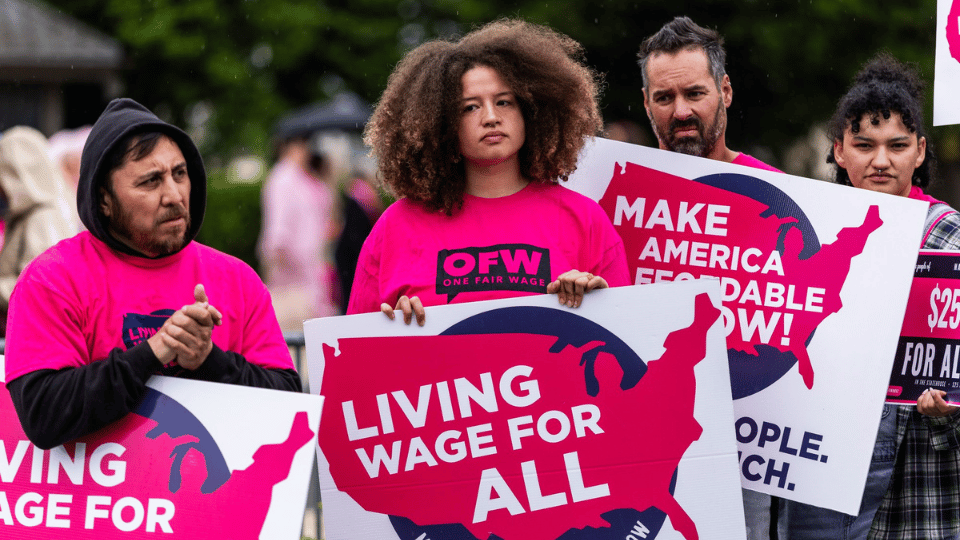
WASHINGTON—The long-running “One Fair Wage” campaign to raise the federal minimum wage is setting its sights higher—a lot higher—than $15 an hour, founder and Executive Director Saru Jayaraman says.
Try $25 an hour, the minimum needed for a family of two to live in the cheapest county in the country, in rural Texas. Or $27 an hour, proposed in Illinois. Or $30 an hour, already on its way to low-wage workers in Los Angeles, timed for the 2008 World Cup and Olympics.
Lawmakers keep talking about an “affordability crisis,” Jayaraman explained to the Progressive Democrats of America in a November 22 Zoom meeting. But it’s really “a wage crisis.”
That’s because except for two short 12-month periods since 2000—the start of the Wall Street-caused Great Recession and the first months of the coronavirus pandemic a decade later—prices never went down.
So the solution to “affordability” is to bring wages up, Jayaraman declares. One Fair Wage’s new federal minimum wage target is $20 an hour by 2031-32 and $25 by 2038.
To push it, One Fair Wage has gathered a coalition of 150 organizations to campaign for a new living wage bill. It’s also urging people to contact their lawmakers individually, since legislators will listen especially to constituents’ stories. Contact information is at https://livingwageforall.org/call.
“We’re closing in on 30 states,” and many cities and counties which have already raised their minimum wages, Jayaraman says. That includes California, Illinois, New York, Massachusetts, Minnesota, Maryland and New Jersey—and Los Angeles, San Francisco, Chicago, New York City and state, St. Louis, the Twin Cities, Cleveland, D.C., and Boston.
And if right-wing anti-worker, pro-corporate GOP President Donald Trump vetoes a higher minimum wage? Raising the wage has immense popular support and becomes a ready-made campaign issue in 2028 for foes of the corporate CEOs and the MAGA mob, Jayaraman replies.
Raising the wage is so popular, she adds, that even 63% of Republicans favor it, an exit poll of 10,000 voters reports. They’re part of overall 78% support, 81% of working-class voters in Texas, and 96% among African-Americans overall.
“There was even a rumor among MAGA that Trump was delivering $25 by an executive order, ” Jayaraman comments. Advocates had to quickly counter that Trump wasn’t raising the wage.
By contrast, Trump’s predecessor, Democrat Joe Biden, used an executive order to raise the minimum wage of workers for federal contractors to $15 an hour in early 2021. Trump dumped Biden’s order in March 2025.
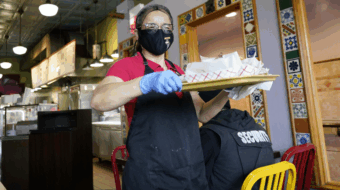
So one way to put real money into people’s pockets, Jayaraman said, is to raise their wages by law. And that would especially benefit at least 13.6 million workers in the restaurant industry alone, including one of every seven working women.
Another, of course, is a step many low-wage workers now take: Unionizing. Not counting “free riders,” the Bureau of Labor Statistics calculated the number of union members increased by 440,000 from 2024 to 2025.
And there were large wage gaps, in favor of unionized workers, even in low-paying service industries.
The lowest—the restaurant workers Jayaraman discussed—had median weekly wages of $699 for non-union workers in 2025 and $741 for unionized workers. The median is the midway point where half the group earns more and the other half earns less.
Many states and cities, tired of waiting for federal action or frustrated by congressional gridlock, raised minimum wages on their own, over the screams of corporate CEOs, who claim it would cost jobs, plus the National Restaurant Association—the lobby for those businesses—and the National Retail Federation, which is viewed as being under Wal-Mart control.
But the federal minimum wage of $7.25 an hour has stalled since 2009, and the federal tipped minimum wage—the minimum for restaurant servers, taxi drivers and other workers who depend on tips—has remained at $2.13 since the Reagan administration.
Jayaraman said tip dependence produced “the least-paying” occupations, starting with “the end of Reconstruction.” There were no “tipped workers” before that, but Southern racists imported the idea of tipping as a way to keep Black workers’ pay down and those workers exploited, she explained.
Now, as a result of that relic of racism, “young women and single mothers” suffer, she said. They must toil for that tipped wage plus tips, which bosses are supposed to supplement by covering the difference between received tips and the local minimum wage rate. But they also suffer sexual harassment on the job and rampant wage theft by bosses.
In her briefing with PDA, Jayaraman also issued a warning: Don’t let the congressional Democrats compromise on raising, and eventually eliminating, the tipped minimum. That happened in prior years.
Some “moderate” Democrats, she warned, may argue for a “compromise” to get Trump to sign any minimum wage hike. With a large Democratic House majority—now 258-173 with two races uncalled and two in Louisiana headed for December runoffs—Jayaraman expects the raise-the-wage bill will easily pass there.
The problem, she says, will be the Senate, despite the Democrats’ new 56-44 majority in the new Congress. The Democratic number includes independents Angus King of Maine and Bernie Sanders of Vermont. Sanders will again chair the Senate Health, Education, Labor and Pensions Committee after years of GOP rule there. But breaking a GOP filibuster, prompted by the low-wage lobbies, needs 60 Senate votes.
“The real necessity is not leaving out the tipped workers. It would be a real travesty and cost us in 2028,” Jayaraman warns.
No paywalls at People’s World
At People’s World, we believe news and information should be free and accessible to all, but we need your help. Our journalism is free of corporate influence and paywalls because we are totally reader-supported. Only you, our readers and supporters, make this possible. If you enjoy reading People’s World and the stories we bring you, please support our work by donating or becoming a monthly sustainer today. Thank you!
CONTRIBUTOR