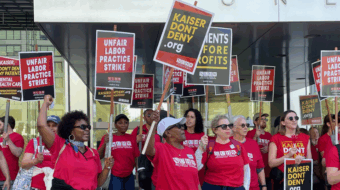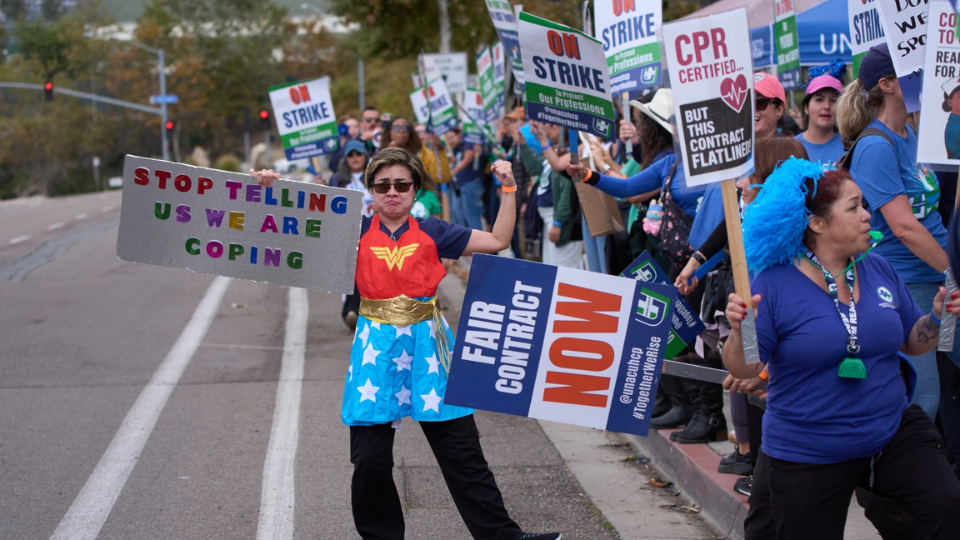
OAKLAND—In one of the largest healthcare strikes in recent U.S. history, an estimated 46,000 frontline healthcare workers at Kaiser Permanente walked off the job Tuesday. They are mounting a powerful, multi-state challenge to the company’s profit-centered approach to healthcare and dangerous understaffing practices, which harm patients and workers alike.
Indeed, the five-day unfair labor practice strike, spanning over 500 medical centers and offices in California, Oregon, Hawaii, and Southwest Washington, represents a massive mobilization of the working class. The workers—including registered nurses, pharmacists, midwives, and rehab therapists—demand a new contract that provides living wages and, crucially, adequate staffing levels needed to ensure patient safety and positive health outcomes.
More than that, many workers on the picket line reported that their fight is also part of the larger struggle against the Trump administration’s attacks on workers, healthcare, and science.
And while Kaiser officials have tried to frame the strike as being “solely about wages,” workers on the picket lines immediately identified chronic understaffing as the primary reason for the historic walkout.
“The issue first and foremost in my heart is the lack of safe staffing,” said Nicole Jimenez, an intensive care nurse at Kaiser’s facility in Ontario, California. “It has not changed for years. We’re stretched so thin that it’s unsafe for the patients and the nurses, and we’re seeing nurses just get burned out, leaving for jobs that don’t require bedside care.”
Despite being compelled to concede to specific staffing ratios and language in previous contracts, workers say Kaiser still chronically understaffs its facilities. The healthcare giant serves more than 12.6 million members nationally, including 9.5 million in California alone.
The strike is organized by the United Nurses Associations of California/Union of Health Care Professionals (UNAC/UHCP) and an alliance of dozens of Kaiser unions. This struggle highlights the stark inequality within the nation’s largest health system.
While Kaiser Permanente and its subsidiaries reported a staggering $13 billion in net income last year, that wealth is not reaching patients or caregivers. The company is sitting on $66 billion in reserves—a figure that has grown by 50% in just the past four years—proving that resources for safe staffing are not the issue.
“Kaiser can choose how they spend their money,” said Clarissa Charlier, an emergency department nurse at Sunnyside Medical Center in Oregon and a member of the union’s bargaining team. “If we don’t have a market-competitive contract, we’re going to continue to hemorrhage nurses.”
Workers are seeking a 25% wage increase over four years to catch up after years of wages failing to keep pace with inflation. The union argues that Kaiser wages are at least 7% behind those of their peers at competing healthcare institutions. This wage disparity fuels worker burnout and a staffing exodus, which, of course, harms patients across the board.
Kaiser’s counteroffer of 21.5% over four years is seen by workers as an insult, especially in the face of extreme CEO pay. On picket lines, several signs highlighted Kaiser CEO Greg Adams’ total compensation, which breaks down to a jaw-dropping $7,211 per hour.
The crisis is particularly acute in the Pacific Northwest, where nurses say they are paid 22-28% below the local market rate. Their bargaining unit is fighting for an additional 27% “market adjustment” on top of the national raise.
The mood on picket lines from Hawaii to Oregon has been determined and resolute, with workers recognizing their struggle as part of a broader fight for the rights of all workers against corporate profiteering, for the right to assemble, and for working-class dignity.
The scale of the walkout sends an unmistakable message to Kaiser’s executive suites and those like them: the workers who form the backbone of this multi-billion dollar company will no longer accept poverty wages and unsafe conditions for themselves and their patients.
The strike is scheduled to last until midnight Saturday, October 18, though workers have vowed to maintain their unity for as long as it takes to win a contract that values their labor and protects their patients.
We hope you appreciated this article. At People’s World, we believe news and information should be free and accessible to all, but we need your help. Our journalism is free of corporate influence and paywalls because we are totally reader-supported. Only you, our readers and supporters, make this possible. If you enjoy reading People’s World and the stories we bring you, please support our work by donating or becoming a monthly sustainer today. Thank you!
CONTRIBUTOR