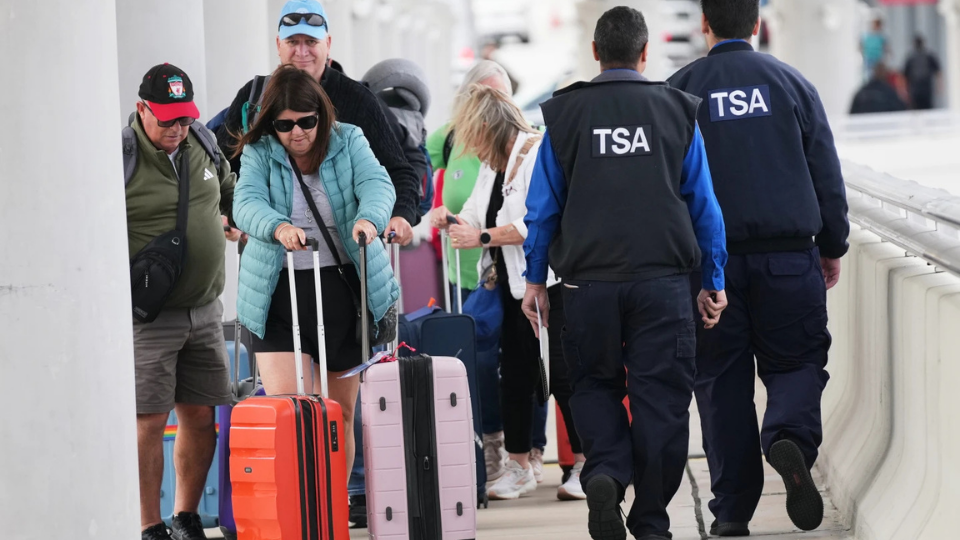
WASHINGTON —The nation’s Transportation Security Officers first endured years of extremely low pay. Then they caught up, but the GOP Donald Trump regime unilaterally canceled their collective bargaining agreements. Then the 45,000 TSOs—the airport screeners—went unpaid during two government shutdowns, with the second one, which ended recently, setting a record.
And through all this, they diligently stayed on their jobs for 125 days without pay, although almost 1,000 quit during the latest closure, says their union president, the Government Employees’ Everett Kelley. That’s on top of 1,100 who left during the prior shutdown last year.
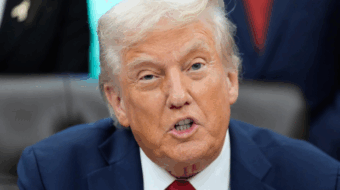
Now, President Trump wants to privatize the TSOs, and that’s a recipe for security full of holes, Kelley warns. His position is an elaboration of the old saying, “If it ain’t broke, don’t fix it.“
In blunt language, don’t privatize them.
Trump wants to break it. His budget for the fiscal year starting October 1 calls for firing 8,400 TSOs—most of them veterans or workers of color—cutting their agency’s budget by $529 million, cutting their pay, and replacing 4,500 with private “contractors” at 220 more of the nation’s 420 airports. Private screeners now serve at 20 low-volume airports.
Kelley produced his opposition at a May 20 House Homeland Security Committee hearing, reviewing the 25-year history of the Transportation Security Agency and the TSOs. Lawmakers also wanted witnesses to discuss future improvements. Besides the cuts, the radical right wants to privatize the TSOs. Kelley doesn’t. He’d enhance their rights, instead.
“The federal aviation security screening model Congress created in the aftermath of the September 11” al-Qaeda attacks in 2001 “is working and the workforce that delivers it deserves to be working and the workforce that delivers it deserves to be strengthened, not dismantled,” Kelley testified.
By contrast, Trump’s actions “taken together over the past year, represent a coordinated effort to destabilize that workforce and create the political conditions for privatization. The consequences of reverting to a contractor-driven model are not theoretical. We lived them before September 2001. The record is unambiguous.”
When aviation security was totally privately run, screeners were “paid at or near the minimum wage” and quit. Training was poor. Security hazards went undetected by novice screeners. At high-volume airports, yearly TSO turnover often exceeded 100%.
Rep. Andrew Gabarino, R-N.Y., who chaired the hearing, did not mention the privatization prospect in his opening remarks. Kelley did. He advocated passage of the Rights For The TSA Workforce Act, HR 2086, and its companion bill, S997.
The measure would put the TSOs on a permanent par with all other federal workers, with safeguards federal law gives them, including the right to organize, against some of the bosses’ arbitrariness and favoritism. Kelley’s union, AFGE, has put that permanent par bill atop its agenda for years, but Congress, regardless of which party runs it, has not approved it.
“Aviation security is a core function of the federal government,” which “should not be auctioned off,” Kelley said.
With the new contract and decent pay, annual turnover was cut in half, from 17.1% eight years ago to 8.6%, before the latest Trump actions, he said. With the shutdowns and the end of the union contracts and their coverage, it’s on the upswing again. AFGE has gone to federal court in Washington state to get the contracts restored.
It won one nationwide injunction against Trump’s then-DHS Secretary Kristi Noem’s contract trashing in 2025. The Trump regime didn’t contest it in court, but Noem slightly changed the language of her trashing order late that year and reissued it in January, Kelley testified. The union’s back in court.
The two shutdowns really hurt the TSOs, Kelley pointed out. The union did not sanction it, but 11% of them called in saying they could not come to work during the latest shutdown. The normal share is 2%. At Atlanta’s Hartsfield-Jackson International Airport, it was over 40%. They weren’t sick; they just couldn’t get there.
“TSOs lacked the funds to pay for transportation to work, childcare, or other costs associated with going to their jobs. Many were forced to take on second jobs in order to put food on the table and a roof over their heads while they were denied a paycheck on payday from their regular job as TSOs.
“Officers slept in their cars to save gas money. Officers donated plasma to make rent. Officers received eviction notices. Officers lost long-term childcare arrangements. Officers defaulted on loans and damaged their credit. Airports around the country set up food drives for the workers screening their passengers.”
Then Kelley returned to the prospect of privatization, which Trump adopted when he used the radical right Heritage Foundation’s Project 2025 as his GOP platform in the 2024 presidential campaign.
“Privatization would lead to wage suppression,” Kelley warned. “That is a transfer of public dollars away from working-class Americans who are disproportionately people of color and veterans, who together make up a far higher share of the TSO workforce than they do of the general labor market, and into corporate profits.”
And if you privatize the TSOs, Kelley warned, with morale already lowered, no union representation, declining pay, and—if there are other shutdowns—none for the “contractors,” it’s a big security problem. It’s even more of a problem because the U.S. will host two major tourist-attracting worldwide sporting events in the next three years: Soccer’s World Cup, which starts June 11, and the Olympics in 2028.
The committee’s top Democrat, Rep. Bennie Thompson, D-Miss., said he and his colleagues have been trying for years to put the TSOs on a legal par with all other federal workers in terms of wages, protections, and workplace rights. Privatization would send any progress into reverse, he warned.
“The administration’s attempts to privatize TSA and strip the agency’s screening workforce of its collective bargaining rights would be detrimental to our national security, undermine all this committee and so many others have worked so hard to strengthen for almost 25 years, and undo all the lessons learned since the 9/11 terrorist attacks. The American people deserve a secure and reliable travel experience, and House Democrats will work to ensure it remains that way for decades to come,” Thompson promised.
The TSOs have been unionized only since the Democratic Barack Obama administration, and decently paid only since 2024 under Democratic President Joe Biden. Before Obama, GOP President George W. Bush invoked “national security” after the 2001 al-Qaeda attacks on D.C. and New York to ban unionization. But Obama didn’t raise the TSOs’ pay. Biden did, then negotiated the new seven-year contract covering them, which Noem smashed to bits.
We hope you appreciated this article. At People’s World, we believe news and information should be free and accessible to all, but we need your help. Our journalism is free of corporate influence and paywalls because we are totally reader-supported. Only you, our readers and supporters, make this possible. If you enjoy reading People’s World and the stories we bring you, please support our work by donating or becoming a monthly sustainer today. Thank you!
CONTRIBUTOR