DETROIT—At one point, the Postal Service closed 10 of 11 local postal retail locations in Detroit. But then the Postal Workers (APWU) mobilized the city’s businesses and residents, picked up political support, and got the decisions reversed, says James Stevenson, a postal clerk and the union’s National Business Agent for Michigan, Illinois, and surrounding states.
‘It’s a grassroots campaign, boots on the ground,” Stevenson told union Executive Vice President Debby Szeredy at a July 14 planning session for the union’s larger “Protect Our Public Postal Service” drive. And the Detroiters won.
They couldn’t get the Renaissance Center branch reopened. “But there’s an alternative at 500 Woodward Avenue,” Stevenson said. “It’ll be a mecca.”
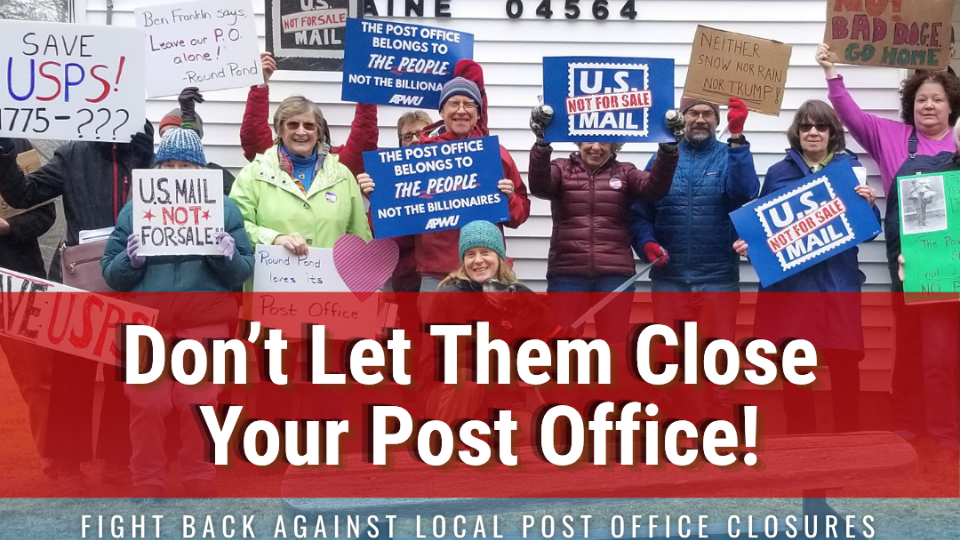
The Detroit victory and other local successes in saving postal drop-off locations from planned closures are models for the union’s larger national effort. It will culminate in rallies and demonstrations nationwide on a “National Day of Action” on July 28 around the “Protect Our Public Postal Service” theme. Details and toolkits are available at www.apwu.org/nopostofficeclosures.
It’s wins like that, in areas large and small, with which the union plans to gain momentum as it launches its second drive to save the Postal Service.
APWU wants to prove again to the country its need for a universal public postal service, delivering everything from greeting cards to medicines to Social Security checks to every address in the U.S. Universal service goes to areas ranging from center city Detroit to California’s rural Klamath River valley.
The union also wants to convince lawmakers not only to shore up USPS’s finances but to let its workers expand their services and their post offices, beyond delivering everything from medicines to Social Security checks.
Or as Stevenson said, “You can’t shrink your way to prosperity.”
The union campaign is to publicize and fight against USPS’s long list of planned closures. That list, for this year alone, includes several hundred local post offices, Szeredy said during the 45-minute planning meeting and booster session.
Common reasons USPS officials give for closing a location are natural disasters, lost leases, and management cost-cutting decisions.
That affects not just postal customers, who must then drive dozens of miles to get their mail, since postal routes would be cut, too, but also the 600,000 USPS workers. At least 80% of the workers are unionized, with the APWU, the Letter Carriers (NALC), and the Postal Mail Handlers, a Laborers sector. Most are women, like Szeredy, workers of color, like union President Jonathan Smith, veterans or combinations of those characteristics.
The USPS, speakers said, is downplaying its closure plans, hoping voters and customers won’t catch on until it’s too late. Speakers said the only “closing” notices are signs in windows of individual USPS stations, meeting the “letter” of the public notice requirement if not the spirit of various statutes governing the USPS.
The union aims to change that, loudly.
“We lost the post office in Siskiyou County to the wildfires,” which swept California, said Sara Wilson, the president of APWU Local 9610. “The one employee who was also affected kept us informed about what was going on in the Klamath River area.
“He talked to our congressman,” but then, the following year, “we were affected by” former Postmaster General Louis DeJoy’s “restructuring,” Wilson added.
The workers in California hit back by taking the problems public: Marching in July 4 parades, handing out brochures and “Save Our Post Office” cards, setting up distribution tables at a local Strawberry Festival, and marshaling public pressure. Wilson even took their drive to TikTok. It worked.
It also worked this May 16, when the post office in Hamilton, Calif., population 2,200, reopened after being closed for 16 months, said Rainy Ramirez, the union’s California legislative director. Until it reopened, patrons, especially those with post office boxes, had to drive 20 miles one-way to Chico to get their mail. Some did so only once a week. Others made the trek twice a month.
That Hamilton reopening was particularly valuable because of the heavy concentration of Spanish-speakers in that farming area. “We have a Spanish-speaking Postal Worker there. But it did take a community effort” to get the USPS to reverse course,” Ramirez explained.
But that’s on the local level. Nationally, the USPS red ink is another story.
Right-wingers, led by GOP White House staffers and libertarian Sen. Rand Paul, R-Ky., want to break up the USPS and sell off its profitable segments to the highest Wall Street bidder—while shortchanging the rest of the country on service. Selling off the USPS would also trash its union contracts.
DeJoy, the first Postmaster General that President Donald Trump foisted on the USPS, in 2020, launched a “Delivering for America” campaign featuring mass consolidations of mail distribution centers, local closures, yanking USPS blue mailboxes out of central cities, and forced relocations, retirements, or resignations of thousands of workers.
Congressional testimony and independent reports show DeJoy’s drive was a giant flop. USPS deficits widened as its prime moneymaker, first-class mail, skidded for the last 15 years, due to rising use of the Internet.
DeJoy’s successor, former Waste Management Inc. CEO David Steiner, has a short-term solution, which the postal unions support: Increasing the USPS’s line of credit to borrow from the Treasury from its current $15 billion—a figure that hasn’t changed in 30 years—to $40 billion.
But Steiner has yet to unveil a long-range plan to rid the USPS of its red ink, other than to proffer more lists of post office closures. He’s pledged to work with Congress on a solution.
And unless the line of credit hike goes through, the USPS will run out of cash to pay its workers and its bills by early next year, Steiner warns.
The APWU is determined not to let that happen and not to let the USPS go broke, but it needs public support for that, Szeredy said.
“They need to see a lot of people behind us,” Szeredy concluded.
We hope you appreciated this article. At People’s World, we believe news and information should be free and accessible to all, but we need your help. Our journalism is free of corporate influence and paywalls because we are totally reader-supported. Only you, our readers and supporters, make this possible. If you enjoy reading People’s World and the stories we bring you, please support our work by donating or becoming a monthly sustainer today. Thank you!
CONTRIBUTOR