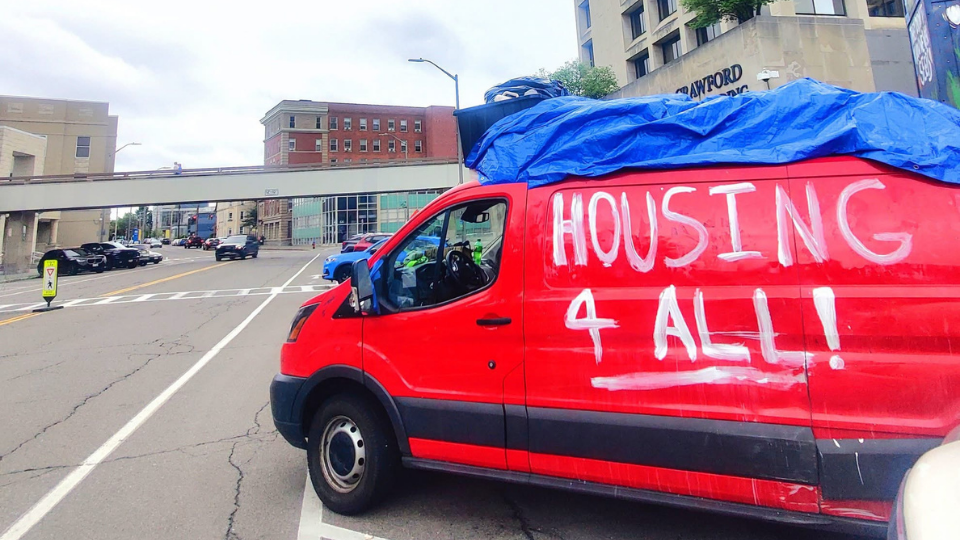
Two years ago, when Jasmine Stradford and her partner, along with their three kids, fell behind on their rent, the landlord evicted them. The family was now at the mercy of New York’s emergency shelter system and what little it had to offer. The emergency shelter system was designed to provide not only shelter, but also food, help finding permanent housing, and child care so parents can find work, go to school, or look for housing. They received almost none of that. The Stradford family was one of many in the growing trend involving homeless people in New York who live outside the city, pushing people in need of shelter into hotels.
Hotels are not permanent housing, of course. Single-room dwellings with no recreation areas are bleak and reinforce the notion that the way to treat the homeless is to keep them out of sight. For the Stradford family, the Broome County Department of Social Services moved them from hotel to hotel, while leaving them to fend for themselves. New York state’s social services agencies placed just under half of the 34,000 individuals and families needing emergency shelter in 2024 in hotels. In Broome County, those numbers more than quintupled. At the same time, state spending on hotels more than tripled.
Adam Bosch, CEO of Hudson Valley Pattern for Progress, a policy research nonprofit, said that hotels are “less supportive, less conducive for good health outcomes, good education outcomes. If our ultimate goal is to get people moving back toward independence, sticking them in a hotel on a hillside away from services, away from schools, away from transportation networks is not a great strategy.”
One paycheck away from homelessness
Research from ProPublica shows that the spike in hotel housing is due to a combination of factors. Inadequate resources, soaring rent, shelter closures, and a poor response to the end of the state’s pandemic-related eviction moratorium in 2022. After the moratorium ended, landlords went on an eviction spree, with eviction rates surpassing those of previous years. Also, if you’re a racist, you can blame immigrants for the housing crisis, and while the data shows that you are wrong, it lets the rest of us know what kind of person you are.
For those living in hotels, doing what they can just to get by has become a way of life. Families share beds while their belongings take up whatever space is available. Without a kitchen, meals are prepared in a microwave. Without transportation, your grocery options are limited to what you can carry, and since most hotels are located alongside highways, walking is dangerous. Without a refrigerator, fresh food is a luxury. And since hotels are a temporary solution and often force families to move out every few weeks, stability is nonexistent.
The line between homelessness and having a roof over your head is a fine one, and becoming narrower by the day. In the 1960s, the median cost of a house was $105,000 in today’s dollars. Today, that house costs over $400,000. The prospects are even worse for apartments, with rent far outpacing income. There is currently not a single state in the U.S. where a person working 40 hours a week on the federal minimum wage can afford a two-bedroom apartment. The Massachusetts Institute of Technology’s living wage calculator suggests a living wage for a single adult with no children living in Broome County is $20.75 an hour. The minimum wage is currently $16. For Bradford County, PA, the living wage for a single adult with no children is $21.70 an hour. The minimum wage is currently $7.25, unchanged since 2009.
Which brings us to the Knights Inn in Endwell, New York. On June 22, a fire broke out at the inn and spread quickly, with the roof collapsing shortly after emergency responders arrived. Later that day, police arrested a man for starting the fire. Six people died in the fire, including three children. Fifty-six people living at the Knights Inn had been placed there by the Broome County Department of Social Services, and many of them had a litany of issues with the inn. Broken lighting, windows, and doors, cockroaches, and an electrical system that could only handle one plugged-in appliance at a time—all issues that the residents say the department knew about.
The Broome County Department of Social Services placed over 200 households at the Knights Inn from April 2023 to March 2024. Jasmine Stradford and her family were one of them. Broome County DSS paid the Knights Inn $750,000 for emergency shelter, despite the hotel receiving written-up notices in every inspection for two and a half years, including several citations for fire-related issues.
The Stradford family lived in four hotels over three months, hotels which the state collectively paid almost $10,000 for, more than what they owed in back rent. The reason Jasmine Stradford and her family were evicted for unpaid rent? She missed work while recovering from surgery. A housing needs study commissioned by Broome County in 2024 found that nearly half of renter households spent at least half of their income on housing.
What happened to Jasmine and her family was both preventable and common. There is no federal mandate for paid sick leave, which often leaves workers returning to work before they are ready or losing their jobs. There are, however, several laws against being homeless in public, which shows us where our leaders’ priorities lie. Arresting the homeless and putting them in jail means our leaders believe in public housing, but they think that housing should be more expensive than just giving them homes. While thousands of homes sit empty, thousands of people live on the street.
Most people don’t realize they are closer to becoming homeless than becoming a millionaire. To deny people housing means you prioritize profit over people, and you don’t think becoming homeless could ever happen to you. So did Jasmine Stradford.
The fight back
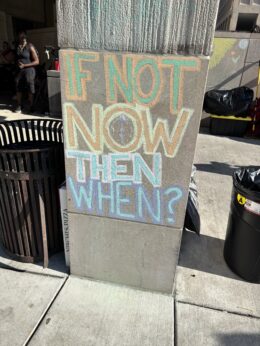
In the immediate aftermath of the fire at the Knights Inn in Endicott, a protest coalesced in front of the Broome County office building on Hawley St. in Binghamton, NY. Community organizers and the unhoused took up residence outside the building to draw attention to the public housing crisis, to give a voice to the voiceless, and to present their demands to elected officials. The walls around the office building are covered with slogans and the names of those who lost their lives in the fire. “If not now, then when?” “We keep us safe.” “Help the homeless instead of just sitting there.” “There’s blood on your hands.” “They tried to bury us. They didn’t know we were seeds.” “Somebody got to pay for them babies.”
For the past three weeks, the people at Hawley St. have been harassed by the cops, arrested, endured a heat wave and thunderstorms, been ignored by their elected officials, danced, broken bread together, cried, been reunited with long-lost family members, and made new friends. ICE agents made a brief appearance, as did the mayor of nearby Johnson City. At one point, City Councilman Nate Hotchkiss tried to sneak away from the people he is supposed to represent. When confronted and asked if he would at least come speak with the people experiencing homelessness in his own district, his response was, “I think not.”
During my second trip to the encampment, I spoke with one of the organizers, Roderick, whom I had briefly met years ago while attending meetings and doing activist work in Binghamton. Roderick and his wife, Sana, had been doing mutual aid work at the Knights Inn for two years when the fire happened. For those two years, they made a trip to the inn every week to deliver food and necessary supplies to the people who lived there; people that the state of NY tried to ignore. Now, these two, along with many others, are doing what they’ve always done, and what their elected officials should have done: taking care of people.
Instead of talking with the unhoused people, elected officials are either deliberately ignoring them or, like City Councilwoman Rebecca Rathmell, outright denying that the people outside her office’s front door are unhoused. Posting on Facebook, Rathmell said, “The Hawley Street Encampment is an occupation, not an encampment of unhoused individuals who have nowhere else to go. It has openly described itself as a protest encampment and should be considered exactly that.” Rathmell continues to ignore them, and several unhoused people in the encampment made a video response to her, all ending their statements with “Shame on you.” Rathmell should know that it’s only an occupation if it comes from the Occupation region of France. Otherwise, it’s just sparkling mischief.
When the residents of the Knights Inn told officials that the inn was unsafe, their concerns were routinely ignored. When community members explained that cramming five people in one room is unsafe, they were met with shrugs. Now, six people are dead. Roderick listened to a recording of the 911 call from one of the people who died in the fire, and hearing him talk about it made me almost cry.
Two weeks after the fire, the residents of the Parkway Inn in Vestal (also in Broome County) were removed with no notice and placed in other shelters. The inn was shut down for severe code violations and poor living conditions, and the county officials, not wanting any more dead bodies placed at their doorstep, decided to take action. At least two of the residents of Parkway Inn made their way to the Hawley Street Encampment to share their story. It’s a familiar tale: the people communicate an issue with their elected officials, the officials ignore them, tragedy strikes, and the officials try to save face. Damage control starts immediately, and public relations experts are called in, while those who raised the issues in the first place continue to be ignored.

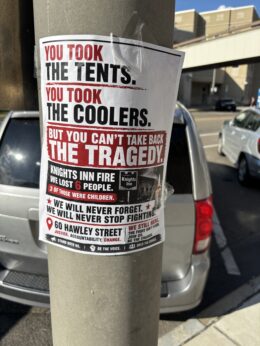
County officials, aware of how bad the encampment makes them look, sent over 50 cops to harass and intimidate. On the first day of the heat wave, with temperatures over 100 degrees, the cops took tents and other shelters, and even the coolers full of cold water. Tents, tables, and coolers are apparently not allowed. As the ruling class so often insists and actively perpetuates, the underprivileged members of society must suffer to maintain the status quo. Malicious compliance ensued. If tables are not allowed but cases of water and signs are, then a table was constructed from water and signs. If coolers are not allowed on the sidewalk, then they are placed in an organizer’s van. If chairs are not allowed, then wheelchairs were donated, since they are considered medical devices. The rascalism was restored and maintained.
Last Friday, the people of the Hawley Street Encampment organized an event dubbed “The Last Supper.” The press and people on social media were led to believe that after Friday, the encampment would be disbanded. The ruse worked, for as the news that evening was reporting the end of the encampment, the people gathered. The music was loud, the food was plentiful, and the people were joyful. “We still here,” Roderick said as he greeted me on Friday evening, and indeed they were.
As you approach City Hall on Hawley Street in Binghamton, you pass a multi-story building for “luxury student housing,” where a one-bed/one-bath deluxe studio apartment will run you $1,659. Two buildings away, a ragtag group of comrades is feeding unhoused people. Roderick and Sana were arrested last Saturday for doing what their elected officials failed to do: taking care of their people. The world needs more people like Roderick and Sana, and we need to make people understand that poverty is not a personal problem, but a systemic one. Framing poverty as a character flaw or a moral failing allows people to place the blame on an individual instead of the system.
As I left the camp for the evening, I noticed a flyer posted on a telephone pole. It read: “You took the tents. You took the coolers. But you can’t take back the tragedy. We will never stop fighting. We still here.”
As with all op-eds published by People’s World, the views expressed here are those of the author.
We hope you appreciated this article. At People’s World, we believe news and information should be free and accessible to all, but we need your help. Our journalism is free of corporate influence and paywalls because we are totally reader-supported. Only you, our readers and supporters, make this possible. If you enjoy reading People’s World and the stories we bring you, please support our work by donating or becoming a monthly sustainer today. Thank you!
CONTRIBUTOR