As the U.S.- Israeli wars across West Asia widen, a clearer picture is emerging of Israel’s long-term strategic and ideological objectives, and they go far beyond claims of “security” or “self-defense.”
This week, Israeli Finance Minister Bezalel Smotrich made that reality explicit. Speaking publicly amid Israel’s escalating assault on Lebanon, he declared that Israel’s northern border “must be the Litani River,” calling for the outright conquest and annexation of southern Lebanon.
This is not fringe rhetoric. It is a statement from a senior cabinet minister, and one that aligns with military actions already underway on the ground.
Israeli forces are not merely striking Hezbollah positions. They are systematically reshaping southern Lebanon: Vital ridges over the Litani River have been destroyed, cutting off civilian movement and isolating the south from the rest of Lebanon. Entire villages are being leveled and depopulated, as the Israeli government calls for the demolition of homes and other civilian infrastructure. This has led to over a million Lebanese already being displaced.
Rather than taking temporary battlefield measures, the Israeli army is putting in place the material preconditions for territorial reorganization.
Military planners and political leaders are increasingly aligned around the idea of a permanent “buffer zone” south of the Litani. Such language has historically often preceded de facto annexation, and Smotrich’s statement removes any ambiguity. The goal is a permanently expanded Israel.
What is now unfolding in Lebanon follows the pattern already visible in Gaza. Israeli officials and lawmakers have repeatedly called for the resettlement of Gaza by Israeli settlers and the absorption of large portions of its territory into Israel. Many in Israeli leadership have even called for the depopulation of Gaza to build a Jewish majority in the territory. The destruction of entire cities like Rafah and Beit Hanoun has already emptied former population centers of their residents.
In Lebanon, Israeli leaders are explicitly invoking this precedent. Government figures have urged applying the “Gaza model” to southern Lebanon, meaning the destruction of villages, displacing populations, and then redefining control on the ground.
Gaza and Lebanon are thus not two separate wars; they are two avenues in pursuit of the same strategy. While bombs fall in Gaza and Lebanon, the West Bank is undergoing its own transformation. Israeli settler violence, mass expulsions, and military raids have intensified alongside open political calls to formally annex that territory, as well. Entire Palestinian communities are being pushed off their land, often under direct protection of the Israeli military.
There is no large-scale bombardment as in Gaza and Lebanon, but the goal of removing the population and normalizing such actions remains the same.
At the same time, Israel has expanded its military operations deeper into Syria, targeting Iranian-linked infrastructure and asserting “freedom of action” across the country. Just this week, Israeli forces entered the Syrian city of Qunetra, set up road blocks, and arrested residents, as if Israel already had legal jurisdiction over this Syrian city.
These strikes are being framed as preemptive defense, but taken together with operations in Gaza and Lebanon, they reflect a broader doctrine. Israel is showing it intends to reshape the entire region through force, regardless of sovereignty.
The messianic vision of a Greater Israel
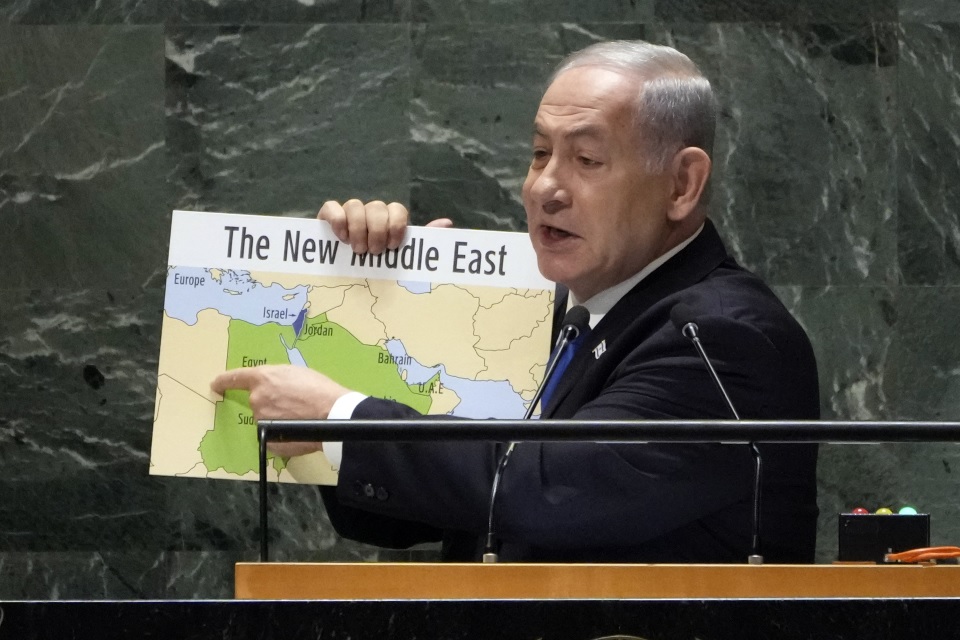
What ties these fronts together is not simply conflict with Hamas, Hezbollah, or Iran. It is a coherent territorial and political project known as The Greater Israel Project. Proponents of this idea have long called for Israel to expand its borders south into Egypt and northward and westward to the Euphrates River. Their claim is based on Biblical passages that say God promised these lands to Abraham’s descendants.
While this idea was once rightfully scene as fringe, religious fanaticism, it has become increasingly mainstream. U.S. Ambassador to Israel and famed Chritisan Zionist Mike Huckabee recently endorsed such a vision during an interview with Tucker Carlson. Even the supposed secular and “liberal” leader of the Israeli opposition, Yair Lapid, said he supported the idea of expanding Israel to match the biblical description.
What’s happening on the ground shows that such talk is not simply empty rhetoric for religious constituents but a plan being put into action. Smotrich’s statement is significant not because it is shocking, but because it is consistent. It articulates openly what Israeli policy has been implementing incrementally: the use of war to redraw borders and reshape demographics across the region.
These wars by Israel are materially enabled and politically shielded by the United States. The current escalation—particularly the joint U.S.-Israeli war against Iran—has created the conditions under which these expansionist, fanatical aims can be pursued under the cover of a broader regional conflict.
The Trump administration continues to frame these actions as part of a defensive alliance, but the outcome on the ground expanding war, mass displacement, and the steady erosion of national sovereignty across multiple countries.
The danger of the current moment lies in its normalization. Greater Israel was once an idea the fascist right wing carefully whispered about only among like-minded people. Today, it has become official policy of the Israeli government, with the backing of the United States.
The question is no longer whether such plans exist. It is whether they will be allowed to proceed unchallenged. If the Litani River becomes Israel’s new northern border, it will not be the end of the process. From there, history suggests, the map will not stop changing.
As with all op-eds and news analytical articles published by People’s World, the views expressed here are those of the author.
We hope you appreciated this article. At People’s World, we believe news and information should be free and accessible to all, but we need your help. Our journalism is free of corporate influence and paywalls because we are totally reader-supported. Only you, our readers and supporters, make this possible. If you enjoy reading People’s World and the stories we bring you, please support our work by donating or becoming a monthly sustainer today. Thank you!
CONTRIBUTOR