NEW YORK—Wall Street is in a state of panic over polls showing that progressive Democratic candidate Zohran Mamdani maintains a double-digit lead in the New York mayoral race over scandal-ridden former Gov. Mario Cuomo, who is running as an Independent. The other candidate, Republican Curtis Sliwa, is a distant third.
The Wall Street panic has extended to billionaires generally, with pro-Trump hedge fund mogul Bill Ackman recently dumping $1 million of his own riches into “Defend NYC,” a new joint super-PAC that serves as the repository of funds for everyone opposing Mamdani. Ackman had already poured $500,000 into “Fix the City,” the main pro-Cuomo super-PAC.
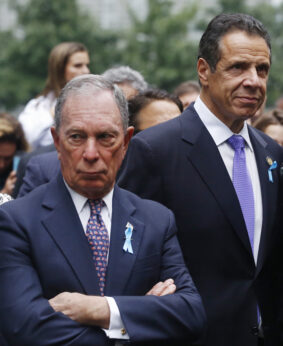
Even with these large contributions, Ackman is still only the second-highest donor in the mayoral race; former New York Mayor Michael Bloomberg has reportedly spent $8.3 million to get Cuomo elected.
Last week’s debate, during which Mamdani performed strongly against Cuomo, likely did nothing to lift these billionaires’ spirits; the latest poll numbers make things even gloomier for them.
But the thing that really upsets Mamdani’s Wall Street opponents is the unprecedented door-to-door campaign mounted by his supporters. In neighborhoods like Sunset Park and Bay Ridge in Brooklyn and Harlem in Manhattan, the overwhelming majority of people have been visited by Mamdani door-knockers talking about the race and the stakes facing the city’s working-class population.
It’s not just the banking interests of Wall Street that are getting desperate, though. Corporate interests of various kinds, too, are opening their wallets. Oil industry heir John Hess, director at the Chevron Corporation, has spent $1 million backing Cuomo, while Republican mega-donor and cosmetics chief Ron Lauder gave $750,000. Casino boss Steve Wynn poured in $500,000.
Real estate developers constitute another significant part of the Cuomo bloc. Boston-based Suffolk Construction has given him $250,000, and Vornado Realty, looking for Cuomo’s help on its Manhattan investments, put up $150,000.
Sumathy Kumar, managing director of NYS Tenant Bloc, an affordable housing coalition, told the media last month, “Since the primary, they’ve been panicking and scrambling, trying to figure out how they can defeat Mamdani to keep their bottom line.”
Public campaign finance records show that, so far, $25 million has been donated to Cuomo’s “Fix the City” super-PAC.
The money goes into producing slick negative attack ads and materials. In the neighborhoods experiencing saturation canvassing, voters are receiving expensive, glossy, and colorful brochures attacking Mamdani as a “socialist” who would turn New York into Venezuela and Cuba.
Cuomo has echoed that line in his public statements. Mamdani is a member of the Democratic Socialists of America, the same organization to which Rep. Rashida Tlaib, D-Mich., Rep. Alexandria Ocasio-Cortez, D-N.Y., and other prominent progressives belong.
Mamdani’s campaign emphasizes affordable rent and groceries for the city’s working-class families, free buses, expanded pre-kindergarten and day care—not Venezuelan, Cuban, or any other country’s version of socialism.
Referring to the recent surge of billionaire attacks on him, Mamdani described them as symbolic of the “conflict between wealthy interests and the will of the working people of New York.”
He said the campaign cash being put in by billionaires and corporate interests amounts to “dirty money” because what they are really doing goes beyond exercising their First Amendment democratic rights via dollars. In that vein, he called the efforts of the billionaires like Ackman “election interference.” Their actions are more than just spending money to express their preferences, he said.
Why is the billionaire’s money “election interference”? Mamdani’s answer is that “New Yorkers, not billionaires who mostly live somewhere else, should decide the future of New York.”
The progressive candidate, notably, frames issues in terms of class. He has called the wealthy “chattering classes who are upset that my campaign poses an existential threat to their rule as a group.” One of his ads features “The Gilded Age” actor Morgan Spector reading real comments from wealthy people complaining about socialism.
Mamdani has challenged Cuomo as “preoccupied by the whims of billionaires who support his campaign,” and the hefty amounts of financial contributions they’ve made to the former governor’s campaign certainly raise questions about who will have the ear of City Hall under a Cuomo administration.
Mamdani humorously said he wished candidate debates were like NASCAR events. “Then Cuomo would have to wear on his suit jacket the names of the billionaires supporting him.”
We hope you appreciated this article. At People’s World, we believe news and information should be free and accessible to all, but we need your help. Our journalism is free of corporate influence and paywalls because we are totally reader-supported. Only you, our readers and supporters, make this possible. If you enjoy reading People’s World and the stories we bring you, please support our work by donating or becoming a monthly sustainer today. Thank you!
CONTRIBUTOR