NEW YORK—Over one hundred students, researchers, and residents packed New York University’s Tamiment Library for the opening night of the “Bringing the Daily Worker to the World” photo exhibit on July 29.
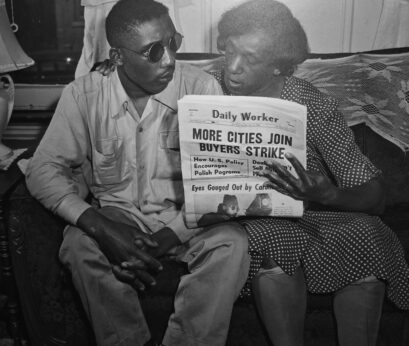
The NYU exhibit was a celebration of sorts, the culmination of over two years of painstakingly detailed and careful work. From 2023-25, NYU-Libraries staff—partially funded by a National Historical Publications and Records Commission grant—digitized nearly 185,000 photo negatives from the Daily Worker and Daily World Archives, making these images available to the public for the first time.
“The Daily Worker and Daily World newspaper photographers drew attention to overlooked, yet pressing, social issues and offered a counterbalance to the mainstream press,” the exhibit’s introductory graphic noted. Reflective of their special role as working class journalists—with long-term relationships among movement leaders and activists—Daily Worker photographers “seemed to move with ease across the demonstrations, strikes, homes, workplaces, and radical-movement spaces they documented,” the graphic added.
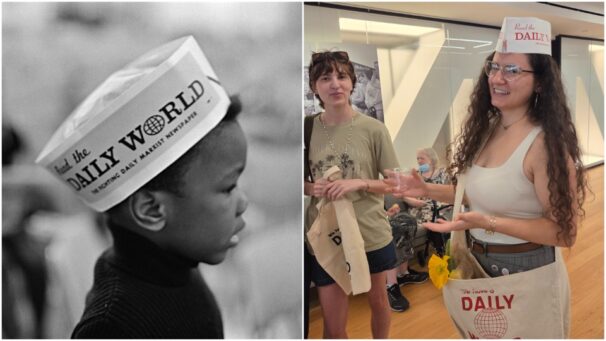
Founded in 1924, the Daily Worker—predecessor to today’s People’s World—has covered the struggle for workers’ rights, African American equality, immigrant rights, peace, solidarity, and socialism, for over a hundred years. The publication has often been welcomed at picket lines and demonstrations, embraced by trade unions and community organizations for its unique, partisan coverage.
Shannon O’Neill, head archivist at Tamiment, provided some history and context to the exhibit in a discussion with People’s World. “I wrote the grant that funded this project not only because the condition of the materials necessitated digitization, but because these images are beautifully rich in visualizing what it means to be a part of the long struggle for workers’ rights, peace, and equality.
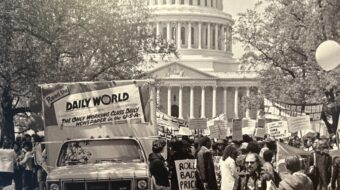
“The Daily Worker and Daily World negatives show us how it is possible to fight together for a better world,” she said. “There are photographs of eviction defenses, grocery store workers striking, anti-fascists returning from the Spanish Civil War, marches, rallies, and protests.
“Importantly,” O’Neill emphasized, “the Daily Worker photographers understood the significance of documenting and humanizing the lives of everyday people. Alongside the demonstrations, rallies, and uprisings, there are photos of neighbors sharing a pint at the bar, beachside celebrations, marching bands—all an incredible reminder that we must incorporate joy and pleasure in the fight for freedom.”
Undoubtedly, this is a major contribution to left, radical, progressive, and Communist historiography—a treasure trove of new resources for historians, students, and documentary film makers—for anyone interested in the 20th century left and labor movements.
The Communist Party USA (CPUSA) / Daily Worker / Daily World Archives are already one of the most sought-after and requested archives in the NYU Tamiment system, with researchers often reserving a spot for access months in advance. The addition of these 185,000 never-before-seen photos will add to this demand—and likely continue a trend among honest historians of rewriting the history of the Communist Party, the Daily Worker, and various Communist-affiliated groups as grassroots, popular, people-powered, democratic organizations.
For example, the photo negatives range from civil rights and labor protests to images of CPUSA leaders Gus Hall and Angela Davis, as well as marches by the National Negro Congress demanding an end to lynch terror or protests in support of the Black Panther Party. There are images of multi-racial demonstrations in support of the Chinese people as they faced down fascism and Japanese colonialism in the 1930s, before World War II. Asian, Black, and white activists were marching together, challenging the racism and segregation of their time.
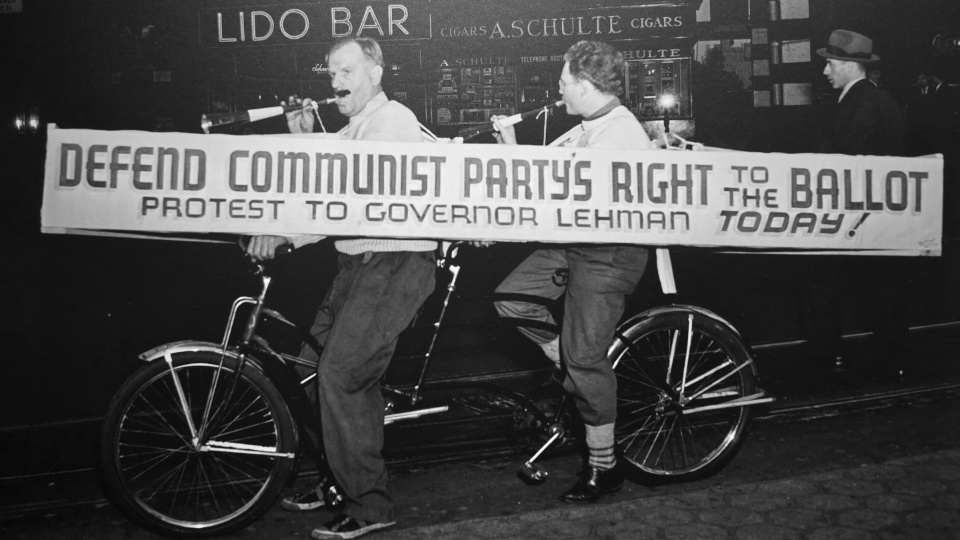
Other photos capture intimate, casual moments of Communists on a beach having a discussion, as well as protesters riding a tandem bike, blowing horns alerting community residents to illegal attacks on CPUSA electoral ballot status. As O’Neill said, they also “humanize the rank-and-file Black and white working-class folks who read the paper or distributed it.”

The three-room exhibit includes a short film by Ting Su, who worked on the digitization project. She reflected on the “quiet of a dark room” and her “relationship to labor” as she pieced “together the personal and historical memories across borders and generations.”

In the short film, titled “Daily Worker” Su pointedly connected the working class struggles of yesterday—captured by the Daily Worker and Daily World photographers—with her own struggle as a student immigrant dependent on a work visa, and how her life is tied to her ability to find work, a point especially relevant today with the Trump administration’s racist attacks on immigrants.
In a short description of the film, Su noted, “We all work to build our lives, and after decades we still strive for the same rights.”
Su’s film has screened at several film festivals around the United States, including the Big Sky, True/False, and the Flickers’ Rhode Island festivals. It will have its international premier in August at the Melbourne International Film Festival in Australia. (Follow the film’s journey: @dailyworker_doc on Instagram.)
There were two complementary parts to the exhibit, one titled “The Struggle in the Everyday,” the other “The Everyday in the Struggle.”
“The Daily Worker and Daily World photographers created a visual record of everyday struggles. At times, this included documentation of injustices and social struggles,” another exhibit plaque explained However, photographers also documented “the Everyday.” For example, “a marching band pauses to pose and smile…[while an] ice cream vendor…” serves up cool treats for demonstrators.
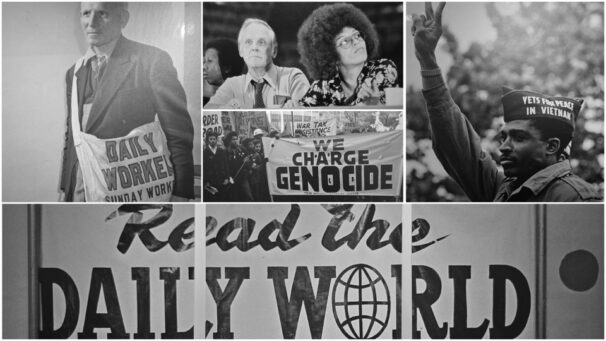
Photographers also documented themselves “as workers, at the helm of producing the Daily Worker or Daily World together.” Negatives include photos of a “best-selling delivery person” or workers hoisting “a load of newspapers fresh off the press.” These photos capture the day-to-day life of Daily Worker volunteers and employees as workers in the act of producing.
In the dehumanizing world of capitalism, the photos fully humanize the relationships photographers and journalists had with each other, with the subjects of their photos, and with the means of production—a living example of socialist principles in practice.
“The visual record the photographs created…aimed to reach people reading the paper at breakfast tables, in living rooms, in breakrooms, in organizing meetings, on morning commutes, or after coming home from the picket line,” another graph concluded.
While the format has changed—to an online daily publication—the goals of today’s People’s World remain the same, to reach readers with stories of struggle, solidarity, and unity.
In the section titled “The Everyday in the Struggle,” exhibit organizers explained that the Daily Worker and Daily World were the “journalistic arm of the Communist Party” and as a result, the publications “had a particular point of view.” Like the Communist Party, “they were often on the ground themselves, and, when documenting uprisings, [they] gained the viewpoint of those uprisings.”

Nora E. North, one of those present for the opening, told People’s World that the exhibit was “fantastic! An Amazing achievement!”
“I knew that Tamiment had all of these materials for a long time. They have tons of stuff, and for them to digitize the photographs and put this together and publicize it is wonderful!”
North, the daughter of renowned New Masses editor Joseph North—who also wrote regularly for the Daily Worker and authored several pamphlets and books—added that the exhibit was “beautifully done.”
O’Neill added, “It’s my hope that, through these photos, a new generation of students and researchers will be introduced to the central role of the Daily Worker in documenting the fight for peace, jobs, and equality.”
Exhibit attendees also received a Daily World tote bag and a 60-page program booklet collection of photographs. If you’re in the New York metropolitan area, the exhibit runs through mid-September and is highly recommended.
Bringing the Daily Worker to the World: Images from the Daily Worker and the Daily World Negatives Collection is on view in the Special Collections Gallery (Bobst Library, 2nd Floor) from July 29-Sept. 12, 2025. NYU community members can visit the exhibition during our hours of operation. Members of the public should coordinate their visit by reaching out to NYU Special Collections.
We hope you appreciated this article. At People’s World, we believe news and information should be free and accessible to all, but we need your help. Our journalism is free of corporate influence and paywalls because we are totally reader-supported. Only you, our readers and supporters, make this possible. If you enjoy reading People’s World and the stories we bring you, please support our work by donating or becoming a monthly sustainer today. Thank you!
CONTRIBUTOR