Literature and art are often used to present viewpoints on history that are suppressed and marginalized in mainstream history and education. Crime is a preferred and successful style used to explore the working-class experience. It is also a popular and accessible genre, used by writers who have something to say to the marginalized communities, who frequently do not find their perspective reflected in the establishment arts.
It is into this literary tradition that Jack Byrne emerges. Born in Liverpool to a father from Wicklow—part of the great wave of post-war Irish migration—Byrne negotiates a complex cultural identity that is English, Irish, and Scouse. Raised on a Speke council estate, he possesses firsthand experience of working-class life. A profound family tragedy in 1975 would forever shape his perspective: his brother Peter, English-born son of Irish parents, serving in the British army, died by suicide in Derry. This event silenced talk of Ireland at home, yet it simultaneously cemented the fracture between class, nation, and survival at the very centre of his being. Shaped by the miners’ strikes, The Ragged Trousered Philanthropists, and the Communist Manifesto, class came to form the author’s political anchor. The persistent Irish connection endured, ultimately finding its expression in his writing.
Byrne’s first literary success was the three-part Liverpool Mystery Series (2021-2023), which follows the fortunes of one working-class born Vinny Connolly. Tracing events from the 1950s to 2016 that move between Liverpool and Ireland, the series explores themes of Liverpool and Irish history, strikes, the IRA, sectarianism, and collusion through a fast-paced narrative, written from a variety of different viewpoints.
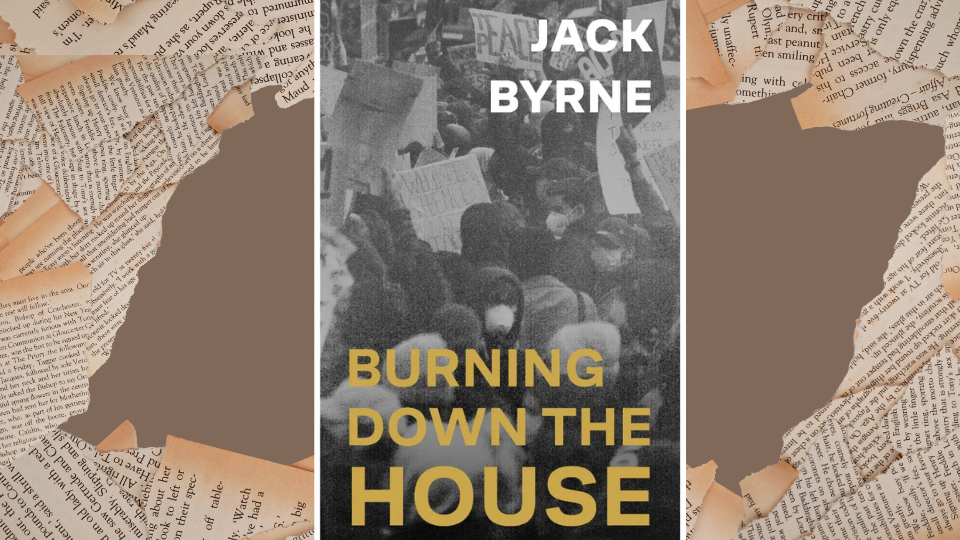
In May 2025, Jack Byrne published Burning Down the House, the first novel in a new trilogy, The Red Detective, which propels the narrative into our immediate present. Now Vinny takes a back seat as his son Charlie Connolly finds himself involuntarily embroiled in politics—racism, climate change, Christian fundamentalism, and police violence against protestors.
Politically charged and morally complex, the novel uses the lens of a police custody death to dissect the corrosive forces of fanaticism, abuse, systemic failure, and historical trauma in modern Britain. It is a novel deeply concerned with how the past pervades and informs the present, arguing that to understand a present-day tragedy, one must excavate the causes buried in history.
This exploration is voiced powerfully through Matthew Whitney, a charismatic climate activist whose death in custody catalyses the plot. Byrne uses Matt’s speeches to articulate a fierce critique of ineffective activism and the structures of power. At a meeting, Matt dismantles the complacency of “slacktivism,” arguing that it serves only to divert attention from the real architects of planetary destruction:
“The oil industry, the aviation industry, the arms industry…these people laugh at you. All your reusable bags, compost heaps, and rechargeable batteries are individual diversions from tackling the real problem of who controls society. Who determines when and where the oil industry can drill? Who says how many flights should come in and out of the country? Who decides what bombs are dropped where.”
His critique extends to how the focus is misplaced onto the global South rather than the consumption of the wealthy West:
“It is always the growth of Asian, Indian or African humanity that threatens the globe. Or threatens ‘our’ borders, ‘our’ civilization, ‘our’ comfort.”
Matt’s philosophy is of proactive, collective action built on “humanity and solidarity.” His call to action is a direct challenge to the status quo that Byrne so vividly depicts. Emma recognizes his role in a new, more pragmatic, and inclusive form of resistance, “we need you, Matt. We need someone with fresh ideas, not afraid to challenge things”. His phrase “The world is burning,” becomes the novel’s haunting, titular motif – a literal warning about the climate crisis and a metaphor for the multiple, interconnected fires of injustice that define our time.
Burning Down the House masterfully argues that these fires are not separate. The fire of the climate crisis is fueled by the same forces that perpetuate the fire of racist violence, the fire of governments that let immigrants “face death in the Channel,” and the fire of violence under which “Palestinians suffer.” Byrne, through his characters, connects these struggles, arguing that they are all symptoms of a single, burning house.
In the tradition of working-class crime writing, Byrne does not just tell a compelling mystery; he uses the genre to ask urgent, philosophical questions about power, justice, and resistance. Burning Down the House, like its predecessors, confirms the past is not past; it is the fuel for the present’s fire. It is testament to the idea that literature is a vital tool for exploring the burning questions of the day, and Jack Byrne wields that tool with unflinching clarity and passion.
Jack Byrne’s website can be found here.
We hope you appreciated this article. At People’s World, we believe news and information should be free and accessible to all, but we need your help. Our journalism is free of corporate influence and paywalls because we are totally reader-supported. Only you, our readers and supporters, make this possible. If you enjoy reading People’s World and the stories we bring you, please support our work by donating or becoming a monthly sustainer today. Thank you!
CONTRIBUTOR