CHICAGO—If you’re a pro-worker government official, and you want to get a corporation’s attention, do something unexpected and drastic: Take away their chances to grab your city’s dollars.
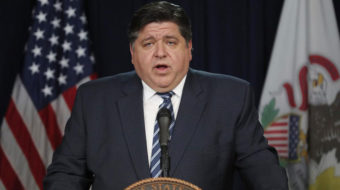
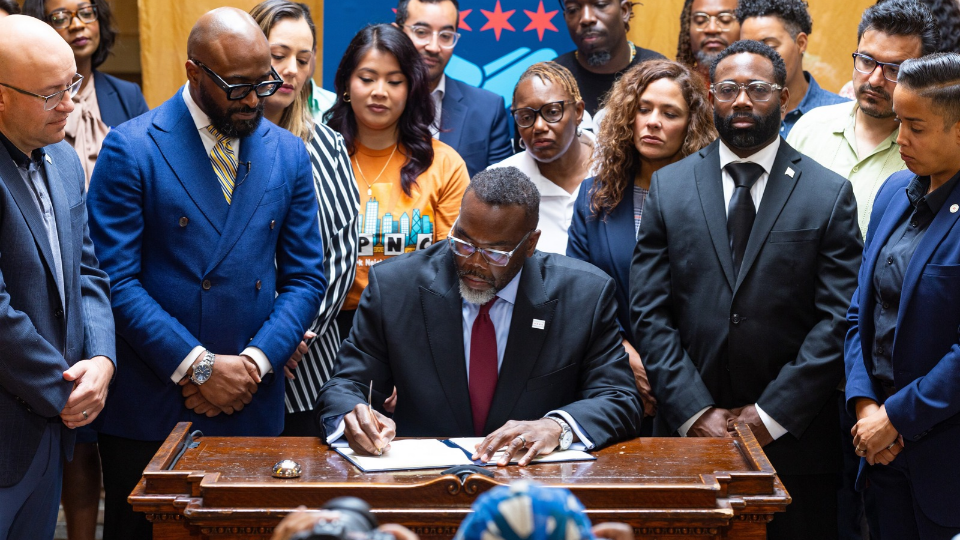
Which is precisely what Chicago Mayor Brandon Johnson intends, with an executive order he issued just before Labor Day and which, if all goes according to plan, will start in late January.
Starting early next year, if your business breaks Chicago or state or federal wage and hours laws, you won’t get city contracts or cash grants of $250,000 or more. That may occur if you break other labor laws, too.
If your business breaks federal, state, or local civil rights laws, you won’t get city contracts or cash worth at least $500,000. If you cooperate with GOP President Donald Trump’s vicious and violent ICE agents, ditto.
If your business is a big national firm, such as Amazon, which supports “government overreach”—Johnson’s code words for corporate beneficiaries of Trump’s repressive ICE raids in Operation Midway Blitz–you won’t get those city contracts or cash either.
If you committed any of those offenses within the past five years, forget future contracts or cash.
And if you break any “other laws protecting workers’ rights,” you won’t get Chicago contracts, grants, or cash worth more than $250,000, unless the city procurement chief decides your services are absolutely necessary and unique.
All these bans are the result of an executive order Johnson issued just before Labor Day. It could also be a precedent for the country, or for the next U.S. Congress, if Democrats and pro-worker forces take power after the November 3 election.
Individual Chicago grants may be $250,000 or more, but the total is huge. We’re talking serious money here: $3.13 billion in fiscal 2026 in federal, state and local grants alone, the City Council’s Office of Financial Analysis says. There are so many contracts that adding them all up is impossible.
“Chicagoans work hard for their tax dollars, and they deserve to know those dollars are being used responsibly,” Johnson, a former Chicago Teachers Union shop steward, said in a statement after unveiling his executive order. “Public money should strengthen our neighborhoods, create opportunity and serve the people who call Chicago home, not support practices that harm our communities.”
Johnson’s executive order makes clear there are dual targets for the contracts and grants ban, and dual good reasons, one each present and past, for it.
The present reason is “Chicago has an obligation to ensure public funds are spent in a manner consistent with ethical standards, legal compliance, and responsible business practices,” it states.
Chicago “may use its purchasing power to promote ethical commerce, encourage timely delivery of goods and services, and reduce the risk that public dollars are subsidizing corruption that undermines our communities,” the mayor’s mandate adds.
The past reason is unstated but present in Chicago’s history: More than a century of corporate graft, horse-trading and manipulation in the city’s pay-to-play corrupt political culture. Bribes and boodle predated street railway and subway czar Charles Tyson Yerkes in the 1880s and extended through 2000 and beyond, enmeshing much of Chicago’s long-dominant Democratic machine.
How dominant and how corrupt? One of the machine’s last two big-name pillars, former 54-year Democratic City Council member–and Finance Chairman and floor leader–Edward Burke, 82, is now on home release after serving two years in federal prison. The other, former Democratic Illinois House Speaker Mike Madigan, is serving a seven-and-a-half-year sentence. Both received under-the-table money in pay-to-play.
And at the end of his first presidential term, Trump pardoned and freed former Democratic Gov. Rod Blagojevich, who was convicted and jailed for soliciting bribes from contenders for Barack Obama’s vacant U.S. Senate seat after Obama won the White House. Blagojevich, too, was a machine man.
Trump, his graft, and his repressive impact on Chicago are Johnson’s executive order’s other top targets. The mayor and his top union supporter, the Chicago Teachers Union/AFT Local 1, have been outspoken and effective Trump critics. CTU just endorsed Johnson for re-election for a new four-year term and promises to hit the pavement hard for him.
“The city of Chicago is living with the consequences of this corporate-funded and enabled authoritarianism and the militarization of civil immigration enforcement, which trades our communities’ well-being for corporate profits,” Johnson’s executive order declares.
That includes violence by Trump’s ICE agents during Operation Midway Blitz in Chicago last year against the city’s Latino and other migrant residents. Trump’s corporate backers “underwrite authoritarianism,” says the non-profit group promoting the cash cutoffs, Not With Our Money.
Chicago’s Johnson was the first city mayor to agree to the cutoffs. So, apparently, do Chicagoans.
A poll that Not With Our Money commissioned found 71% would ban city contracts for wage and hour lawbreakers and 12% would not. The same margin holds against a firm that greases a politician’s palm in hopes of getting a grant or contract, regardless of whether it wins or not.
The margin against money for civil rights lawbreakers is 66%-21%. By a 64%-15% score, voters would not send city money to the Amazons of the world–big firms whose CEOs cozy up to Trump and reap millions, or in Amazon’s case, billions in federal contracts as rewards, or who cooperate with Trump’s troops.
To root out such malefactors and set standards for dealing with them, Johnson, a noted progressive, will set up a commission to travel the city, holding hearings on such corporate lawbreakers and how to penalize them by banning city procurement officers from funneling them money.
Johnson’s giving the panel 180 days to report, make recommendations and write regulations to ban such largesse. All its work will hit the streets just days before next year’s mayoral primary in February.
Not With Our Money pushes the idea of battling corruption—including Trump’s—by cutting off the cash. The group is campaigning for other cities and states to put their money where their mouths are. Not With Our Money says on its website that it’s in talks with leaders of other cities about similar edicts. One is Albany, N.Y., which for decades had its own machine, without Chicago’s scale of graft.
Chicago is also the group’s example of how to combat graft and corruption.
Johnson’s executive order declared “an unprecedented level of corporate corruption is undermining democratic norms, eroding labor standards, reducing affordability, weakening our public safety, undermining our small businesses, harming our immigrant populations, and surveilling Chicago’s workers and communities.”
And while federal, state and local laws “have long prohibited individuals and companies from bribing public officials or supplementing public officials’ salaries to advance their own business interests,” many do so anyway.
Such corruption, Johnson’s order says, “evades timely disclosures” and does not just hurt city “taxpayers who foot the bill, but it also has direct impacts on our communities’ well-being by supporting government overreach.”
The mayor’s executive order also praises “responsible firms which have taken a stand against overreach…and pay-to-play deals,” losing contracts and grants as a result. And it says anti-discrimination workplace practices “enhance productivity and increase the likelihood of timely, predictable, and satisfactory delivery of goods and services” while “avoiding the complications” the city hits by dealing with law-breaking companies.
The big problem with Johnson’s anti-corruption campaign is that Trump has gotten in the way. That’s another reason his corporate backers are targets of Johnson’s executive order and will be targets of the commission and its rules, too.
Trump’s trashing of workplace protections is also a direct contrast with laws his second-term predecessor, Democrat Joe Biden, proposed and the then-Democratic-run Congress approved, as well as with Biden executive orders. Biden ordered federal procurement officers to weigh a firm’s labor relations—including allowing organizing drives—obedience to anti-discrimination statutes and its tax-payment record when awarding contracts. Trump dumped that mandate.
And Congress inserted two provisions into jobs laws to encourage unionization. One gave an extra tax credit to buyers of union-made electric vehicles. The other mandated Project Labor Agreements on most federally funded construction projects.
That’s a direct contrast to Trump, as Johnson’s executive order makes clear.
“The federal government has in recent years undermined compliance efforts, especially with respect to critical workplace anti-discrimination protections, weakening enforcement of civil rights laws and enabling practices that exacerbate inequality in our workplaces and communities,” it reads.
“Follow the money, and you find the same pattern in city after city: Companies enriching this White House’s political operation or underwriting the president’s pet construction projects are winning lucrative federal contracts in return, and then showing up on municipal vendor lists for the cities they helped attack,” Dorian Warren, Co-President of Community Change Action and spokesperson in the city for Not With Our Money, told WBEZ public radio.
“The people’s checkbook is not a getaway car. If you want the privilege of doing business with the City of Chicago, you have to do business the right way.”
No paywalls at People’s World
We hope you appreciated this article. At People’s World, we believe news and information should be free and accessible to all, but we need your help. Our journalism is free of corporate influence and paywalls because we are totally reader-supported. Only you, our readers and supporters, make this possible. If you enjoy reading People’s World and the stories we bring you, please support our work by donating or becoming a monthly sustainer today. Thank you!
CONTRIBUTOR