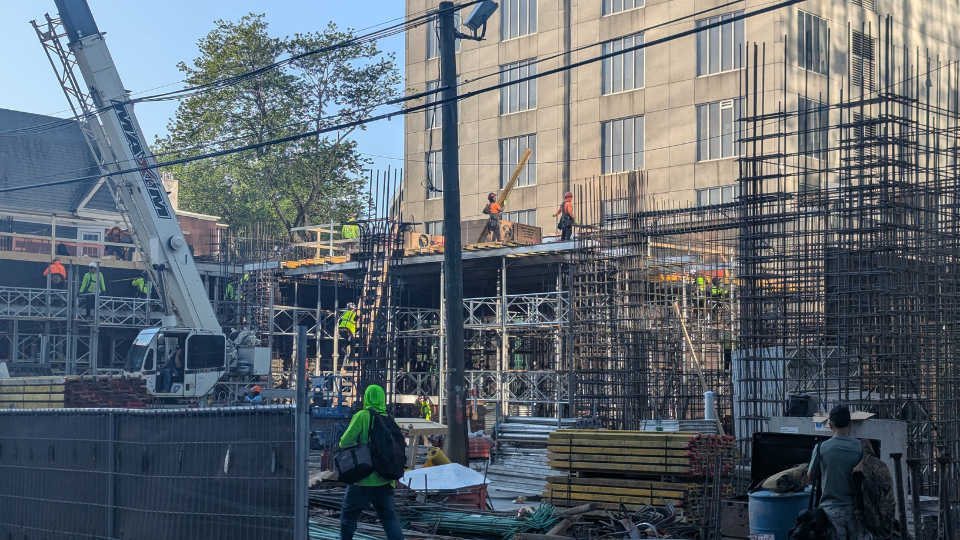
JERSEY CITY, N.J.—Workers are moving dirt and steel and pouring concrete for a new development complex by the city’s mass transit Journal Square PATH station.
The Eastern Region of the Laborers’ International Union of North America (LIUNA) is calling attention to issues affecting the workers on the non-union project, which spans 29 Van Reipen Ave. and 612 Pavonia Ave. Multiple safety violations have been observed, and the companies behind the development are paying wages well below the prevailing (i.e., union standard) wage.
Workers have been observed digging a foundation without a trench box, exposing them to a potentially fatal avalanche of dirt in the event of collapse. Electric wires have been seen being held out of the way above workers’ heads in an ad-hoc manner with the backhoe bucket or with sticks, and workers have been observed setting up scaffolding without harnesses. There are no clear walkways, forcing workers to step over various large construction materials while entering and leaving the job site, or walking around inside it. Workers enter the worksite without hard hats. Rebar—steel bars used to reinforce concrete—lacks rebar caps that protect workers from potential impalement. Heavy construction materials are being carried around the job site by hand. On a union job, they would be moved with machinery. Companies on-site park their trucks in the road while workers direct traffic around them without reflective vests, flags, or signs.
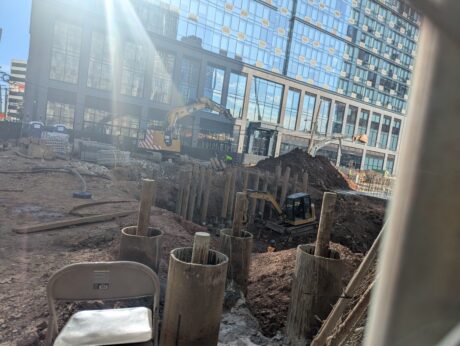
The lots, part of the Journal Square 2060 Redevelopment Plan, are zoned for commercial and neighborhood mixed use. Major entities behind the project include General Contractor AJD Construction and Namdar Group. The latter has eight other developments in Jersey City. AJD has organized the production of over 30 major projects in the city. It has a $6 billion portfolio and an annual revenue of $19.3 million.
Since 2023, individuals associated with Namdar Group have contributed at least $54,000 to Jersey City Mayor Steven Fulop’s super PAC Coalition for Progress and to his campaign for governor of New Jersey. Others associated with AJD Construction have given $62,000 to Fulop’s campaigns since 2014. People connected to Concrete Rising LLC, a subcontractor on the site, gave $17,400 this year.
It so happens that Namdar Group, run by Joel Namdar and located at 98 Cutter Mill Road in Great Neck, N.Y., is situated roughly 500 feet away from Igal Namdar’s “bottom feeder” company, Namdar Realty Group at 150 Great Neck Road. The latter has an estimated $2.7 billion portfolio and a history of safety violations, shoddy management, and scrapping labor contracts with maintenance workers, which forced 32BJ members in Manhattan to go out on strike last year.
AJD subcontractors’ abusive records
LIUNA Eastern Region represents many workers like those building the AJD project, and is familiar with how AJD operates. The New Jersey Department of Labor (NJDOL) has four stop-work orders and five open cases against subcontractors AJD hired at 1 Journal Square and 10 Journal Square, known as “The Journal.” Those properties are owned by disbarred attorney and real estate developer Charles Kushner, Trump’s ambassador to France and father-in-law to Ivanka Trump.
Workers at The Journal had informed LIUNA Eastern Region organizers that they worked for weeks without pay on that AJD project last year. The union worked with more than 70 workers at that time to help them file claims with the NJDOL. When personnel from the state’s labor department visited the site, company foremen and supervisors lied to the workers, saying the investigators were ICE agents. Many of those hired by the company were immigrants.
On June 4, the N.J. Department of Labor ordered four AJD subcontractors to stop work there due to unpaid wages, refusal to pay overtime or provide workers’ compensation insurance, and hindering NJDOL investigations. The subcontractors cited were 506 Painting LLC, MJQ Drywall Group, and two subcontractors MJQ hired—Exxon Development Corp. and Oliveria General Services. The NJDOL also has an open case against GP Concrete, another AJD subcontractor at The Journal.
However, work on The Journal continues. The NJDOL stop-work orders posted at the site are surrounded by gates and caution tape. A People’s World reporter attempting to photograph the postings was accosted by a man who berated the photo taker for being “fucking nosy” and then dragged a piece of plywood in front of the NJDOL orders, obstructing them from view.
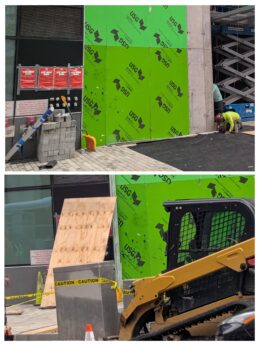
Below: A piece of plywood obstructs the stop-work orders from view at 9:03 am on 8/14/25 after the man who dragged it there told a reporter they were being “fucking nosy” for trying to take pictures of the postings.| Cameron Orr/ People’s World
Concrete Rising LLC, now hired by AJD at the 29 Van Reipen Ave. – 612 Pavonia Ave. project, was charged with multiple violations at The Wave (now called Bisby at Newport), a luxury building on Jersey City’s waterfront. It is owned by LeFrak. Concrete Rising contracted at that site with labor broker Signatura Laboris, a company owned by Salvador Almonte, who already had a record in New York of seriously injured employees and refusing to cooperate with the state’s Workers Compensation Board. One employee was killed—Juan Chonillo, a father of five. When Concrete Rising hired Signatura Laboris, Almonte was also facing insurance fraud charges (which he was later convicted of) for evading over $1 million in insurance premiums—a scheme that left over 100 construction workers underinsured.
Violations at The Wave included withholding wages, refusing to pay overtime, not properly classifying workers, and making illegal deductions from workers’ pay. When a worker on that project was injured on the 32nd floor, the company took him off the site in a garbage bin. (A similar story played out at The Journal in 2023.) Under pressure from the union, a NJDOL investigation, and a stop-work order, Concrete Rising settled with the NJDOL in April of last year, paying $402,397 to 181 affected workers and another $127,739.73 in fees and penalties. The subcontractor was also required to have a monitor on all its projects for a year and was banned from working on any public works projects for three years.
A new “Wild West”
It used to be, union organizers note, that most developments in Jersey City were constructed with union labor. LIUNA Eastern Region organizer Chris Capers notes he began to see a change around 2017. Since then, he says, it’s become the “Wild West.” Often, it is immigrant workers being illegally super-exploited. Employers know they may face steep legal risks in attempting to defend their rights on the job. Meanwhile, union-standard jobs are also denied to other people of color and women who are passed over by non-union employers.
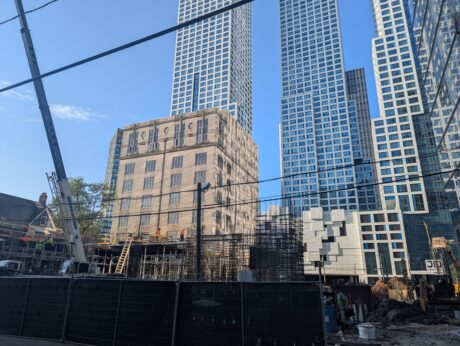
Behind the center Journal Squared tower, a new AJD Construction and Panepinto Properties project can be partially seen, which broke ground in 2023. The laborers’ work being done there is non-union.| Cameron Orr/People’s World
The local situation has been affected by decades-long legal battles between workers and employers at the federal level. On private projects, city officials have been left with limited tools to fight corporate abuse, labor leaders say.
In September 2016, the 3rd U.S. Circuit Court of Appeals, based in Philadelphia, sided with an association of developers and contractors opposed to Jersey City’s Project Labor Agreement (PLA) laws. The city’s PLA laws had required employers to use union labor with collective bargaining agreements (CBAs) that met certain minimum standards. Among other things, the CBAs helped to ensure companies provided good wages and safe working conditions. The PLA laws applied to developments that cost at least $25 million to build and that were receiving tax abatements.
The Associated Builders and Contractors of N.J. argued that tax exemptions from Jersey City were not sufficient to make the city a “market participant.” Therefore, they claimed, the city was acting as a “market regulator,” overstepping the National Labor Relations Act, according to a 1959 U.S. Supreme Court ruling, San Diego Unions v. Garmon.
In August 2017, the Jersey City Council passed a new PLA law in response to the court decisions. In addition to the PLA requirements of prior years, it mandated that at least 20% of the workforce be minority (i.e., Black, Latino, Asian, and Native) and women workers who are residents of Jersey City. Black, Latino, Asian, and Native people together make up more than 73% of Jersey City’s population, and women make up 50%. But the updated law now only applies to $25 million and up projects if they are receiving both a tax abatement and other financing from the city, such as a grant or bond. It does not mandate specific penalties for violations, making strong enforcement optional for the city’s Department of Administration.
Without a PLA, employers are under no obligation to hire locally or to hire people of color or women workers.
As in previous versions, the law forbids workers from going on strike without providing for exceptions in cases where employers are not complying with the law or CBAs. It also allows developers to use non-union labor if a project includes more than 50% affordable housing.
While the NJDOL has been persistent in investigating labor violations, LIUNA’s Eastern Region Director of Research, Nicole Vecchione, says, “no amount of enforcement has yet prevented further abuses.” Lack of public transparency, especially for subcontractors and labor brokers, is a problem. Many of them, union representatives believe, are not registered with the city or state, although Jersey City technically requires them to be.
“By offloading their workforce into an underground economy of unregulated labor brokers and subcontractors, prime contractors can limit their own liability, profit off exploitation, and make it difficult for the city and state to investigate violations and enforce the law,” Vecchione adds. This contributes to a situation in which union contractors who do follow the law, pay living wages, and provide benefits are forced to compete with anti-union firms that skirt the law and super-exploit workers, creating a race to the bottom.
Hold them accountable
LIUNA Eastern Region representatives are shining a light on the 29 Van Reipen Ave.–612 Pavonia Ave. project so that the city and community members can put pressure on employers to follow the law, provide prevailing wages and benefits, and allow workers to unionize. Union organizers have also been present at the site to make known their solidarity with the construction workers who, like all employees in New Jersey, have the right to fight for union representation regardless of immigration status. 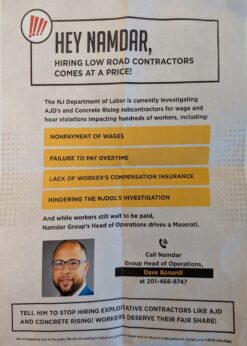
“We want our elected officials to consider construction workers when making decisions about development,” Vecchione says. “Elected officials have a lot of power over what gets built, and labor standards should be a central part of those decision-making processes.”
We hope you appreciated this article. At People’s World, we believe news and information should be free and accessible to all, but we need your help. Our journalism is free of corporate influence and paywalls because we are totally reader-supported. Only you, our readers and supporters, make this possible. If you enjoy reading People’s World and the stories we bring you, please support our work by donating or becoming a monthly sustainer today. Thank you!
CONTRIBUTOR