The U.S. president issued an executive order on Jan. 29 “declaring a national emergency and establishing a process to impose tariffs on goods from countries that sell or otherwise provide oil to Cuba.” The order mentioned “confronting the Cuban regime” and “countering Cuba’s malign influence.” “I think we would like to see the regime there change,” declared Secretary of State Rubio, testifying before the Senate Foreign Relations Committee the day before.
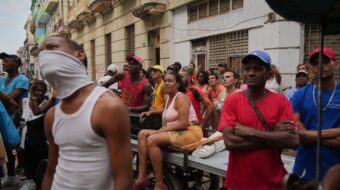
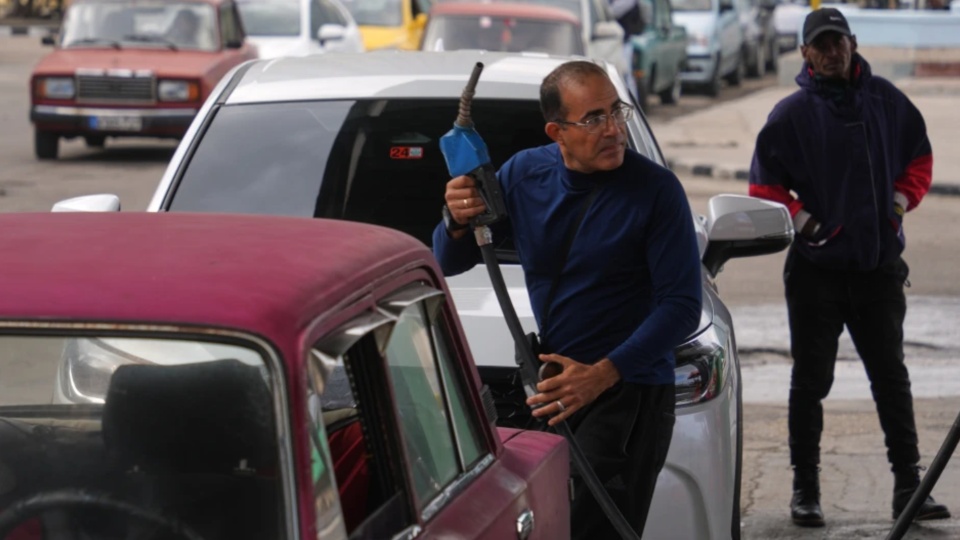
Cuba faces catastrophe. At work now are the cumulative effects of six decades of the U.S. economic blockade, a tightened stranglehold during the two Trump administrations, increasingly desperate living conditions, worsening shortages of essential goods, serious electrical power shortages, and the cut-off of oil from Venezuela after the U.S. invasion there on Jan. 3.
Mounting humanitarian danger and U.S. assault on Cuba’s sovereign independence are moving the international and U.S. Cuba solidarity movements into action.
The matter is urgent. In a statement, the U.K. Cuba Solidarity Campaign declares that, “This latest escalation…will cripple the electricity system and devastate every aspect of daily life” in Cuba. Th organization predicts:
“Hospitals without power. Incubators and life-support machines unable to function. Emergency surgeries carried out without light. Schools and workplaces forced to close. Bakeries unable to operate. Fuel shortages preventing the transport of food and medical supplies. Food spoiling in fridges and freezers. Hunger, illness, and suffering will spread. This is a deliberate attack on an entire civilian population, intended to inflict pain, deprivation and desperation. It is cruel, calculated, and it will cost lives.”
Victory for U.S. imperialism over Cuba’s socialist revolution would have dire implications. A European analyst explains that, “Cuba remains the only living example of a country that continues to attempt socialist construction on the basis of social ownership, planning, and working-class power, rather than market dominance and capitalist accumulation.”
Trump’s executive order sanctioning suppliers of oil to Cuba prompted a crescendo of statements supportive of Cuba, including from many Communist Parties of the world, from China, Russia, Vietnam, the Arab League, the African National Congress, the Bolivarian Alliance for the Peoples of Our America, multiple Cuba solidarity organizations, organizations of Cubans living abroad, and the World Federation of Trade Unions.
Cuban President Miguel Díaz-Canel commented on Jan. 30 that, “Under a false pretext and empty arguments, peddled by those who engage in politics and enrich themselves at the expense of our people’s suffering, President Trump seeks to stifle the Cuban economy by imposing tariffs on countries that trade oil with Cuba as is their sovereign right.”
Denying U.S. accusations, Cuba’s Foreign Ministry insisted that Cuba “does not harbor, support, finance, or permit terrorist or extremist organizations.” Nor does Cuba “harbor foreign military or intelligence bases” or represent “a threat to the security of the United States.”
Cuba soon may be unable to import any oil at all. According to a Financial Post report on Jan. 29, “Cuba has 15 to 20 days left of oil left as Donald Trump turns the screws.”
As explained by analyst Gabriel Vera Lopes, Cuba itself produces 30% of the 120,000 barrels of oil (BPD) used in the country each day. Venezuela in 2025 provided up to 35,000 BPD, representing 29% of the total. Mexico sold Cuba 17,200 BPD during the first nine months of 2025, until oil exports lagged due to U.S. pressure.
Vera Lopes indicates that even oil sent for humanitarian reasons will be blocked, as will be the small amounts of oil sent to Cuba through China or Russia. Apart from oil produced in Cuba itself, all that remains is oil from Mexico. Crucially, “The new executive order now appears to be aimed directly at Mexican supplies.”
Mexican President Claudia Sheinbaum, speaking to reporters on Jan. 30, highlighted humanitarian considerations and respect for international law. Insisting that Mexico’s government will negotiate with officials in Washington, she stated that “contractual considerations,” not political pressures, accounted for the PEMEX oil company’s recent suspension of shipments. Sheinbaum added that “ Mexico will always stand in solidarity, always seeking the best way to support the Cuban people.”
Mexico has been sending only 1% of its total oil production to Cuba. Up to 84% of it goes to the United States. In fact, Mexico and the United States have a mutually dependent but asymmetric relationship as regards hydrocarbon products. Maintaining that relationship may take precedence over Cuba’s needs.
Mateo Crossa’s recent article appearing in Monthly Review titled “The Shale Revolution, U.S. Energy Imperialism, and Mexico’s Dependence” is relevant. He writes:
“In the context of the Shale Revolution positioning the United States as the world’s top oil producer and as the leading exporter of refined oil, Mexico has become the largest market for the United States, importing $30 billion worth of refined oil in 2023—accounting for 28% of the $107 billion the United States exported that year.”
He adds: “This pattern highlights a troubling shift in energy dynamics, with Mexico increasingly locked into a subordinate role that weakens its economic autonomy and energy independence…. Mexico has not only become the largest importer of U.S. natural gas but also plays a pivotal role in the broader U.S. imperial energy strategy, serving as a platform for liquefied natural gas exports to Asia.”
Cuba solidarity activists in the United States are responding. In a communication shared with the International U.S.-Cuba Normalization Coalition Committee, labor activist Mark Friedman, associated with the Los Angeles Hands off Cuba Coalition, stated:
“We need to go on an emergency footing and reach out to those forces who in the past have not been willing to take a stand.… We need to fight for unity in the Cuba solidarity movement.”
At an emergency meeting of the coalition on Feb. 1, emphasis was given to significant expanding the existing material aid campaign for Cuba, outreach to the labor movement and to activists mobilizing against ICE and U.S. wars, local teach-ins, and a focus on defending Cuba’s sovereign independence.
Renewed action now on Cuba’s behalf is continuation of the struggle for Cuba that began in earnest in the United States under the leadership of Cuba’s national hero, José Martí. Revolutionaries inside Cuba who opposed the U.S.-dominated pseudo-republic (1902-59) carried it on. Anti-imperialist struggle intensified after 1959 with the defense of Cuba’s socialist revolution.
Under unprecedented threat now, the revolution’s fall would undo the long struggle of untold numbers of people against U.S. imperialism.
Fidel Castro, in his “Second Declaration of Havana” of Feb. 4, 1962, gave voice to Cuba’s struggle against U.S. Imperialism. A relevant excerpt follows:
“In 1895, Martí already pointed out the danger hovering over America and called it by its name: imperialism. He pointed out to the people of Latin America that more than anyone, they had a stake in seeing that Cuba did not succumb to the greed of the Yankee.… Sixty-seven years have passed. Puerto Rico was converted into a colony and still is a colony…. Cuba also fell into the clutches of imperialism. Their troops occupied our country. The Platt Amendment was imposed on our first Constitution, as a humiliating clause which sanctioned the odious right of foreign intervention. Our riches passed into their hands, our history was falsified, our government and our politics were entirely molded in in the interest of the overseers; the nation was subjected to 60 years of political, economic, and cultural suffocation. But Cuba was able to redeem itself.… Cuba broke the chains which tied its fortunes to those of the imperialist oppressor…and unfurled its banner as the Free Territory of America.”
We hope you appreciated this article. At People’s World, we believe news and information should be free and accessible to all, but we need your help. Our journalism is free of corporate influence and paywalls because we are totally reader-supported. Only you, our readers and supporters, make this possible. If you enjoy reading People’s World and the stories we bring you, please support our work by donating or becoming a monthly sustainer today. Thank you!
CONTRIBUTOR