

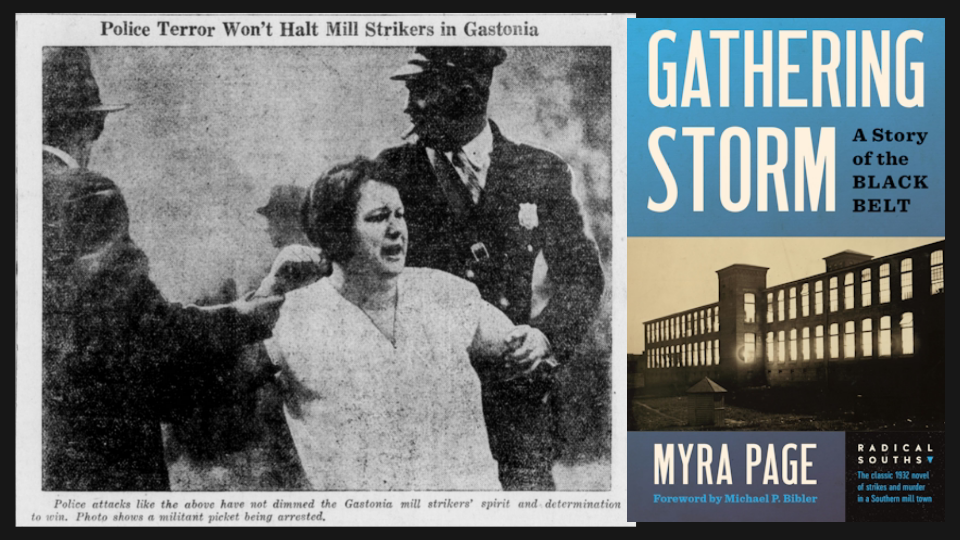
Beginning in the spring of 1929, hundreds of textile mill workers in and near Gastonia, North Carolina, struck against 60-hour workweeks, unsanitary living conditions, speed-ups, and racist job discrimination. This struggle ended after brave men and women workers withstood several months of company-driven violence. Generally regarded as a short-term failure, the struggle led to a small reduction in the workday with the same pay and to an end of speed-ups. More importantly, it created a union movement that spread across the region and forced companies to improve working and living conditions. This is the real historical event that is retold in Gathering Storm.
The reprint of Myra Page’s classic proletarian novel, part of the University of North Carolina Press’s “Radical Souths” series, is a welcome addition to any library. Page, a southern-born teacher, moved to New York to attend graduate school after World War I. There, she became politically active and took a job as a labor organizer in the garment workers’ union. In 1925, she joined the Communist Party and later completed a Ph.D. in anthropology. Her 1929 booklet Southern Cotton Mills and Labor was published by the Communist Party’s Labor Research Association. It documented conditions in the mills and analyzed the labor movement there. Much of that research, along with her firsthand knowledge of the Party’s role in the labor movement in the late 1920s, served as the basis for Gathering Storm. The novel’s focus on working women’s experiences—raising topics of contraception and abortion, intimate partner violence, the gender pay gap, and women’s leadership in public settings—establishes its feminist credentials as well.
Page’s research and labor movement experience yielded a remarkably detailed command of labor history that sets the stage for the novel’s main conflicts. It provides essential background on the segregationist AFL craft unions, the IWW’s partial commitment to inclusion, and the demands for full equality and self-determination by Communist-led unions in the late 1920s. A striking fact about the novel’s events is that they unfolded before the Great Depression and before the formation of the Congress of Industrial Organizations (CIO), the often Communist-led labor movement most prominently associated with the New Deal after 1935.
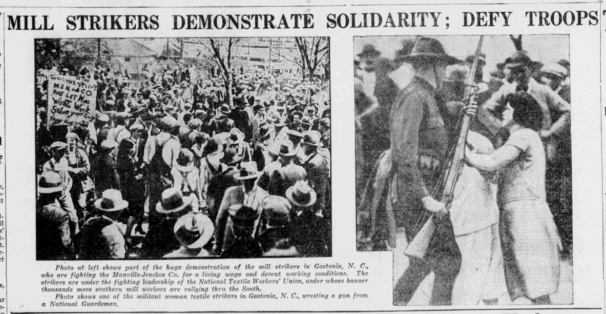
The mill workers’ atrocious living and working conditions are given a sharpened political focus by the novel’s subtitle—A Story of the Black Belt—a direct reference to racist Jim Crow practices in the U.S. South. It is also a specific allusion to the Communist Party’s emphasis on dismantling Jim Crow through the labor movement’s struggle for full equality for workers, an extension of its policy on the “national question.” The novel’s depiction of racist lynching violence, job discrimination, the racist wage gap, and housing segregation as a structuring feature of U.S. capitalist development is unique. It shows how white workers’ alignment with the racist values of the bosses leads to their own degradation. In Gathering Storm, the union organizers and strikers insist that the labor movement’s success depends on the unity of Black and Euro-American workers and communities, requiring white communities to unlearn ingrained racist behaviors and ideas.
The novel’s narrative structure is dynamic. The opening half of the book uses a third-person narrator to convincingly portray the interior lives, personalities, and motives of the two major Black protagonists and the two major white characters. But in the latter portions of the novel, as the narrative shifts to a collective setting and the narrator rapidly moves from scene to scene to drive the plot, those interior lives begin to vanish. The author used this narrative strategy to show how the major characters overcame their early internal emotional and intellectual conflicts over the struggle for power, their suspicions or fears of other racial communities, and the new ideas associated with the communist movement.
Two characters illustrate how this shift operates. Marge Crenshaw, the white woman through whom large parts of the story are narrated, had given her grandmother a pledge before her death to keep up the people’s fighting spirit. Despite the promise, Marge has no idea how to keep it, and the notion of fighting the bosses and companies to win a better life for the workers fills her with fear and anxiety. Part of her growth is learning that working with others, building trust across communities, and developing a clear strategy for success help her overcome that fear. As she aligns her promised values with her actions, she manages this internal conflict more effectively; it no longer pushes her toward silence or inaction.
Similarly, George Johnson is initially driven by thoughts of direct revenge and the idea of fighting for his people. He had been traumatized by witnessing the lynching of his family and neighbors in retaliation for the murder of the mill owner’s son, who had raped and murdered a teenage community member. Like Marge, he doesn’t know how to go about it until he connects with the labor movement and eventually the Communist Party. Now he declares to a friend that he understands how to fight racism as a systemic feature of capitalism; he knows that together the workers are stronger than one person alone. This alignment of strategic thought and action drew him into the Communist Party.
The novel’s turn from such interior character development to a collective perspective signals the full integration of the major characters’ personalities. But in the process, the focus on Black people, the conditions of their lives, and their role in the struggle falls to the margins of the story. Still, the story’s intent is to depict how white people overcome their own racism in a joint struggle for the union and interracial unity. The novel foregrounds how the Communist Party understood and fought racism that was systematically enacted through lynching terror, racist job discrimination, and super-exploitation. For example, Marge, who is impoverished by a gender pay gap, is astonished to learn that her Black union sibling, Nancy, earns about 40% less per week than she does, a fact that unfortunately remains in place when the strike is called off.
A recurring theme invoked by several characters throughout is who is identified as “us common folks.” The growing expansion of this category reveals a new consciousness developing among white workers. For example, in the opening, Marge’s grandmother tells the story of how the family came to live in the mill villages 40 years earlier. She tells how they had migrated from the mountains in western North Carolina, famous for its hostility to the Confederacy during the Civil War. Grandma remembers how her husband and their neighbors had fought to “free the slaves,” but concludes it was a fight that won nothing for “the common workin’ folks.” While Grandma claims a strong history of struggle, she is unable to see Black people as part of the common folk. Later, as Marge’s brother Tom leads the struggle to unite all the workers in the campaign against the mill owners as a prelude to the next “Civil War,” Marge’s friend Nancy tells her that Tom is “‘bout the first white man to—you know, act like we was folks.” Nancy’s declaration hints that the term’s exclusive racial meanings are crumbling. Will white workers be able to see that the struggle for Black freedom is also a struggle for “us” common folks?
Beyond the novel’s political level, its musicality stands out. In the opening chapters, scenes of white working families gathering around the organ to sing and pass the Sunday evening are juxtaposed with Black families doing the same (except using a banjo for accompaniment) in the village’s segregated section, at precisely the same time. Composed mostly of traditional religious songs, these acts of cultural production hint at workers’ need for spiritual sustenance and creative expression, otherwise suppressed by the endless drudgery of work and grinding poverty. The narrator emphasizes that white working-class cultural practice expressed class anger against the mill owners. Black cultural practices centered on themes of freedom and equality. As the union grows and the struggle gains momentum, including more Black members in its ranks and turning back white resistance to inclusion, a chapter titled “New Times, New Songs” shows how the songs begin to speak of work and struggle, relying less on abstract religious ideas about happiness only after death.
That changing musicality illustrates how the novel’s later chapters portray the union movement—led by the Communist Party—as the central protagonist. As the story’s final conflict unfolds, a whirlwind of events and characters appears. The major characters of the early chapters are submerged in the mass of people and the rush of action. The company’s attempt to suppress the movement through violence will cause a visceral, emotional reaction in readers who recognize the enduring relevance of such scenes of absolute injustice in a society that pretends to be the most advanced democracy in the world. In addition to the mills, the company stores, and the workers’ houses, the company controls the banks, the law enforcement agencies, political power at most levels, the media, the church leaders, the railroads, and many nearby farms. As Marge notes, “the mill takes everything.” Against this monopoly power, the workers have each other and their union. They work to organize support from local farmers who also hate the banks and the company, local grocers who compete with the company-owned store, and the labor movement across the country (and, through the Communist Party, the labor movement worldwide).
Despite this build-up in the plot, the representation of union organizing remains frustratingly incomplete. The story shows how, in the post-First World War years, the IWW organizers plan an organizing blitz based on “cajolin’ and persuadin’” as many workers as possible over a weekend to create an organizing committee that would present demands to the bosses the following Monday. The hope was that others in the workforce would spontaneously go along with the committee and its demands, thereby winning concessions. The Communist organizers who led the struggle in the mill villages used a different approach that required more intentional organizing work. The anti-racist strategy was a pillar of the new way of doing things, along with community-based coalition-building. The union’s strategy of extending the struggle geographically, from one shop to other mills, to other unions in other parts of the country, and to the global stage, is shown. But the foundational model of the much slower process of worker-to-worker organizing, in which organizers and hundreds, and even thousands, of workers held secret conversations to build a comprehensive picture of worker demands and strengths and to develop internal leadership, is not shown. The activity is portrayed as abstract and spontaneous; a natural product of the organizer’s role, which leads to the union.
The foreword to this new edition provides biographical information about Myra Page and offers a reasonable discussion of the book’s literary qualities. It refuses to let the novel’s overt political messaging allow it to be dismissed merely as “propaganda.” Still, the foreword’s author makes some strange claims. Despite Page’s literary attempt to represent the Communist Party’s view of racism and gender oppression as catalyzing factors in workers’ lives and struggles, the author of the foreword claims that Page fails to address “the racism and sexism infamously built into the very structure of the CPUSA during this time.” Labeling something as “infamous” means that it is so well-known and so bad that no explanation or evidence is necessary, which, unfortunately, leaves the contradiction unaddressed.
It may be more precise to assert that the Communist Party developed an innovative and strategically necessary understanding of U.S. racial capitalism, as well as anti-racist and anti-sexist policies, which it tried to enforce within its ranks and to project into society through its organizing activities. Nevertheless, American racism and sexism occasionally reared their poisonous heads in movements led by communists. Gathering Storm represents the complex, difficult unevenness between stated values and their partial expression through action. One example of this from the novel is worth highlighting. When the newly arrived northern union organizer and Party member, Herb Sampson, suggests to the lead organizer, Tom Crenshaw, that the union could do better by downplaying racism to win over more white workers, Tom denounces the idea. “The Party ‘n union know what they’re doin’,” he replies. Full equality is a matter of principle and of strategy. “The biggest thing about this strike with all its shortcomin’s, is the beginning of solidarity of Black and white in the South.” A temporary victory that reinforces Jim Crow policies, Tom suggests, would diminish the longer-term goal of shared class power.
Gathering Storm shows how, through collective struggle on an anti-racist basis, many white workers could come to see that Black workers are part of “us common folks.” But this conclusion isn’t certain. Workers who support white supremacy seem to accept the reality of their own intense exploitation in exchange for the psychological comfort of feeling superior to Black people. The false but powerful notion of whiteness as a phony bond among Euro-Americans, regardless of class, denies white workers the vision of a horizon of freedom that can only be found when they overcome the fear of radically adjusting their social affiliations. The Communist Party insisted that the struggle for Black freedom was also a struggle for white workers and all workers, and failing to recognize this only perpetuates the very conditions that keep the working class divided and powerless. The grinding poverty of white mill hands proves the rule. Realizing this enables workers like Marge and Tom to see beyond their inherited prejudices and to act against the self-inflicted consequences of those prejudices. Thus, a future built on workers’ power depends on the presence of such political leadership.
Gathering Storm: A Story of the Black Belt
Myra Page
University of North Carolina Press, 2025
We hope you appreciated this article. At People’s World, we believe news and information should be free and accessible to all, but we need your help. Our journalism is free of corporate influence and paywalls because we are totally reader-supported. Only you, our readers and supporters, make this possible. If you enjoy reading People’s World and the stories we bring you, please support our work by donating or becoming a monthly sustainer today. Thank you!
CONTRIBUTOR


MOST POPULAR TODAY

French Communists unveil youth plan as student revolt rocks schools

Controversial ‘God made Trump’ campaign ad produces bipartisan uproar
Communists work to save ‘Millionaire Tax’ in Evergreen State

The other ‘lizard people’: Why the Epstein files are shattering global theory

Trump’s catalog of constitutional crimes: Long and getting longer