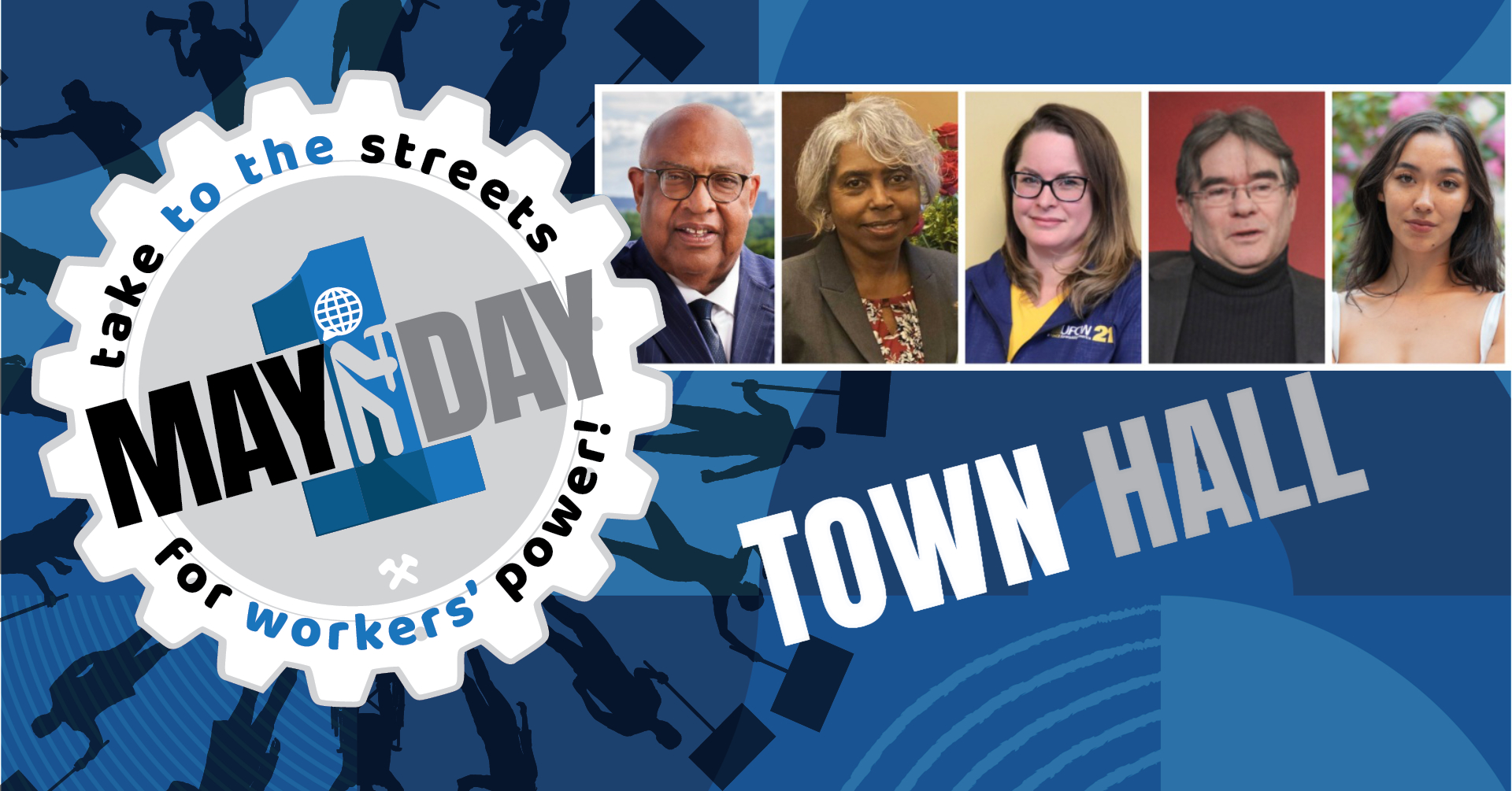
Video of the town hall meeting can be watched below.
CHICAGO—“May Day is our day. It belongs to all working people,” declared Fred Redmond, secretary-treasurer of the AFL-CIO, at a virtual town hall of labor leaders hosted by People’s World on Thursday, April 16.
The event featured a panel discussion on the ways workers are reclaiming May Day this year as well as organized labor’s role in mass resistance movements opposing the Trump administration and the corporate offensive being waged on workers.
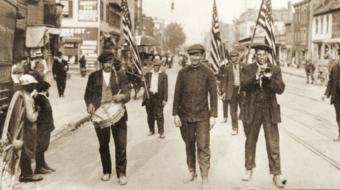
The first May Day shut down Chicago on May 1, 1886, when 80,000 workers struck for an 8-hour day. That strike, 140 years ago, produced two results.
One was the Haymarket Massacre on May 4, where police fired on strikers after someone threw what looked to be a bomb. The day before, police shot and killed six workers. Eight “radical” unionists were arrested after the massacre, where seven people died. Four of the unionists were hung after a trial that was a travesty of justice. The other result was adoption of May Day as International Workers’ Day.
Redmond, himself a native of Chicago, described the 1886 protest movement as “one of the boldest things that workers in this country have ever done. Refusing to show up for work, tens of thousands, mostly immigrants, were in the street protesting and bringing the economy to a halt.
“It paved the way for massive wins, for workers to stand up and not live in fear and really realize the power that they had together,” he said. “And here we are more than 100 years later…in so many ways, we’re in the exact same fight. We are seeing our dignity and our rights trampled on by this current administration.”
The AFL-CIO leader said he couldn’t think of a May Day in recent history as important as this upcoming one. He was joined by four other labor leaders during the virtual town hall who made that same point.
No more business as usual
Sylvia Chapman, staff representative of District 4 of the Communication Workers of America (CWA), a union that represents about 700,000 workers in the U.S. and Canada, emphasized how economic disruption will be a major tool workers will use this May Day.
She said the Chicago Teachers Union and the Chicago Federation of Labor have voiced support for the May Day Strong call for an “economic blackout” modeled on the “No Work – No Shopping – No School” tactic employed in Minnesota to protest ICE deportations and violence.
“What this means is that those who can take off work do so, and we will not make any purchases on this day,” Chapman said. “No ICE, no war, and protecting our voting rights is our battle cry in 2026 because we have our own people being terrorized and killed by those who are supposed to protect this country.
 “Undocumented people denied due process of law because of an administration that chooses to ignore their rights, the suppression of voting rights—all of these things are an erosion of democracy in this country.
“The comfort of a few,” Chapman emphasized, “should not come at the cost of many.”
Panelists also urged viewers to start thinking about what comes next after May Day 2026, as well. Like Chapman, Faye Guenther urged workers to remember all the different aspects of their economic power.
Guenther is president UFCW Local 3000, which represents more than 50,000 grocery, retail, health care, and other workers in the Pacific Northwest. Her union has been going from workplace to workplace to talk with workers about the need for “a general strike pledge to protect workplaces and communities.” Many of their conversations have centered on abuses committed by federal immigration agents.
“We’re talking about general strikes that have happened in the past and how they’ve helped build power,” Guenther said. “When the normal democratic process fails, refusing to go to work is one strategy to push back on the government and corporations, and withholding labor and economic disruption is the only way to make sure people understand we are not going to accept business as usual.”
Workers of the world
May Day 2026 comes on the heels of the No Kings III protests that rallied an estimated eight million people across the U.S. against the Trump administration. These demonstrations focused on a wide range of issues, including the U.S. and Israel’s current war on Iran and Lebanon that has killed thousands of people and left many worried about further conflict.
Ed Ott, an organizer with the New York Left Labor Project and retired executive director of the New York City Central Labor Council, said “the war in Iran has brought back onto the table the aggressive nature of U.S. foreign policy.” He talked of how Trump’s foreign policy is reminding workers of the global aspect of the struggles they’re fighting here at home.

Ott elaborated, saying there has been “broad but unfocused opposition to Trump’s fascism” but that May Day represents an “opportunity to bring forth the working class as a major leadership component.” Among the issues Ott said he expects to see raised at protests is Trump’s escalating threats against Cuba, which he speculated will be the “next target” after attacks on Venezuela and Iran.
Ott also said the politics of the Trump administration no longer allow unions to concern themselves only with issues in their respective workplaces.
“Trump has attacked working people across the board, and it’s no longer enough to just settle down into your own little niche and fight for your next demand,” Ott said. “We need to get together with other workers, other working-class organizations, and add a new dimension to the resistance of the Trump era.”
Like other speakers, he pointed to the example set by workers in the Twin Cities. “The folks in Minnesota put their relationship” with migrants into practice, Ott said.
The rest of the union movement should do so not just with migrants but with a wide range of other like-minded groups and individuals at home and abroad, he said. “But this is something that will not be done easily,” Ott conceded.
Unity is the winning ingredient
But it can be done, as shown by the successful strike by 3,800 JBS meatpacking plant workers in Greeley, Colo., said Caitlyn Clark, an organizer and activist for Denver-based UFCW Local 7. She’s also a key mobilizer for Essential Workers for Democracy.
“The workers at Greeley literally feed America,” as JBS is one of four meatpackers who together form an oligopoly controlling 85% of the U.S. beef, poultry, and pork market, Clark said.
But their working conditions are terrible. “Workers that we met on the picket line showed chemical burns, cuts on their hands, they even had prolapsed organs or herniated discs from lifting too much weight or doing repeated motions,” Clark said. The plant also violated child labor and human trafficking laws. Workers who complained were illegally fired.

Trying to get the workers in Greeley together posed a special challenge: The workforce is made up of dozens of nationalities, with 57 languages spoken in the plant. Management, she said, tried to take advantage of this to cause division.
Clark mentioned alleged abuses against immigrant workers at the JBS, including hazardous working conditions imposed on Haitian workers, which have prompted a lawsuit against the company.
She said that despite ICE agents being stationed outside on the day of the strike authorization vote, workers still voted 99% in favor, in what Clark called “a shining example of immigrant workers from all over the world coming together and uniting around a common cause.”
The workers had two demands. One was to raise their extremely low pay. JBS tries to “get more work out of them every year for less and less money,” said Clark. The other was to have JBS buy or reimburse them for the cost of personal protective equipment—special hooks, wire mesh chest guards, heavy work gloves, masks, steel-toed boots, etc.
The protective gear costs up to $1,100 per worker, and JBS forced workers to buy it from the company, taking the money out of their paychecks. But the workers found common ground in their appalling working conditions and spent time on the picket lines for three weeks teaching each other about their respective cultures.
“What we saw on the picket line in Greeley was workers singing together, sharing music, dancing, sharing food, workers exhibiting so much bravery in the face of both their employer and the current state of immigration policy,” Clark said. “And it really shows the importance of the labor movement and the shared fight to stand up for the dignity and respect of all workers, regardless of where they come from.”
In the end, the workers’ unity saw them through to victory—they won both of their major demands.
Building permanent worker infrastructure
The town hall included a question-and-answer period moderated by Cameron Harrison, a labor correspondent for People’s World.
Among the many questions asked by attendees was whether a general strike is a “realistic goal” in the U.S., to which Guenther answered in part: “We can’t go back to the way it was before, because it wasn’t working for working people, and our system isn’t working right now.
“I love all the protests people go to, but if they don’t go home and organize a union, that power vaporizes,” she said. “We need permanent worker infrastructure, and the way you have permanent worker infrastructure is through a union, and then we can build towards the multiracial democracy that we deserve.”

Another part of that infrastructure, the AFL-CIO’s Redmond said, is having pro-worker media that reports honestly on labor’s struggles. He gave a shout-out in particular to People’s World, sponsor of the town hall.
“I want to really thank the incredible staff at People’s World. You are spreading the gospel of this movement far and wide, and we appreciate People’s World and everything that they do to make sure that our message of self-determination, of dignity and respect for all workers, is being heard loud and clear,” Redmond said.
“I can’t tell you how important it is to have an outlet by workers and for workers, telling important stories about working people and families in a way you just do not see anywhere else.”
Turning again to May Day, Redmond summed up the whole point of the protests. “The bottom line is the Trump administration has betrayed working people and sold us out to the billionaire class,” he said.
“But we still have that same weapon that we’ve had all of these years, the most powerful weapon that working people have, which is our solidarity. May Day will show us what we can do. It’ll show that we, as the working class, are willing to fight for our liberation, to fight for our justice, and to fight for our freedom.”
C.J. Atkins contributed to this article.
People’s World is in the midst of its annual fund drive, trying to raise $140,000 by May Day. So far, just over $80,000 has come in. The financial support of our readers is what makes events like this town hall possible; we have no corporate sponsors. To support working-class journalism, please consider making a donation or become a monthly sustainer. Thank you.
CONTRIBUTOR