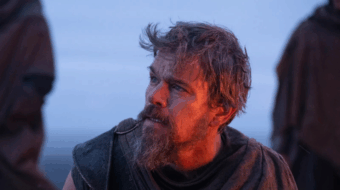
As the big-budget, live-action Moana prepares to hit the screen, co-starring part-Samoan actor Dwayne “The Rock” Johnson, director/screenwriter/producer Julian Cepeda’s low-budget indie HomeTown Hero is the latest development in South Seas Cinema, the film genre about Pacific Islanders and their Islands. This hard-hitting drama was shot entirely on location in Hawaii, mostly at Nānākuli on the Waianae Coast, where the movie opens with an aerial shot of this community on Oahu’s Leeward Side.
Located about 40 miles northwest of Honolulu, Waianae is distinct because many parcels of Hawaiian Home Lands—acreage the federal government set aside in 1920 for Native Hawaiians to farm and live on—are concentrated there. But HomeTown Hero, which was co-produced by assistant director Keith Nuñez (who is Dominican), is not about the Indigenous people of Hawaii. Rather, this 106-minute narrative film focuses on another Polynesian people—Samoans who have relocated from their archipelago, 2,200 miles south of Hawaii in the South Pacific, to reside in America’s 50th State.
In other words, although they are also Polynesian, Hawaii’s Samoans are a minority within a minority. HomeTown Hero does a powerful job dramatizing the hardships faced by many Samoans living in the Aloha State and is likely the first feature to do so (although there have been movies about Samoans residing in New Zealand, including the 2006 comedy Sione’s Wedding, which was so popular it spawned a 2012 sequel). The stateside Samoans’ trials and tribulations include: Substance abuse, unemployment, alienation, deculturalization, suicide, and more.
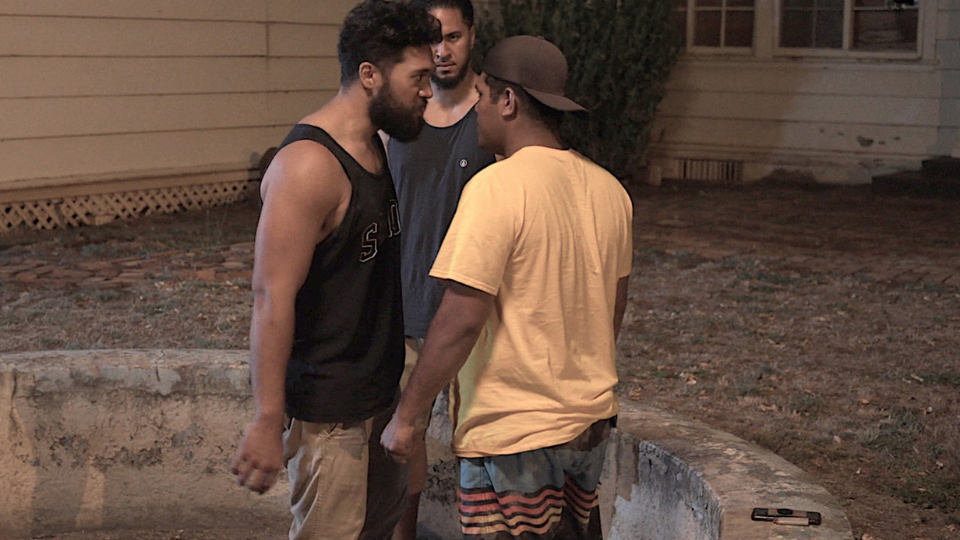
Johann Tuiolosega (Russell Satele) works as a student adviser in the administration of what appears to be a community college in Oahu, and is married to Gigi (Maima Savusa). As an employed, married adult, Johann (who may bear that name because parts of Samoa had been colonized by Germany) seems to have outgrown his childhood Samoan social circle, which includes his younger biological brother, high school student Jakey (Itumalomanu’atele Uikirifi), plus Ikaika (Christopher Pierce), Curtis (Crichton Uale), and Apelu (Charlie Prescott). Although the latter is struggling to complete college, much to Johann’s consternation, the “boys” appear to be irresponsible ne’er-do-wells who abuse substances, don’t work, skip classes, etc. 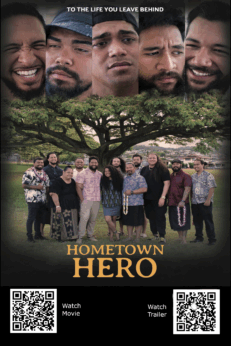
Johann is caught between his own career aspirations and lingering feelings for and ties to his band of boyhood brothers (called “usos”) and aiga (family). Jakey, who still lives at home, aspires to be a rapper, but after one of his songs is played on the radio, instead of being praised by his parents, the wannabe musician is met with sharp disapproval from his father, Toa Tuiolosega (Pal Tafiti), who fails to see any value or usefulness in his music. The rejection by his dad and distance from his mom, Angie (Lori Pelenise Tuisano), crushes Jakey, who retreats into the purple haze of increasingly harder drugs. Westernization has added the generation gap as a factor in Samoan culture, which traditionally values and stresses family ties.
This reminded me of something the artist Momoe Malietoa Von Reiche—as I recall, a member of Samoa’s royal family—once told me many moons ago, when I was a painter in Upolu. Referring to the legend of Paul Gauguin—who had to “flee” Europe to live like a “savage” in the South Seas, where he could find his authentic artistic voice once freed from civilization and its discontents—Momoe told me the opposite was true for Indigenous creators. That it was difficult for Pacific Islanders to pursue careers as artistes in the Western sense (not in the traditional Polynesian concept of craftsmen who deploy their skills and talents to create useful objects, such as hand-carved canoes or bowls), because art, in the Western sense, is not per se useful. To the best of my recollection, Momoe also said that it was especially hard for Samoan artists to paint nudes, because of taboos imposed by missionary-inspired churches which dominate Island society, and to be sure, organized religion plays a role in HomeTown Hero, with Misa Tupou playing the Pastor.
Johann is a man being pulled apart by competing, conflicting forces and emotional bonds. He is constantly besieged and prevailed upon. Unbeknownst to most, including his wife and mother, Johann has been offered a job as an academic adviser that would be a significant career upgrade at a college near San Diego (and would also offer a convenient escape from his hometown blues in Waianae). With this plot device and theme, HomeTown Hero harkens back to the first feature film based on a text written by an Indigenous Islander, 1979’s Sons for the Return Home, the screen adaptation of the great Samoan author Albert Wendt’s debut novel. Wherein its Pacific Islander protagonist is faced with that existential dilemma, which, as The Clash put it, is: “Should I stay or should I go?”
The location shooting of HomeTown Hero enhances and reinforces its sense of authenticity. I lived in Makaha on the Waianae side of Oahu and especially enjoyed seeing glimpses of Mount Mauna Lahilahi, where my seaside home once upon a time was. The movie definitely captures a social realist slice of life, but while this drama certainly does present the problems displaced Samoans suffer and experience in Hawaii, it gives no context for what spawned their angst and dislocation. The fact that there is tension between Samoans and Hawaiians is never broached; the movie has only one significant Hawaiian character, Kuulei (Pua Cockett), Johann’s supervisor.
Today, there are two Samoan entities: American Samoa, an unincorporated U.S. territory since 1900 (that is, a colony), and what had been called Western Samoa (now known as Samoa), which has been independent since 1962. The miniature flags from both Samoas hang from the rearview mirror in Johann’s car. The film never makes it clear which Samoan entity Johann, as well as the other characters, hail from. In this day and age of persecuting immigrants, this is important, as those from American Samoa have an easier path to legally residing in the USA.
In one key scene, Alvin (Mason Manuma) and Melvin (Tully Galuvao), cousins from the South Seas motherland, visit Johann’s family and belittle him, taking their Americanized cuz to task for not being able to fluently speak their Indigenous tongue (the film is spoken mostly in English with some subtitles). Of course, this only deepens Johann’s sense of being uprooted, displaced, and estranged from his homeland while a stranger in a strange land. But it’s never clarified as to which Samoa the visitors are from. (As I recall, in the 1970s Western Samoans felt richer in culture, while American Samoans were materially richer due to their links to the U.S. metropole. And those Samoans transplanted to Hawaii and the continental U.S. were even more separated from their traditions and mother tongue.)
According to an article in the Hawaii magazine Pacific Edge, writer/co-director Julian Cepeda, who is Black, Puerto Rican, and Dominican, was raised in Brownsville, which is in or near Bedford Stuyvesant in Brooklyn, N.Y., and attended SUNY Buffalo, N.Y. He subsequently relocated to Oahu, and although there are vast cultural and natural differences, it can be argued that Nānākuli is to Oahu what Brownsville is to N.Y.C. The story of HomeTown Hero grew largely out of Cepeda’s experiences and observations at Oahu.
As said, HomeTown Hero has a naturalistic cinematic style, but the astute viewer should watch closely for a plot twist that throws a curveball into the social realist mode of storytelling. Keep your eyes peeled!
Russell Satele delivers a convincing, powerful performance as the troubled Johann. An accomplished thesp, Satele has also acted in many Hawaii-shot productions, including the reboots of Hawaii Five-0 and Magnum P.I., plus HBO’s The White Lotus, and with John Travolta and Bruce Willis in the 2022 shot-in-Hawaii action flick, Paradise City. As Johann’s wife, Gigi, Maima Savusa puts her own spin on the “Haole-wood” Sarong Girl celluloid stereotype. As Jakey spirals out of control, Itumalomanu’atele Uikirifi conveys the urgency of a tortured soul. With her sly, charming performance as Johann and Jakey’s mom, Lori Pelenise Tuisano steals almost every scene she’s in, like a Polynesian Jane Darwell as Ma Joad in the 1940 classic The Grapes of Wrath. Previously, Tuisano appeared opposite Dwayne Johnson in 2019’s Samoa-set (but Hawaii-lensed) Fast & Furious Presents: Hobbs & Shaw and in Taika Waititi’s truly beautiful 2023 Next Goal Wins.
Cepeda elicits compelling portrayals from their cast of characters, trying to find their way in paradise lost, Samoans in the diaspora. HomeTown Hero presents a side of Hawaii rarely seen on screens and by tourists. According to publicity for the movie, “Cast and crew are mainly of Samoan descent, People of Color, and locals from Hawai’i.” This mostly realistic film is executive produced and produced by Jacob Kamhis, who brings his insight as a longtime Oahu resident to this low-budget, independent film that makes an important contribution to the evolving screen image of Pacific Islanders.
To see HomeTown Hero, visit here.
We hope you appreciated this article. At People’s World, we believe news and information should be free and accessible to all, but we need your help. Our journalism is free of corporate influence and paywalls because we are totally reader-supported. Only you, our readers and supporters, make this possible. If you enjoy reading People’s World and the stories we bring you, please support our work by donating or becoming a monthly sustainer today. Thank you!
CONTRIBUTOR