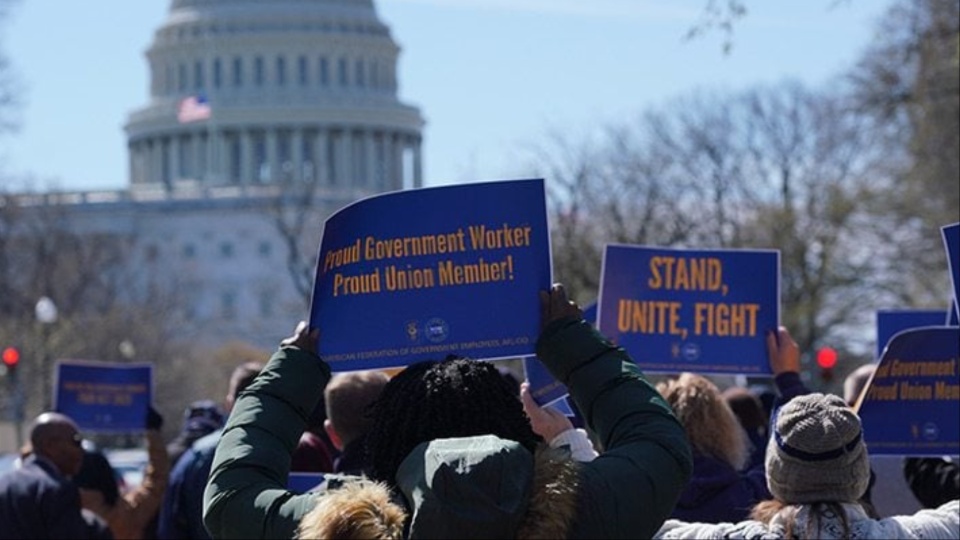
In a significant rebuke to the Trump White House, the House of Representatives passed the bipartisan Protect America’s Workforce Act (H.R. 2550) before year’s end, voting to reverse the Trump administration’s executive order that stripped collective bargaining rights from over a million federal workers. The 231-195 vote, forced by a discharge petition, marks the first legislative move to overturn a Trump order this term.
The bill’s passage is a result of the sustained pressure by federal worker unions and their allies. As it stands now, this represents an important defensive victory against what has been rightly called “the single largest act of union-busting in American history.”
Trump’s executive orders to bust the federal unions, with the stroke of a pen, were yet another phase of a long-running campaign by the ultra-right to weaken public sector unions. It is also a central pillar of the racist and anti-worker Project 2025 blueprint pursued by hardline factions within the ruling class. Nearly 20% of the federal workforce are African-American.
While the passage of the bill in the House is a necessary first step, the terrain of struggle now shifts to the Senate, where the battle will be tougher. The need for a mass mobilization campaign from labor is a necessity if the bill is ever to make it over the finish line.
Labor’s uneven response
While the unions representing federal workers, the AFL-CIO, and more militant sections of the rank-and-file have been fighting back, the collective action from the entire labor movement has not yet met the urgency of the moment. But many movement commentators say the scale of the federal union-busting demands a response comparable to the attacks on PATCO in 1981, in which half-a-million union members went to Washington in protest for Solidarity Day.
This type of fragmentation saps labor’s power at the very moment it needs to be concentrated. The scale of the Trump administration’s attack on federal workers, coupled with the ongoing crippling of the NLRB, is a direct assault against the very bedrock of trade union rights.
To successfully defend itself, the labor movement must build a unified front that can transform isolated actions into single, coordinated campaigns that also have the ability to fight forward.
Necessity for mass pressure
The legislative fight now moves to the Senate, where a companion bill already has 48 co-sponsors. Winning in the Senate should include a tactical focus on the political vulnerabilities within the Republican coalition. The MAGA agenda’s declining popularity in off-year elections and even among Republicans has made several GOP senators acutely sensitive to pressure.
Key targets include:
- Susan Collins of Maine, who represents a state where the House version of Protect America’s Workforce Act passed with bipartisan support.
- The open seat in North Carolina (to replace retiring Sen. Thom Tillis), a battleground state where working-class voter turnout is pivotal.
- John Cornyn of Texas, who needs to navigate a tough primary and a potentially competitive general election against a rising Democratic candidate. This creates a moment where organized, visible pressure by constituents and labor could sway his political calculations.
- The open seats in Ohio and Iowa, states where a message connecting this attack to broader economic hardship can resonate strongly among voters who back organized labor.
The labor movement’s strategy must employ every available tool, including the courts, but the most crucial addition to the legal challenges, letter-writing, and phone-banking is coordinated visible mass pressure from below. For instance, union-led picket lines at GOP district offices, town hall takeovers, and major demonstrations in state capitals are essential tactics that can mobilize and translate the growing worker anger against the MAGA agenda into political leverage that these vulnerable senators simply cannot ignore.
Right now, the main strategic goal is to pass the bill through the Senate. But if it passes there and heads to Trump’s desk, a veto is almost certain. But that veto would also further reveal the administration’s allegiance to the union-busting executives behind Project 2025 and (hopefully) dispel any lingering myths of a “pro-worker” MAGA politics.
Therefore, this campaign must be about more than just this one bill. It is ultimately a necessary exercise, a “structure-test” if you will, in working-class unity, mobilization, and the labor movement’s political clarity. It is a chance for the trade unions to demonstrate their collective strength and to show the ruling class that attacks on our fundamental right to organize will be met with an unrelenting, unified resistance.
This moment requires all hands on deck, from every union hall and central labor council, in a coordinated push to defend the rights of all workers.
As with all op-eds published by People’s World, the views reflected here are those of the author.
We hope you appreciated this article. At People’s World, we believe news and information should be free and accessible to all, but we need your help. Our journalism is free of corporate influence and paywalls because we are totally reader-supported. Only you, our readers and supporters, make this possible. If you enjoy reading People’s World and the stories we bring you, please support our work by donating or becoming a monthly sustainer today.
CONTRIBUTOR