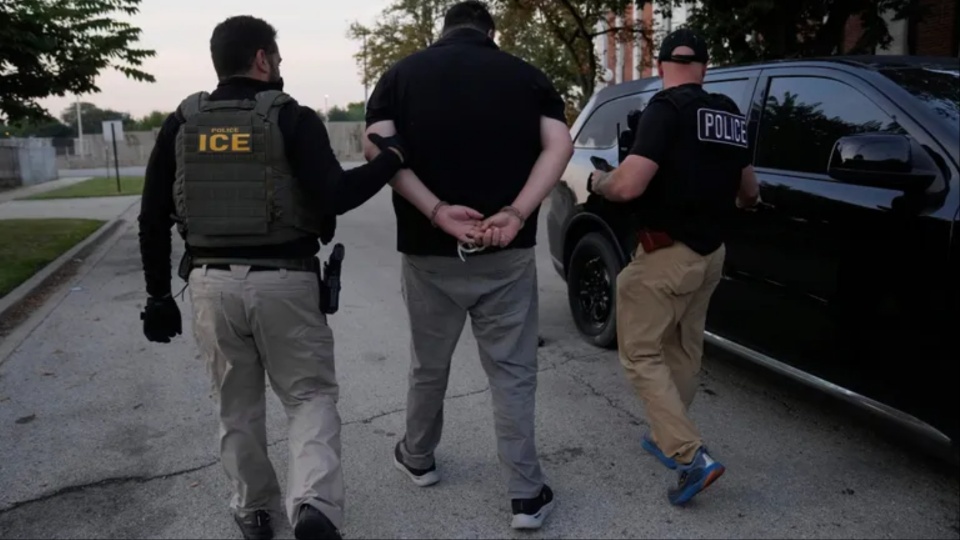
A new study, “Agents of Chaos and Cruelty,” has been released by the American Civil Liberties Union (ACLU) in the aftermath of the recent killings of Lorenzo Salgado Araujo in Texas and Joan Durán Guerrero in Maine. This new report details the racial profiling, threats, and excessive force in ICE’s operations during Trump’s second term as president.
The authors found a pattern of misconduct in state after state, in both cities with massive enforcement surges like Minneapolis and in communities that never saw significant federal law enforcement deployment.
“The horrific abuses our nation witnessed in Minneapolis were not an aberration—in fact, they are the tip of the iceberg,” the ACLU says. “What happened in Minnesota did not start in Minnesota, and it continues in communities across the United States as ICE and CBP’s funding and footprint continues to expand to a degree never before seen.”
No surprise there.
As ICE (U.S. Immigration and Customs Enforcement) rides roughshod over civil rights with out-of-control enforcement abuses and outright murder, it remains unchecked and unaccountable at the federal level.
 Though denied by the Department of Justice, ICE agents received notice earlier this July that the FBI will no longer investigate ICE confrontations, instead leaving it to DHS’s Homeland Security Investigations, an arm of ICE itself. This leaves states, cities, and communities faced with the daunting task of holding ICE accountable.
What makes the task even harder is that, in many cases, it’s not just federal agents doing the dirty work. Local police departments and jail facilities are being contracted to carry out ICE operations and hold detainees.
A look at the situation in just one state, Virginia, shows how difficult the task of tracking it all becomes, especially when you zoom out to the entire nation. But the response of advocacy and activist groups in the state also shows a model for what can be done in communities elsewhere.
Outsourcing enforcement and detention
An analysis of U.S. Immigration and Customs Enforcement data shows that since 2024, ICE arrests in Virginia have risen substantially, from 1,595 in 2024 to 9,000 in 2025. This data “also shows that 13 minors under the age of 6 years old were detained by ICE in Virginia during that same period.”
According to the Legal Aid Justice Center, this escalation can be attributed to an increase of 287(g) and IGSA agreements, as well as voluntary compliance with ICE detainer requests. Under 287(g) agreements, local law enforcement officers become an extension of ICE, with delegated powers to enforce federal immigration law, oftentimes with less than 40 hours of training. An LAJC investigation found that when state and local agencies comply with ICE, they are “committing resources and assuming risk, setting aside public safety concerns and the constraints of the laws of Virginia.”
As of December 2025, Virginia had 27 current 287(g) agreements. These include 23 local sheriffs, two jails (Rappahannock / Warren Shenandoah Regional Jail, Southwest Virginia Regional Jail) and two local police departments (Gordonsville Department of Public Safety and Shenandoah Police Department).
The LAJC reports that, as of the end of last year, “at least 223 state and local personnel have been delegated to act as immigration enforcement, at least 157 of which have been certified.” This includes two “security resource officers” in public schools (Buckingham and Washington Counties) and one “behavioral health advocate.”
While 287(g) deals turn local officers into stand-in ICE agents, IGSA agreements transform local jails into detention entry points, extending ICE’s detention capacity. Under these deals, jail beds are rented out to ICE, on a per diem basis, to house immigration detainees.
ICE has IGSA agreements with Riverside Regional Jail Authority in Prince George County and Southwest Regional Jail in Abingdon.
On-demand detainers
In addition to formal agreements between ICE and governments at the state and local levels, there are also informal methods of collaboration. Nationwide, 70% of all ICE arrests actually result from ICE detainers and transfers from other law enforcement agencies rather than via the highly-publicized raids by uniformed ICE personnel.
An ICE detainer is a request for a jail to transfer someone detained for some other non-immigration offense directly to immigration authorities. These requests include two primary parts: (1) A “courtesy call” to notify ICE of the release date and time for a person of interest, and (2) A “hold” to keep the person in custody for up to an additional 48 hours, allowing ICE time to pick them up.
An important condition to these requests is the acceptance of, and compliance with, ICE warrants (administrative warrants issued by ICE with no judicial authority). In other words, through ICE detainers, jails transfer detainees to ICE custody voluntarily, without being legally required to do so by a judicial warrant.
It should be noted that courts across the U.S. have found ICE holds to be unconstitutional.
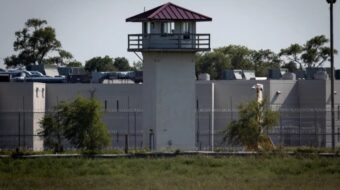
Once a person is held on one of these detainers, their next stop is likely to be an official ICE detention center. The agency operates two such facilities in the state, both located in Central Virginia: the Caroline Detention Center in Caroline County and the Farmville Detention Center in Prince Edward County.
According to TRAC Immigration, over 70% of detainees at these centers have never been convicted of a crime. Of the remainder, only 1% have been convicted of a serious, though not necessarily violent, crime.
WRIC reports, “the most common conviction listed amongst Central Virginia’s ICE detainees was driving under the influence of alcohol, with 816 bookings…. In over 200 cases, the most serious offense a detainee had ever been found guilty of was a traffic violation.”
State officials’ half-hearted fight
In the face of ICE’s increased assault on our communities, earlier this year the National Immigration Law Center (NILC) advanced five policy recommendations for state and local officials as part of their “No Secret Police, No Troops in Our Streets” campaign:
- End collaboration with federal immigration enforcement.
- Require government facilities to establish non-public “safe community places” that immigration officials can’t access without a judicial warrant.
- Ban law enforcement agents from concealing their identities.
- Prevent state and local law enforcement from becoming militarized.
- Document abuse and create pathways for accountability.
Virginia has taken incremental steps to adopt some of these policies, as Gov. Abigail Spanberger (D) recently signed Senate Bill 352 and House Bill 1482, which prohibit any law enforcement officers from concealing their identities.
However, no sooner was this done than Federal Judge Robert Payne issued an injunction, blocking Virginia from enforcing its new ban.
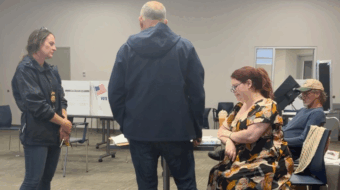
Coinciding with Spanberger’s signing these bills, however, was her veto of two much more substantial bills—SB351 and HB650—that would have designated courthouses, polling stations, and schools as protected spaces, prohibiting arrests without judicial warrants or subpoenas. In other words, no ICE warrants would be allowed.

The governor defended her veto, arguing that the state doesn’t have the authority to interfere with federal agents. “I do not want to make false promises to vulnerable people that…we at the state government can dictate where federal agents can come,” she said. “That is not a promise we can keep.”
Chris Kaiser, policy director with the ACLU of Virginia, points out that Spanberger’s vetoes leave targeted communities fearful of visiting courts and of taking their children to school. “Warrantless ICE arrests do continue unabated in Virginia courts, and they will continue unabated until the state does something to address it,” Kaiser said, calling the situation “extremely concerning.”
Earlier this year, Spanberger scaled back state collaboration with ICE by rescinding Executive Order 47, which had encouraged local law enforcement cooperation with the agency. However, as the Legal Aid Justice Center points out, “The state has also signed additional contracts with ICE that are not prescribed in the Executive Order, such as with the Department of Wildlife Resources.”
In February, Spanberger issued an Executive Order to end state 287(g) agreements, and subsequently signed bills SB783/HB1441 into law, which limit local ICE contracts as well. It is important to note, however, that due to a gubernatorial amendment, this seemingly progressive legislation does not prohibit ICE detainers and explicitly maintains that jails can still honor these requests.
Compared with the NILC policy recommendations, Virginia’s recent attempts at policymaking fall disappointingly short in stepping up measures to counter ICE. The small steps that have been taken lack any real impact so far, and the glaring problems of unprotected spaces, warrantless arrests, and ICE detainers still loom large in the Commonwealth. These are all issues that the legislature has addressed. The governor is, unfortunately, the main stumbling block.
Richmond policies suggest progress
Meanwhile, in Richmond, Virginia’s capital, policies have been issued that also align with NILC recommendations. These initiatives, from the City of Richmond Inclusive Communities Preparedness Work Group, are meant to help safeguard the community and build the trust required to do so.
First off, there are new guidelines to help distinguish local police uniforms from ICE uniforms. “Richmond” is now a prominent qualifier on all badges and flak jackets.
The city, which already prohibits ICE access to Flock cameras, will also now cut off access to data from automatic license plate reader (ALPR) cameras for both federal agencies and any police jurisdiction that has joinedin a 287(g) agreement.
WRIC reports that this last initiative comes after “Richmond Police previously acknowledged two breaches involving improper access to the Flock camera system by federal law enforcement agencies.”
Mayor Danny Avula has stated that Richmond has not, and will not, enter into a 287(g) agreement. In a statement released at the beginning of the year, Avula stressed: “Richmond Police do not participate in deportation activities or coordinate with ICE. Our priorities are community safety and ensuring residents know their rights.” An additional measure prohibits federal agencies from using city-owned property to perform immigration operations, including surveillance and detainee processing.
While they are good initial steps towards ICE mediation, the effectiveness of the city’s new policies will depend entirely upon the level of their actual enforcement.
The people take the lead
In Virginia, when it comes to safeguarding targeted communities against the onslaught of ICE’s enforcement tactics and abuse, however, the most concrete and effective work is happening on the community level.
In the Richmond metro area, this takes various shapes and forms, from ICE watch Facebook pages like RVA ICE-SCREAM to labor unions, from grassroots mutual aid organizations to trusted nonprofits.
Groups like Ojos coordinate court watches and mutual aid; the Legal Aid Justice Center (LAGC) and The Amica Center supply direct legal aid and advice; and trusted institutions like The Sacred Heart Center do critical organizing and education work to help targeted communities.
“Many different groups are creating resources. Connecting with any one of us is connecting with all of us. There are a lot of entry points to assistance,” states Kaylin Cecchini, vice president of the Richmond Community Legal Fund (RCLF) and a court-appointed attorney in Henrico.
Having just celebrated their first anniversary, the RCLF has established an impressive track record. Working closely with Sacred Heart and LAJC, and as a fiscal sponsor of Ojos, they help troubleshoot connections to legal services and other mutual aid needs.
Since forming, they’ve allocated $68,000 to support people facing immigration and civil rights cases, and $410,000 to individuals and families requiring assistance with legal costs and stabilization funds following an arrest.
Cecchini describes ICE’s presence in Virginia as an “ever-present specter of fear” for targeted communities, affecting day-to-day work and family life. People are afraid to get groceries, send their kids to school, or even call 911.

To help targeted communities with emergency preparedness, RCLF has organized 50 workshops and clinics and is currently working with both The Sacred Heart Center and LAGC on a Standby Guardianship Clinic.
This will provide preparedness and guidance on how to predesignate safe guardians for youth who are in danger of losing their families to ICE detention. The harsh alternative results in children being processed into the same abusive system as their parents.
Always looking for donations, new volunteers, and partners for sustained funding, RCLF is preparing for the future to fund more aid requests, organize more workshops, expand outreach, and explore new service areas, such as civil rights defense.
Through their local small business fundraising, an expanding network of attorneys, a growing base of volunteers, steadfast caring community members, and wide-ranging partnerships, RCLF is building a strong community in Richmond, and importantly, helping it stay connected.
In an initiative to indicate solidarity, RCLF’s Chinga La Migra yard signs have spread throughout the metro area. Cecchini points out that the signs are a message of support to targeted communities: “There are a lot of people who want you here. There are neighbors you can trust.” This is an important message, and one that needs to be heard.
Navigating a lawless landscape
In line with the ACLU’s newly released report, Cecchini observes, “It’s a lawless landscape. What we’re seeing is working parents who are pillars of their community being taken, and there’s really no evidence to suggest that these arrests are a public safety measure at all, rather acts of cruelty and domination. Contrary to their stated goals, the behavior of ICE agents is what’s criminal.”
When asked about recent state and local policies, Cecchini remarks:
“Every measure that the state and local government take to thwart ICE is appreciated. But there’s always more power that our governments can exercise. Truthfully, our governor is more of the issue than our legislature. We could have effected the law banning [ICE] from courthouses.
“I think that the state does have the authority; it may have to be litigated to say that this is a state-run process and you can’t interfere with our administration of justice in the service of your own. It’s really the minimum our state should be doing. At least putting up a fight on behalf of our impacted community members.”
Cecchini is right. As Virginia communities struggle against an out-of-control ICE, local government and the state government must take a stronger stance. They must put up a fight for our communities, our workers, our families before more devastation is done, before someone else gets shot and killed.
They must look at what is happening on the community level and stand up to the authoritarianism of the federal government. At the very least, they must adopt all five policy recommendations from the National Immigration Law Center, including designating safe spaces and prohibiting both warrantless arrests and ICE detainers.
Virginia needs actual ICE OUT legislation, and as the ACLU report makes clear, so does every other state. Ideally, as Cecchini says, our governments must demand ICE “agents of chaos and cruelty” get out of our communities.
We hope you appreciated this article. At People’s World, we believe news and information should be free and accessible to all, but we need your help. Our journalism is free of corporate influence and paywalls because we are totally reader-supported. Only you, our readers and supporters, make this possible. If you enjoy reading People’s World and the stories we bring you, please support our work by donating or becoming a monthly sustainer today. Thank you!
CONTRIBUTOR