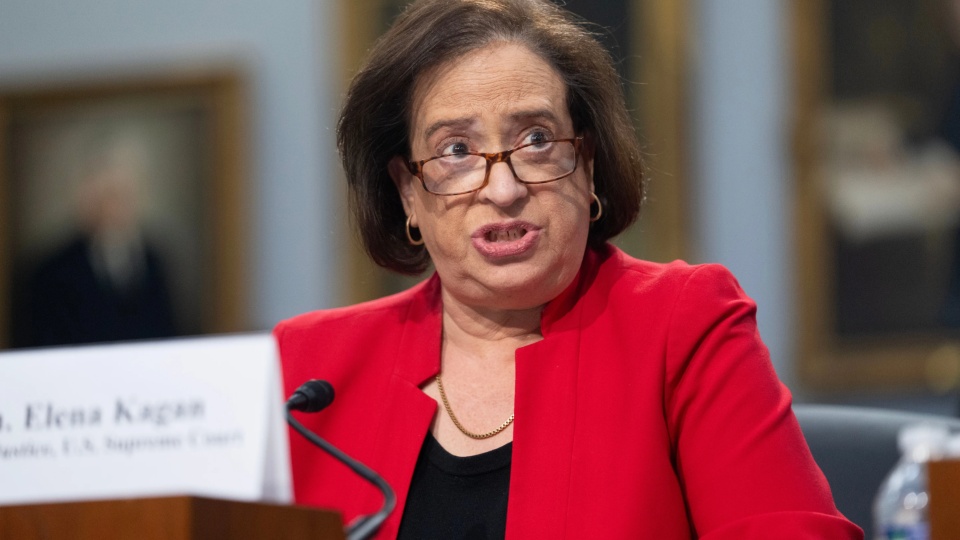
WASHINGTON—The “originalism” theory that the Republican-appointed U.S. Supreme Court majority often uses in its rulings turning back the constitutional clock doesn’t fit with the Constitution itself, Supreme Court Justice Elena Kagan says. It also increases political polarization and gives too much power to the president, she warns.
In a Q&A at Catholic University, in a special series on the rule of law, the justice added the founders envisioned an amendable and flexible Constitution, through the laws Congress enacts, to cope with changing times.
“They were writing the Constitution for the ages. They were writing the Constitution, knowing that there would be change in the world,” Justice Kagan. “The whole project of originalism is kind of misconceived, and it’s not a very good match with the Constitution we have.”
But that doesn’t sway the court’s “originalists,” headed by Justices Clarence Thomas and Samuel Alito, and they have used it to hand too much power to presidents, Justice Kagan said.
While not naming Donald Trump—who has brought the cases expanding presidential power—that tilt has damaged the Constitution, she said. She did not go quite as far as one predecessor, the famed progressive Justice William J. Brennan, who called originalism “arrogance cloaked with humility.”
The Constitution, Justice Kagan explained, “speaks in terms of the president’s duty, not the president’s power. It’s what the president has the obligation to do, not what he has the power to do.
“And when it says he has the obligation to take care that the laws be faithfully executed, it’s an obligation that pertains to fidelity to law. It’s not a provision that just hands the president lots of power to do as he wishes. It’s a provision that says to the president, you have an obligation to do what the law commands.
“The danger of a completely unitary system is the danger of one president being able to ride roughshod over all the other institutions of government, and over the people, who are supposed to be the sovereign rulers in our democracy.
“What the old, non-unitary system did was make sure the president was checked: That Congress could devise a way of structuring government. And, of course, Congress has to get what it does through the president as well. He has to sign it, so he has a say, too. But Congress could create governmental structures that don’t allow the president to run roughshod over everybody else.”
That’s damaged the court in the eyes of the public, Kagan said. And the majority compounds the problem, she warned, by endangering another check on the president: the U.S. people.
The court majority is removing that check by eviscerating voting rights, too—again not what the Constitution wants, the justice said. Surveys show the public now views the court majority as voting their politics, not the law.
The court majority and the originalists particularly get things wrong in cases involving the basic right to vote, Kagan told law professor Joel Alicea, who years before was a clerk (top aide) to Alito.
The majority worsened things in three voting-related cases in which Kagan and the other two Democratic-named justices, Ketanji Brown Jackson and Sonia Sotomayor, found themselves in the minority, Kagan said.
While Kagan didn’t say so, Jackson—the first-ever African-American woman on the court and the only justice who is a former public defender—in particular has been scathing in her dissents from the majority’s rulings.
Kagan’s remarks are notable because the justice has at times found areas of agreement on major issues, notably in religion-oriented cases, with the GOP-named majority.
But not on voting rights. Kagan said the “originalists” on the court don’t pause and consider the potential consequences of their rulings—and they should.
“In the gerrymandering case, the court said, ‘Well, this can be done by others. The court doesn’t have to do it. The system has its own self-regulatory devices.’ I think that’s just been proved wrong,” Kagan said.
“As we’ve seen over the last couple of years especially…both parties have been engaged in a race to the bottom in doing these partisan gerrymanders, effectively depriving masses of citizens of their right to voting equality, driving people away from the center, toward the wings, toward the extremes.
“The only thing anybody has to worry about anymore is being primaried, and making what is unfortunately a too-polarized country even more so.
“In this election and the next, we’re seeing large states with substantial numbers of people who vote for Republicans and who vote for Democrats, and those states are going to be turned all red or all blue in a way I think is very disruptive of our democracy.”
Those consequences will show up on Election Day and afterwards, particularly in the South and in other “red” states which enacted restrictions on voting rights.
And when the court majority started dismantling the Voting Rights Act around a decade ago, the North Carolina legislature took “45 minutes” to restrict voting rights there, the Rev. William Barber II, co-founder of Moral Mondays movement and Repairers of the Breach, has said.
The same sequence occurred with key campaign finance cases, including one the National Republican Senatorial Committee won during the High Court term which officially ended just before Independence Day.
That case opened the door to having the parties and local candidates work hand-in-glove to both gather the tsunami of corporate cash which the court has allowed for the past decade or more, and work jointly on spending it. Kagan said voters look at that and see corruption.
“The one place the court has allowed campaign finance regulation to operate is to prevent quid pro quo corruption, money for favors. And the court never seems to see the opportunities for doing exactly that. The NRSC case was like that.”
But the majority, Kagan said, “doesn’t see that even when you have that rule, if you have a thousand ways to circumvent it, which are allowed and cannot be prohibited, then you have that same opportunity for corruption. And I think the people of America look around this political system and think that all this money chasing all these political candidates is a nightmare. And they’re right.”
The court majority, however, termed the NRSC case one of free speech, protected by the Constitution’s First Amendment. Justice Kagan noted. That’s in line with the string of cases that, for decades, have seen the GOP-named justices remove virtually all restrictions on campaign contributions and spending under the theory that money—spending on campaigns—is speech.
Dissenting justices, Kagan included, have been outspoken in questioning that equation. So has public opinion, putting the court majority out of step with the country. In recognizing the impact on politics, including the power of the president and voting rights, the country is ahead of the court, Kagan said.
One case she criticized eviscerated what was left of the historic 1965 Voting Rights Act by abolishing any restrictions on state and local governments’ revisions of voting rules to prevent discrimination. Voters in Louisiana challenged its second majority-Black congressional district on equal protection grounds and won.
The majority said only obvious and proven racial discrimination via gerrymandering is unconstitutional. Political gerrymandering which discriminates against voters of color, Black voters in particular, is not.
The majority’s ruling set off a fast round of redistricting in Dixie as Louisiana—where the case originated—Texas, Alabama, Tennessee, North Carolina, and Florida carved up majority-minority districts. Trump ordered those remaps and the Louisiana ruling blessed them. Mississippi planned to redistrict but ran out of time. Missouri’s remap is tied up in courts. The Nov. 3 election is expected to reduce the size of the Congressional Black Caucus as a result of all these maneuvers.
A second key case basically let political parties coordinate big giving and big spending with individual campaigns, as the National Republican Senatorial Committee advocated. That was the latest in a line of campaign finance rulings which trashed rules about the tsunami of money in politics.
“If the Court helps to get the democratic system right, then it can go on its own. So it’s foundational that the democratic system be a healthy one. And I have found myself in dissent in this area more than I would like,” Kagan said in an understatement.
No paywalls at People’s World
We hope you appreciated this article. At People’s World, we believe news and information should be free and accessible to all, but we need your help. Our journalism is free of corporate influence and paywalls because we are totally reader-supported. Only you, our readers and supporters, make this possible. If you enjoy reading People’s World and the stories we bring you, please support our work by donating or becoming a monthly sustainer today. Thank you!
CONTRIBUTOR