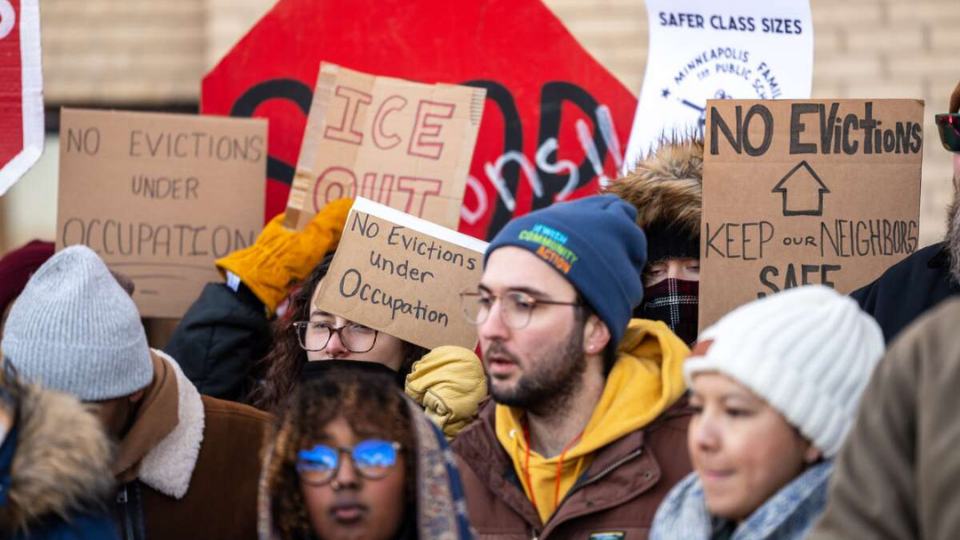
MINNEAPOLIS—A coalition of labor unions and tenant unions in Minneapolis and St. Paul has announced a massive rent strike drive set to begin March 1. Organizers here are calling it the largest rent strike in nearly a century.
They are continuing their demands from the statewide shutdown on Jan 23, particularly ICE out of Minnesota, and also demanding that Minnesota Governor Tim Walz immediately enact a statewide eviction moratorium and allocate $50 million in emergency rent relief.
The strike, announced on Tuesday in a press release, will bring together five of the major labor unions that mobilized for the shutdown, alongside the newly formed Twin Cities Tenants Union. Together, these groups represent a combined base of more than 25,900 workers and tenants. The coalition pledges to withhold their rent to protest an economy still reeling from the months-long federal occupation, which they say has pushed working-class families to the brink.
“In the last two months, I’ve been stuck in the house. I can’t work, so I can’t pay rent,” said Anain, a member of Inquilinos Unidos por Justicia and Twin Cities Tenants, in a statement. “All we want is freedom, to feel that we belong someplace, to work. Today I am pledging to rent strike on March 1 because I know that when we fight, we win.”
The coalition includes SEIU Healthcare MN/IA, SEIU Local 26, Unite HERE Local 17, ATU Local 1005, and CWA Local 7250. They are joined by community organizations like Take Action Minnesota and Unidos Minnesota.
The economic impact of such a strike would be widely felt. The organizers estimate that if just 10,000 tenants withhold their March rent, it would create a $15 million economic disruption, more than doubling the typical monthly rental debt in the Twin Cities. If the strike is fully authorized and launched with nearly 26,000 people, it would be the largest rent strike in the United States in the last 100 years, and the largest in Minnesota history.
Eviction crisis under occupation
The rent strike is in response to what labor and community leaders describe as a “catastrophic economic toll” following nearly three months of “Operation Metro Surge”—the federal occupation of the Twin Cities. Even as the federal government announces a drawdown of forces, the economic devastation lingers.
Before the occupation, over 35,000 low-income households in the Twin Cities were already struggling to afford rent, the coalition said. Since then, an estimated $47 million in wages has been lost among workers unable to safely go to their jobs, creating at least $15.7 million in new rental debt.
Despite the heroic efforts by mutual aid networks to distribute nearly $5 million in rent relief, evictions are still spiking. In January 2026, landlords filed 1,311 evictions across Minneapolis and St. Paul—a 12% increase from December and a whopping 26% increase over the January average of recent years.
The top evictors listed by the organizers include major corporate landlords like Dominium, Aeon, Roers Companies, and Related Companies. The list also names Sherman Associates, which organizers note has opened its hotels to ICE, drawing ire from the community.
“We are ready to withhold”
The rent strike also has the support of four Minneapolis City Council members—Jason Chavez (Ward 9), Aisha Chughtai (Ward 10), Aurin Chowdhury (Ward 12), and Robin Wonsley (Ward 2)—all of whom are tenants themselves and have pledged to strike on March 1.
“Tenants in Minnesota are in a crisis. The federal invasion forced many of our neighbors to stay home, and devastated our local economy,” said Council Member Aisha Chughtai. “I will be going on rent strike on March 1, and I call on my constituents to join me, until we can get a real solution from our state government for this crisis.”
Labor leaders framed the strike as a natural extension of union solidarity beyond the workplace.
“Our union has always understood that no matter what we win at the bargaining table, if we don’t join fights led by the community around things like… having an affordable place to live, we aren’t materially making lives better,” said Greg Nammacher, President of SEIU Local 26. “We know that collective action is the only way to take on problems this large.”
Geof Paquette, Internal Organizing Director at Unite Here Local 17, echoed Nammacher. “It has now become an emergency as many of our members are behind in their rent. It’s well past time for some relief.”
David Stiggers, President of ATU Local 1005, highlighted the link between housing stability and public safety. “Public transit workers are tenants, too… Unstable housing leads to stress, which leads to poor work performance, and that’s detrimental to safety and reliability.”
The coalition does make clear that the strike is a last resort. They said the action can be called off if Governor Walz steps in to meet the demands for a moratorium and direct relief. But if not, they are prepared for a historic fight.
“Out of deep consideration and profound seriousness, and facing March 1, when the rent is due, and so many still can’t pay, tenants and workers have decided that they have no other choice but to strike,” said Tara Raghuveer, Director of the Tenant Union Federation. “In taking this step, they join a storied tradition of struggle. The struggle can end whenever the Governor steps in to do what’s right.”
We hope you appreciated this article. At People’s World, we believe news and information should be free and accessible to all, but we need your help. Our journalism is free of corporate influence and paywalls because we are totally reader-supported. Only you, our readers and supporters, make this possible. If you enjoy reading People’s World and the stories we bring you, please support our work by donating or becoming a monthly sustainer today. Thank you!
CONTRIBUTOR