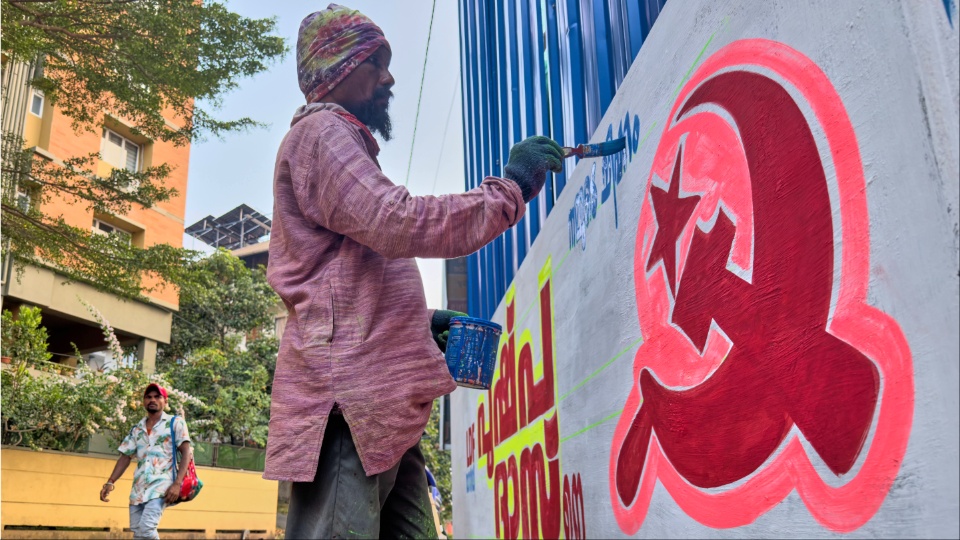
The Communist Party of India (Marxist)-led Left Democratic Front suffered a sweeping defeat in Keralam’s state assembly elections, results confirmed on May 4, ending a decade of left governance in one of India’s most progressive states and delivering the Congress-led United Democratic Front a commanding majority.
The center-left Congress Party won 63 seats and its allies added 39 more, giving the UDF 102 of the assembly’s 140 seats. The CPI(M) was reduced to just 26 seats, complemented by the 9 won by the other LDF parties, for a total of 35—down from 99 last time. Prime Minister Narendra Modi’s right-wing BJP, which rules at the national level, grabbed three seats—a historic first in the state.
Though there was a large swing in the seat totals won by the various parties, the scale of the shift in votes was somewhat less dramatic. A 12% vote decline resulted in a loss for the LDF of 64 seats due to India’s first-past-the-post electoral system. The UDF coalition, by comparison, only increased its vote share by 4.79% but gained a nearly-identical 61 seats.
Once the UDF assumes power, it will be the first time since 1977 that Communists will not be in government in even a single Indian state.
Accepting the people’s verdict
The Political Bureau of the CPI(M) issued a statement saying it “respects the people’s verdict and will introspect on the reasons that led to the defeat.” CPI(M) State Secretary M.V. Govindan said the party would “study the mandate closely and make the necessary changes on both the organizational and political fronts.”
Binoy Viswam, the Keralam secretary of the Communist Party of India, the CPI(M)’s main coalition partner, acknowledged the scale of the defeat, telling reporters: “We were expecting a majority, but it was proven wrong. We will take our lessons from this defeat. There are reasons for this big failure that we faced as the Left and Communists.”
The result ends an unprecedented run for Chief Minister Pinarayi Vijayan of the CPI(M), who had led the LDF to back-to-back victories in 2016 and 2021—a rare feat in Keralam, where power has historically alternated between the two major fronts.

Congress MP K.C. Venugopal said the UDF’s performance was backed by prevailing anti-incumbency sentiment against the LDF. “There was clear anti-incumbency against the government in the public mood, and we capitalized on that sentiment,” he said. The anti-government vote appears to have been highly concentrated in particular constituencies, allowing the UDF to edge out the LDF in close contests and run up its seat total.
Analysts pointed to several factors behind the Left’s collapse. Much media attention focused on scandals, including a case where gold intended for temple restoration was allegedly misappropriated and former top CPI(M) officials were implicated. The Congress Party hyped up the controversy, making it a major issue in central and southern Keralam, denting the LDF’s Hindu support. Allegations of corruption in cooperative banks also fueled claims of mismanagement by the LDF.
Several prominent CPI(M) leaders who had quit the party just before the election citing corruption and nepotism won in former party strongholds, delivering further blows in what had been reliably Communist territory.
Minority communities, a traditional Left constituency, shifted decisively toward the UDF, with Muslim and Christian votes swinging to the Congress-led alliance. Polls suggested many felt the LDF had not fought back hard enough against the attacks on minorities carried out by Modi’s Hindu nationalist BJP government.
Social achievements despite economic siege
The LDF’s electoral setback unfolded against a backdrop of genuine and historic achievement. Just last November, Keralam became the first state in India—a country that the World Bank counts as home to the world’s largest population of extremely poor—to officially declare itself free of extreme poverty.
The Extreme Poverty Eradication Project, launched at the LDF’s first cabinet meeting after re-election in 2021, worked through an exhaustive door-to-door survey led by local self-governments and women’s networks. It used the data gathered to draft participatory micro-plans covering housing, healthcare, employment, land titles, and pensions.
Chief Minister Vijayan said in 2025 that success in eliminating poverty came from “involving people from all sections of society and incorporating ideas that emerged from their participation and feedback.”
These gains built on decades of left governance that produced near-total literacy, low infant and maternal mortality, long life expectancy, and some of the highest human development scores in India. Welfare pensions, paid to just 3.2 million people at roughly $7 a month when the LDF came to power in 2016, expanded to cover 6.2 million people at $24 a month by the end of its tenure.
Keralam’s win over poverty stands in contrast to the rest of India, where inequality continues to widen. The richest 1% of the country’s population own more than 70% of the national wealth.

The LDF’s achievements are even more notable because of the odds it faced. The coalition governed under conditions of sustained fiscal siege. Revenue transfers from the central government—controlled by Modi’s BJP, which has treated Keralam’s left government with open hostility—fell from 5.52% of the state’s GDP in 2020–21 to just 2.54% by 2024–25, amounting to what left economists described as a “near economic blockade.”
The LDF nonetheless tripled capital expenditure over its decade in office, from roughly $1.5 billion (USD) to $4.7 billion, and undertook infrastructure projects worth approximately $12 billion. But the squeeze took its toll. Outstanding public debt roughly doubled over the decade to around $37 billion, with pensions and interest payments consuming a disproportionate share of revenue—the price, in part, of actually funding universal social programs while being starved of central resources.
For working people who had seen poverty eradicated and welfare expanded, the debt figures still made for a devastating campaign weapon in the hands of the business press and a Congress opposition with little interest in explaining why Keralam’s books looked the way they did. Unemployment figures hovering around 15% and steady outward migration of young people further fed the narrative that the LDF was mismanaging the economy.
What’s next for India’s Communists?
The Keralam result came as part of a broader round of state elections that saw reversals for left and progressive forces across India. In West Bengal, the BJP secured a landslide win, with the state recording a record voter turnout of 92%, though allegations of vote stealing are swirling.
“The employment question and lack of options for a highly-educated population lies at the heart of the loss,” according to Prof. Elisabeth Armstrong of Smith College in Massachusetts. She is the author of the book, Gender and Neoliberalism: The All-India Democratic Women’s Association and Globalization Politics.
Armstrong told People’s World that the CPI(M) and its allies take the election results very seriously, representing an “important gulf, even if marginal in percentage terms, especially because their government had made so many positive changes in rural and urban locations.” She predicted the LDF’s loss will spark a meaningful process of self-examination and said it “poses the central global challenges” for the world Communist movement “as it seeks to build a dynamic economic alternative to a form of capitalism that relies on chronic underemployment.”

CPI(M) General Secretary M.A. Baby said Monday that the party had “done its best for the welfare of the people despite the financial constraints imposed” by Modi. He said the CPI(M) continues to have “a strong presence among workers, peasants, and unorganized sectors,” but has to “examine why this is not adequately translating into electoral gains.”
For the left in Keralam, the coming period will require rebuilding the working-class base that once made the state a model of progressive governance—including robust public health, land reform, and labor protections—while reckoning honestly with the organizational failures and corruption allegations that helped hand the initiative back to the Congress Party and simultaneously created openings for the extremist forces of Modi and the BJP.
Baby emphasized the same point, putting a focus on unity. “The task remains to expose, isolate, and defeat the BJP and its policies,” he said. “For that, cooperation among secular democratic forces will continue, both inside and outside parliament.”
We hope you appreciated this article. At People’s World, we believe news and information should be free and accessible to all, but we need your help. Our journalism is free of corporate influence and paywalls because we are totally reader-supported. Only you, our readers and supporters, make this possible. If you enjoy reading People’s World and the stories we bring you, please support our work by donating or becoming a monthly sustainer today. Thank you!
CONTRIBUTOR