WASHINGTON—Call it corporate welfare. The nation’s taxpayers are subsidizing the nation’s largest private employers, notably WalMart and Amazon, who pay their workers so little that millions of their employees are forced to survive by turning to public subsidies, notably food stamps (SNAP) and Medicaid, a new report says.
And that applies to much of the so-called “gig economy,” especially Uber, Lyft, DoorDash and similar delivery services, too, the study adds.
The latest Government Accountability Office (GAO) report, based on data through September 2024—the most recent complete statistics available—also shows a huge rise since the prior study, using then pre-pandemic data in 2020, said Sen. Bernie Sanders, Ind-Vt., who commissioned both reports.
The reports cover 11 states, including high-wage states such as Massachusetts and low-pay states such as Georgia and North Carolina. It did not estimate how much the firms “saved” by their tactics.
“American taxpayers should not be forced to subsidize the starvation wages of large corporations like Walmart and Amazon. These corporations are making record-breaking profits, paying their CEOs exorbitant compensation packages and spending billions of dollars on stock buybacks to enrich their wealthy shareholders,” said Sanders when he released the latest report in July.
“It is beyond unacceptable that these corporations, owned by some of the wealthiest people on the planet, are receiving corporate welfare from the federal government.”
GAO reported low-paid adult workers make up a large share of recipients of both Medicaid and food stamps (SNAP). Citing data from a Bureau of Labor Statistics scientific sample of firms and workers nationally, the report says 50% of the 56 million Medicaid enrollees in 2024 and 52% of the 39 million people in households receiving SNAP benefits were adults, ages 19 through 64.
Sanders has been a congressional voice in the wilderness for decades, decrying the huge gap in wealth between the rich and the rest of us. The GAO report, he notes, features firms headed by many of the richest people in the U.S. They include Jeff Bezos, the founder and longtime CEO of Amazon, and the entire Walton family, heirs to the family Walmart retail chain and to the founders’ anti-worker, anti-union culture.
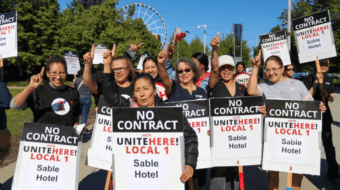
Though Sanders did not say so, the list of the 50 largest employers in the states with the most-complete records of company payrolls and of workers’ forced use of SNAP and Medicaid is also rife with firms that break labor law, not just in wages, but in worker rights.
Just as one example, Walmart has steadfastly and successfully derailed not just union organizing but even class-action suits by U.S. women workers who suffered pay and promotion discrimination at its 5,215 U.S. stores, including Sam’s Club outlets.
But in Canada, which has stronger labor laws and stronger penalties for lawbreaking, 800 workers at a Walmart warehouse in Mississauga recently reached and ratified the first-ever union contract at a Walmart in North America. They won significant raises and job security protections.
One down, a lot to go. There are 395 other Walmarts in Canada alone.
And in the U.S., four years after the then-independent Amazon Labor Union overwhelmingly won a recognition election at the retail monster’s JFK8 warehouse on Staten Island, N.Y., the workers have yet to get a signed contract. Amazon has dragged the case through the National Labor Relations
Board and the federal courts. The ALU is now a semi-independent Teamsters sector.
Until Amazon rose to power and prominence, Walmart held the record for the cumulative number of cases before the National Labor Relations Board that resulted in convictions for unfair labor practices, the formal name for labor law-breaking, according to the Cornell University School of Industrial and Labor Relations.
And Amazon’s job safety and health record reveals a rate of worker injuries on the job that is double that of other U.S. warehouse firms. Its record is so bad the labor-backed National Council for Occupational Safety and Health permanently retired Amazon from its annual “Dirty Dozen” list of violators. It put Amazon in its own violation category, after it made the Dirty Dozen list year after year.
The 11 states the GAO report covers together have a fifth of the U.S. population. This report calculated “13.8 million working Americans were forced to enroll in Medicaid and 10.6 million depended on SNAP to make ends meet and feed their families, despite working full-time — up from 12 million and 9 million, respectively, in the 2020 report.”
“It is time for the Walton family, worth $485 billion, and Mr. Bezos, worth $257 billion, to get off of welfare and pay their workers a living wage with good benefits. No one who works for a company making billions in profits should be living in poverty,” Sen. Sanders continued his analysis.
“This is especially true after these corporations and their multibillionaire owners received a massive tax break from President Trump’s so-called Big, Beautiful Bill, paid for by the largest cuts to Medicaid and nutrition assistance in history.” Specific data included:
- Walmart’s annual profits increased 50% from 2020 through the end of 2024, to $21.89 billion. It didn’t share the wealth with its workers: 16,055 workers in the 11 states had to rely on Medicaid in the states GAO sampled. That’s 55% more than in the prior report. And 15,515 workers in those states needed SNAP (food stamps) to survive.
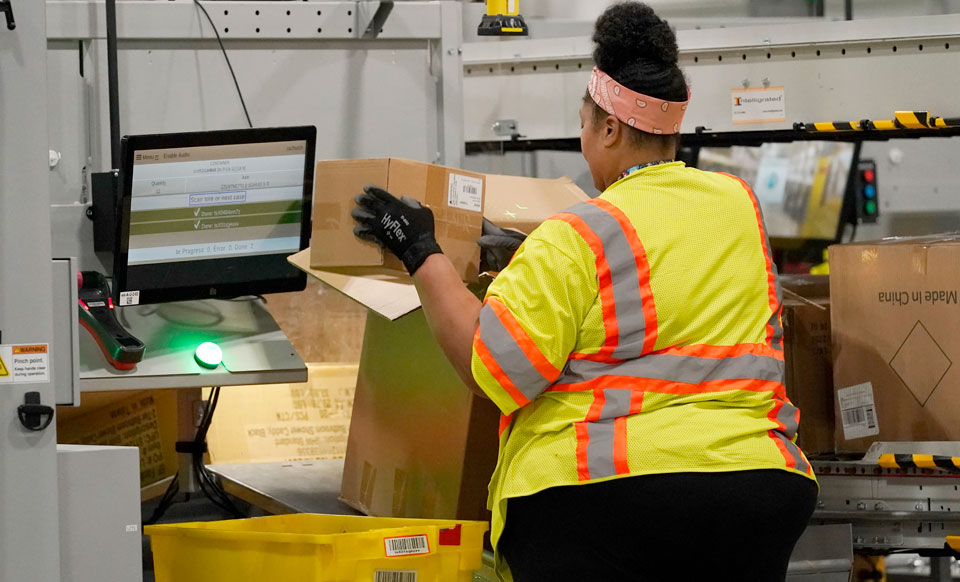
- Amazon’s annual profits rose 670% in that same era, to $77.67 billion. It was second to Walmart in the number of workers, 12,346 who needed food stamps and the number, 11,338, who needed Medicaid. The overall number of Amazon workers who needed one or both of those forms of federal aid tripled.
- Rideshare firms classify their drivers as “independent contractors,” which means they can’t unionize and also aren’t covered by the minimum wage and overtime pay law. In 2024, that group overtook both Amazon and Walmart in workers needing food stamps: 22,709. Their numbers were negligible five years ago. So was their share of the economy.
- Fast food firms also made the list of top employers of workers who needed food stamps and Medicaid to survive. One big problem those workers have, and the GOP Donald Trump regime and the Republican-run Congress intend to make it worse, is the workers are bounced from pillar to post in trying to exercise their rights.
Such “joint employers” as McDonald’s headquarters in Oak Brook, Ill., and the local McDonald’s franchise holders can each blame the other for low pay and bad working conditions. McDonald’s was fourth in workers in the 11 states needing food stamps (6,709), while Burger King was ninth (2,186) and Taco Bell was 14th (1,569).
- The number of FedEx workers who needed Medicaid more than tripled in five years, from 1,046 pre-pandemic to 3,814, GAO calculated. That put FedEx—which, except for its pilots, are non-union—sixth on the list of top firms whose workers need, and get, Medicaid. It was also sixth, with 4,944 workers, on the numbers of food stamp recipients. That number doubled in five years. And then there is UPS, which is always looking to increase profits by cutting jobs but is not on the list of poverty-wage firms.
While low-wage firms whose workers need Medicaid and food stamps to survive have been concentrated in the same five industries—retail trade, food and beverages, and warehouses among them—since 1995, there were exceptions.
“Manufacturing had a higher total number of workers enrolled in Medicaid, but construction had a higher percentage of workers enrolled in Medicaid,” GAO reported. But neither individual factories nor construction firms made the list. The seasonal variation in construction work may account for its higher percentage.
And the Commonwealth of Massachusetts—the state government—was first on that state’s Medicaid list, as GAO calculated 2,574 of its workers needed Medicaid to get by.
Others included the University of Indiana and the Georgia Department of Human Resources. The Georgian agency had 722 workers receiving Medicaid, placing it 17th in that state, GAO calculated. The top four firms atop its Medicaid list were Walmart, Amazon, Dollar General and Waffle House.
The University of Indiana was fourth on that state’s Medicaid list, with 2.015 recipients, GAO calculated. Amazon led that list, too. The rideshare and delivery app firms as a group were second in Indiana, and Walmart was third.
We hope you appreciated this article. At People’s World, we believe news and information should be free and accessible to all, but we need your help. Our journalism is free of corporate influence and paywalls because we are totally reader-supported. Only you, our readers and supporters, make this possible. If you enjoy reading People’s World and the stories we bring you, please support our work by donating or becoming a monthly sustainer today. Thank you!
CONTRIBUTOR