Ever since last Friday, the news has been dominated by around-the-clock coverage of, first, the Alaska summit between Presidents Donald Trump and Vladimir Putin, and, then, of the White House meeting of Trump, European Union leaders, and President Volodymyr Zelensky of Ukraine.
Despite the endless reporting, however, the story presented by the U.S. corporate media has actually been bereft of any discussion of several of the most critically important issues connected with these developments.
Initially, the liberal press harped about how Putin had pulled off a coup of sorts by having been granted an audience with Trump on U.S. soil. How happy the Russian leader must have been, the likes of MSNBC and New York Times said, that he, a “criminal,” was being welcomed with open arms by the U.S. president, another criminal, in Alaska. Then, they pounced on such trivial things as Trump letting Putin ride around in the presidential limousine.
Meanwhile, the far-right media—Fox, One America News, and the other propaganda outlets of the ruling regime—bestowed titles like “peacemaker” and “visionary” upon their dear leader. The conservative press praised Trump’s supposedly “unmatched skills” as a dealmaker and his pursuit of “strength through force” with such gimmicks as flying a B2 stealth bomber over Putin’s head as he arrived on the tarmac.

Few, if any, in the media—liberal or conservative—dared voice one fundamental fact: A meeting between the leaders of the United States and Russia was not only necessary but should have happened long ago.
Regardless of one’s position on all the causes of the current war in Ukraine or the various issues connected to it, there has really never been any doubt that the conflict is a proxy war between the U.S. and Russia. It is a war that U.S. imperialism has, without any serious interruption, been pursuing and encouraging for the past three-and-a-half years by almost any and all means available to it.
Under international law and the principles of national sovereignty, Russia’s invasion of Ukraine in February 2022 was illegal, but before that moment and since, this has not just been a Russia-Ukraine war. It is, above all, a U.S.-Russia war. Ending it absolutely requires talks between Russia and the United States. There is no other way to stop the killing.
The necessity of U.S.-Russian talks goes beyond the matter of Ukraine, however. Another major reason that the two powers must be in regular communication is the fact that there will soon be no major nuclear arms treaties between the planet’s two most heavily armed nuclear powers.
The New Strategic Arms Reduction Treaty (New START), the last bilateral nuclear weapons agreement between the two countries, expires in less than six months—on Feb. 5, 2026. The treaty limits the number of long-range nuclear missiles the signatories can build and aim at each other, but the atmosphere of confrontation that’s prevailed for the past several years is totally unconducive for its renewal.
Putin has occasionally made reference to Russia’s nuclear capacity, which should serve as a reminder to everyone that nuclear disarmament needs to happen sooner rather than later. For his part, Trump has never mentioned curbing nuclear weaponry and has instead said that the best course is to build up and modernize the U.S. arsenal.
The world demands that these stockpiles of planet-killing weapons be reduced and eventually dismantled entirely. The dangers of nuclear war are apparently beyond the grasp of the corporate media, though, when they say the U.S. is “falling into a trap” by talking to the Russians.
Many other critical issues, too, evade solution without U.S.-Russia negotiations. Whether it is tackling climate change, exploring space, or finding diplomatic means to end other wars around the world, talks between Russia and the United States are a necessity. While Trump is not by any means the ideal person to be heading such negotiations, a pullback from confrontation is a welcome development nonetheless.
Rather than blowing up pipelines that were delivering energy from Russia to Europe, for instance, the United States could have encouraged trade between Russia and the EU, thereby contributing to world peace and economic relationships that benefited all sides. Instead, U.S. policy succumbed to the armament makers and the fossil fuel companies that profited from EU and U.S. hostility toward Russia.
The European leaders who came to the White House on Monday are not the same crowd as those who led the EU when their countries were peacefully trading with Russia before the U.S. ended that cooperation. Elections have led to considerable turnover since then.
The EU countries, as part of NATO, are now expanding their militaries and directing all their firepower at allegedly protecting themselves against the threat of “Russian expansion.” The need to bolster the military side of their economies to shield their consumer goods sectors from Trump’s trade war cannot be ignored as a factor in this build-up as well, even if few are saying so openly.
The Russian Federation, of course, has never attacked an EU country. In fact, it is Russia that has watched as NATO, in violation of U.S. promises to the Soviet leadership at the end of the Cold War, expanded further and further east and even into the former USSR’s Baltic republics.
In 2015, in Minsk, the Russians and Ukrainians—with the participation of the Organization for Security and Cooperation in Europe (OSCE), France, and Germany—agreed that Ukraine would forego NATO membership and there would be autonomy for the Russian-speaking eastern regions of Ukraine. A ceasefire would have ended the fighting there, and Russia pledged to respect Ukrainian independence and territorial integrity while recognizing European nations’ extension of security guarantees to Ukraine.
Years later, in the early days of the current war in 2022, Britain (on U.S. instructions) told Ukraine’s new leader, Zelensky, not to agree to any ceasefire with Russia that honored the terms of the Minsk Accord. Instead, he was told that the Western powers, led by the U.S., would fund the war against Russia on his territory indefinitely. Ukrainian oligarchs who stood to benefit from that arrangement joined in to support the U.S. and British position and have enjoyed the profits of doing so ever since.
There is even more history, further back, which we could draw upon to show how poorly the mainstream media in the U.S. has illuminated the realities that led to and sustained this deadly war. We’ve long heard, for instance, about how the war is a case of Ukrainian “democracy” fighting for its survival against the Russian “dictatorship.” The government in Moscow may have few democratic credentials to show, but the government in Kiev, too, dispensed with democracy long ago.
Installed by a U.S.-backed coup in 2014 in order to stop a Ukraine-Russia trade deal, the current Ukrainian state has suppressed the language rights of its Russian minority in the east, closed down all press outlets that don’t carry the government’s stamp of approval, silenced pro-peace and anti-war voices, and seized the assets of opposition political parties, starting with the Communist Party of Ukraine.
Right-wing fascist militias were given free rein to wage war against national minorities—a situation which helped prompt separatist sentiments in the east and led to prolonged fighting which took more than 14,000 lives even before Russian tanks crossed the border in February 2022. There is no doubt that the subsequent Russian invasion was illegal and brutal, but to describe Ukraine as a democracy does not comport with the facts.
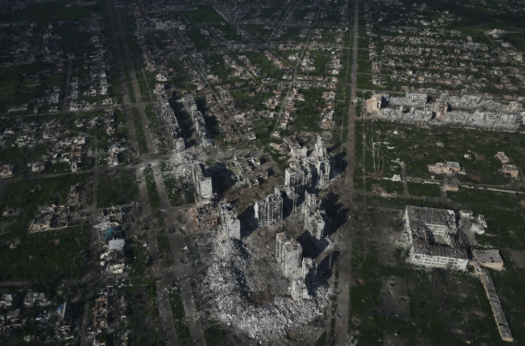
And while backing for the war has always been strong among U.S. journalists and media commentators, only 24% of Ukrainians currently support continuing the war; 69% want a negotiated end as soon as possible. If a democratic referendum were held in Ukraine, the war would likely be over. This war—like all wars—will end thanks to negotiations.
Talks between major powers, regardless of their differences—even differences of social system—have often yielded results that were of benefit to everyone. What would have happened if FDR, when he was president of the U.S., said, “No, I don’t like that communist Stalin, so we won’t work with the Soviet Union to fight fascism” and end World War II?
As we know, no sooner had World War II concluded than U.S. imperialism launched the Cold War against its former Soviet ally. And now, too, if Trump and Putin somehow find a path to conclude hostilities in Ukraine and U.S.-Russia relations are normalized again to some degree, then U.S. imperialism will immediately take advantage of the situation to turn its fire toward China for a new Cold War with that growing socialist power.
Regardless of that likelihood, the people of the U.S. should support negotiations between our government and Russia. The more than $1 trillion U.S. military budget to fight wars in Ukraine and elsewhere harms the working-class majority of our own country, too, as fossil fuel, which sees its health care and so much else eroded as a result.
For everyone’s sake—in Ukraine, Russia, Europe, China, here in the U.S., and everywhere else—negotiations and the normalization of U.S.-Russia relations should continue.
As with all op-eds published by People’s World, the views presented here are those of the authors.
We hope you appreciated this article. At People’s World, we believe news and information should be free and accessible to all, but we need your help. Our journalism is free of corporate influence and paywalls because we are totally reader-supported. Only you, our readers and supporters, make this possible. If you enjoy reading People’s World and the stories we bring you, please support our work by donating or becoming a monthly sustainer today. Thank you!
CONTRIBUTOR