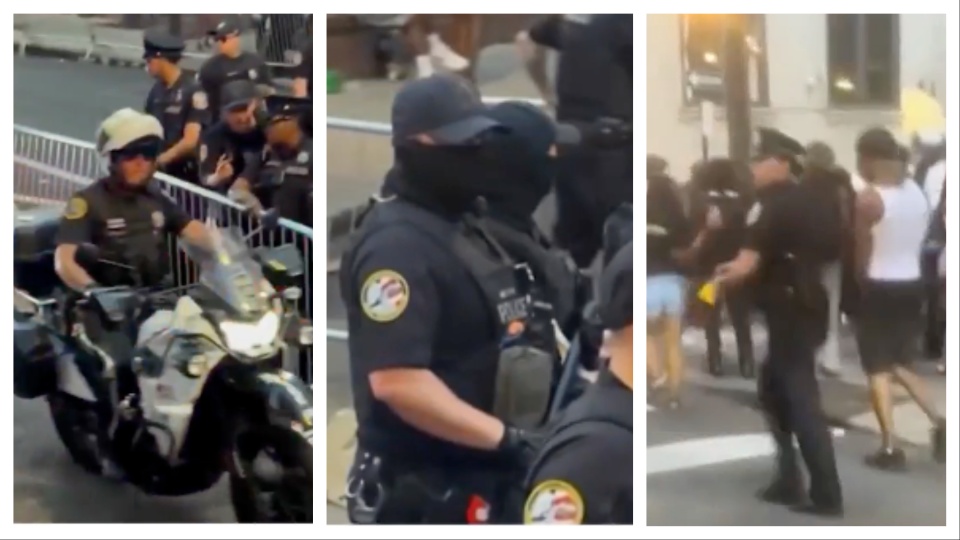
PHILADELPHIA—“When young people wear masks, we demonize them,” City Council Democratic Majority Whip Isaiah Thomas said. “Unfortunately,” when it comes to law enforcement, “we find these justifications.”
Thomas was speaking at an Aug. 5 hearing of Philadelphia’s Committee on Legislative Oversight focused on the issue of over-policing at Pride. Officers are under scrutiny for the aggressive “crowd control” tactics they used against celebrants in the city’s Gayborhood on June 7.
Several officers, some of whom were on motorcycles and horseback, took over the streets early in the evening that day following official celebrations and violently forced people to leave the area. After outcry from the community, the City Council launched a probe.
Philadelphia Police Commissioner Kevin Bethel dodged questions at the hearing which were aimed at getting him to provide additional details beyond the fact that “eight or nine” police officers were under investigation by internal affairs for wearing facial coverings—a violation of department policy—while on duty at Pride.
He claimed that police actions that day were in response to “about a thousand minors” growing restless in the Gayborhood because there was “nothing for them to do.”
Thomas questioned Bethel about whether a single police officer had reported another for any form of misconduct on June 7 during the celebrations, noting that Bethel himself had claimed many officers come from “the community.”
Thomas continued to push on the issue, drawing a comparison to teachers as mandated reporters. When Bethel would not budge, deferring to the internal investigation process and the rights of officers represented by the Federal Order of the Police (FOP), Thomas clarified his question:
“I think what we’re trying to figure out is the culture of the police department. Do we have a police department where…the culture is ‘If I see somebody doing something wrong, I say something’? Or do we have a culture…where ‘I’m more loyal to the brotherhood than the people we serve.’”
Earlier in the hearing, Kendra Brooks, Working Families Party Minority Leader on the council, drew attention to officers wearing masks being not only a violation of police uniform codes but also of the city’s “ICE OUT” legislation. The policy was introduced by Brooks, alongside Democratic Councilmember At-Large Rue Landau.
“As a part of my ICE OUT package, I had direct conversations with the police department about masking policies, and I was told that their dress code policy has specific language banning masks, and this was not an issue,” Brooks said. “The police department and the administration must now produce that dress code policy because it is clear words and promises are not enough.”
Landau, who called for and chaired most of the hearing, is the first out LGBTQ person to serve on council and thus the Pride incidents were a priority for her constituents.
Pride at the Parkway
For many years, Philadelphia Pride has been hosted in the Gayborhood, but for 2026, the city’s official parade and festival were moved to the Benjamin Franklin Parkway. Bethel, who was formerly the department’s liaison to the LGBTQ community, used this point to defend the over-policing that took place.
The change in venue was criticized by many when it was announced, and it was known that many celebrants intended to continue the traditional festivities in the Gayborhood. As reported in the Inquirer in early May: “Social media posts announcing the changes were flooded with comments from people denouncing them. ‘I’ll be in the Gayborhood regardless,’ wrote one user.”
Bethel instead presented a narrative where youth were oblivious to the move, stating: “There’s a large group of young people who descended into the neighborhood for what they think is something there.” But, “there is nothing for them there, other than to take over the street.”
While showing a map of the 2025 Pride festivities in the Gayborhood, Bethel stated, “There are things for people to do. This is a planned and organized event.” In comparison, while he admitted that he predicted people would come back to the Gayborhood after the festival on the Parkway, he stated, “We know there are people coming back there, but coming back to what?”
Landau took issue with this framing. She pointed out Bethel’s double standard when it comes to the gatherings that often take place after other local events and festivals, like the Greek Picnic or Mummers. “You did not say that ‘there is nothing there’” for attendees at those events. “To us, there is never ‘nothing there’ in the Gayborhood for us.”
What people came back to was over 150 police officers kettling crowds of LGBTQ people intimidating them with tasers. Police were reportedly heard saying, “Party’s over.” While bars in the Gayborhood had DJs and events planned until late, the crowds were forced out around 7:00 pm.
Bethel defended the officers, stating, “No one in my department gave any order that you’re going to go down into the Gayborhood and attack the LGBTQ community. That is not who we are as an organization. We went down there with the purpose of making it safe. It wasn’t until 7:30—we went quite a long time.”
Youth gathering
Bethel’s explanation of what happened that day begins earlier in the afternoon with two videos of teenagers fighting and another of young people inside a parking garage. However, what exactly occurred is difficult to determine, given that the videos were blurred.
After the clips were presented, Thomas probed Bethel. “Downtown all the time, [I] see groups of young people gathered like this…and not just in Philly,” he said. “What does that clip have to do with today’s conversation?”
According to Bethel, there was not a plan for police to be in the Gayborhood until 3 p.m. Therefore, with the activity earlier in the day, the Mass Incident Response Team (MIRT) was called upon. Bethel explains that MIRT are “the ones in the all-black.” Describing MIRT and the reasons they may wear a mask, he stated:
“Ladies and gentlemen, they are never oftentimes seen. I had about 400 of them work the FIFA. They come out when there is a potential biological agent that has been dispersed. There may be an explosive event.”
Young LGBTQ people gathering in high numbers in the Gayborhood during Pride was, apparently, a comparable threat.
Throughout the hearing, the lack of third spaces beyond home and school/work for Philadelphia youth was a theme. Landau turned Bethel’s accusation that there was nothing for youth back onto the commission, asking, “Whose fault is it that you’re saying the kids have nothing to do when I’m also saying even getting together as a community is something to do?”
Landau listed areas in Philadelphia where youth are prohibited from, such as Liberty Place or the Fashion District after 2:00. “We have shut down all their places!” she exclaimed.
Landau has championed raising money for the Attic Youth Center, including asking the city for additional funding. Landau implied that, had this funding been approved, in the same area where LGBTQ youth gathered only to face heavy policing, the Attic could have been opened and providing a space for youth. “They will have their home at 12th and Chestnut,” Landau commended.
De-escalation
When questioned further as to the reasons police acted the way they did on Pride, Bethel continued to deflect, saying, “It is not my job to police that event; it is to keep it safe.” To Bethel, this meant traffic control and making sure people in the streets were not run over by vehicles. However, in order to disperse LGBTQ individuals gathering in the Gayborhood, Bethel described the same tactics that were being criticized by the public as “de-escalation.”
The tactics seen on the videos shared with City Council—of kettling, tasers, and horses—were defended by Bethel as approved tactics. He stated that horses “have been used in crowd control for over 200 years” and “did exactly what they were supposed to do.” He said, “When people see a horse, they run. It de-escalates the situation.”
In response to concern about officers using their tasers to disperse crowds, he clarified that “No one was tased. However, what we did have, which was part of our policy, was the officer is able to arc, to create that electric sound as a deterrent and a de-escalation to move crowds.”
Since Pride, the department has removed arcing as an appropriate method of crowd dispersal.
In response to the criticisms of kettling—or barricading individuals so they cannot move, which seems counter to the goal of dispersing individuals from the Gayborhood—Bethel stated: “We will accept that the barricades created this thing, this kettling that people talk about, and after our review, we realize that we should’ve made a different decision.”
However, he then returned to claiming there was nothing going on in the Gayborhood and that, therefore, the crowds should not have been there.
Community response
When LGBTQ community members were called up at the hearing, they responded to the problematic narratives put forward by Bethel. They did not allow the violence that occurred on Pride to be blamed on youth gathering or on a changed location; they instead pinpointed police tactics that did not de-esclate but rather traumatized and instigated.
Michael Robinson, a community member, stated, “Only adult bullies scapegoat children, and that was a weak display of leadership.” Naiymah Sanchez called for the Citizens Police Oversight Commission (CPOC) to have subpoena power.
Last summer, the FOP negotiated with the city for the first time since the most recent iteration of police oversight in Philadelphia, CPOC, was approved via ballot measure in 2020. Despite city council members and the mayor calling for CPOC to have independent investigative power, the police contract continues to prohibit external investigation.
Jacen Bowman, president of Philly Black Pride, called for an independent after-action review, a permanent LGBTQ public safety and advisory council, and more consistent cultural competency training for officers.
Bowman said the incident on Pride raises the issue of police accountability in Philadelphia and the limits of CPOC, stating, “The question is whether or not the structure has the authority, independence, or enforcement power necessary to produce accountability. Oversight without authority is observation.”
We hope you appreciated this article. At People’s World, we believe news and information should be free and accessible to all, but we need your help. Our journalism is free of corporate influence and paywalls because we are totally reader-supported. Only you, our readers and supporters, make this possible. If you enjoy reading People’s World and the stories we bring you, please support our work by donating or becoming a monthly sustainer today. Thank you!
CONTRIBUTOR