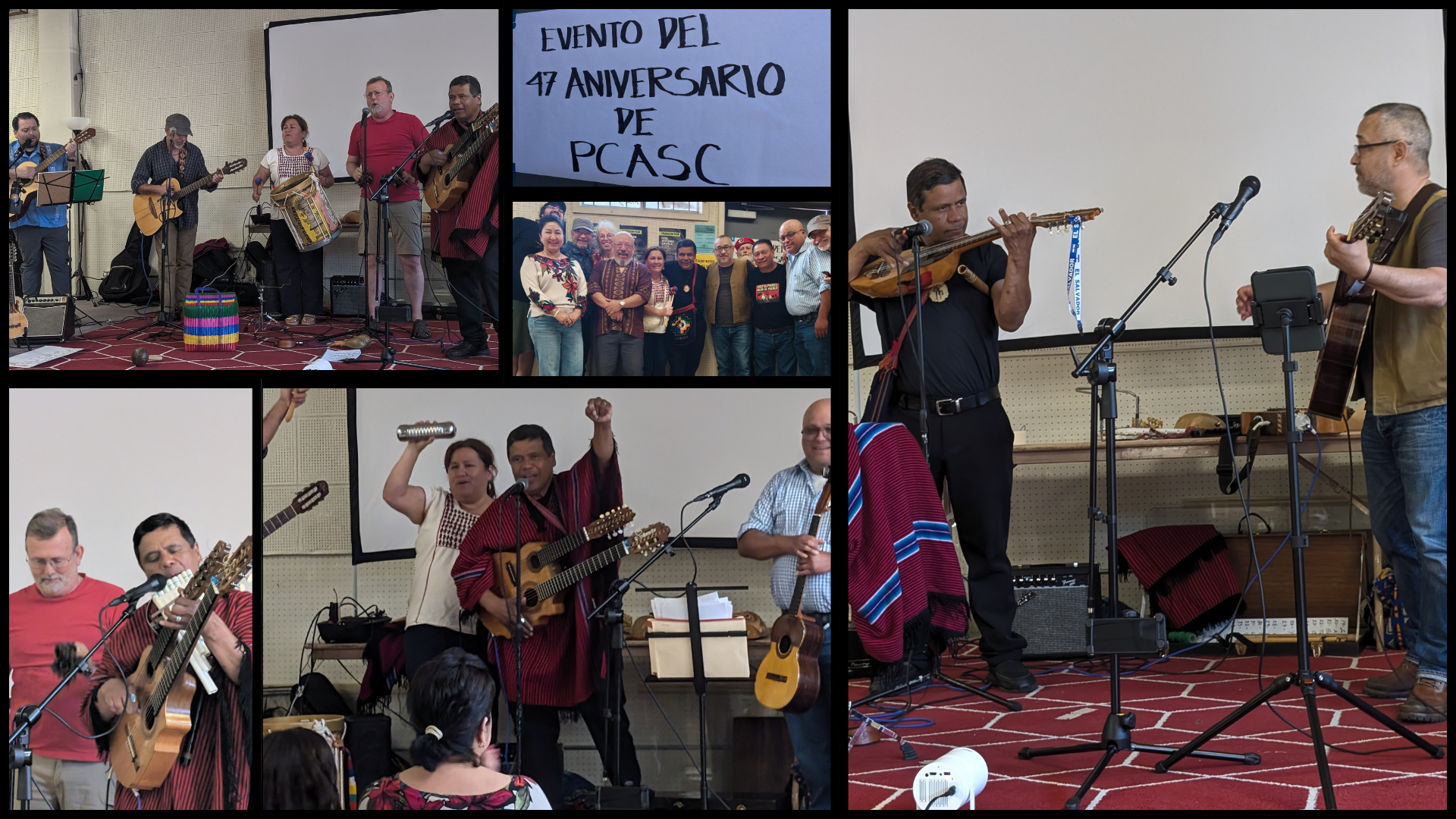
PORTLAND, Ore.—The Portland Central America Solidarity Committee (PCASC) celebrated its 47th anniversary on July 19, 2026. Over 50 PCASC members and supports joined the celebration, some long-time members and some brand new, coming to their first PCASC event.
PCASC’s mission is to educate and mobilize community members, workers, and students around struggles for human rights and social justice throughout the Americas. They primarily focus on education and organizing—creating a space for those with anti-capitalist, anti-imperialist, and anti-racist values to build community and foster conversations.
Several speakers throughout the evening highlighted the importance of their education work as the U.S. tries to interfere with various countries throughout the Americas.
 The United States has a long history of intervention in the affairs of the entire world, and Central America is no exception. Currently, MAGA forces and Donald Trump are threatening to take over the Panama Canal, and ICE has been sending detainees to El Salvador. Historically, the CIA armed and trained the Contras as a force against the Sandinistas in Nicaragua.
Additionally, although not in Central America, the U.S. is currently threatening Cuba and has been economically blockading the island for decades. Acts of aggression, such as bombing numerous vessels and the kidnapping of Nicolás Maduro from Venezuela, show this history of intervention remains an ongoing operation as the U.S. continues to be a destabilizing force in the region.
Numerous speakers shared their history with PCASC and how the organization has influenced their lives. Shizuko, the event’s MC, got involved while she was a student at Reed College. One student was organizing trips to Nicaragua, where she learned the history of revolution and social movement. She attributed her current work as an immigration attorney 100% due to PCASC. She wants to highlight the history of U.S. intervention in the area and explain why people actually come to the U.S.
The celebration was held in a local Musician’s Union Hall, and speakers shared how important music was to their struggle. The first musician to play was Samuel D. from Salem, Ore. In between songs, he spoke about the importance of PCASC and the struggle:
“Think about 47 years of struggle. All of the people that came together and believed that solidarity wasn’t limited to imaginary lines on maps. Music, which is what moves me, is a form of solidarity. It reminds us of what we love, what we’ve lost, and what we strive for.
“There are those that say fear, hate, and war are all inevitably. But I think I’m in a room of people that reject that. With every act of solidarity, we minimize war. Peace begins not when every war ends, but when we stop letting division take part in our hearts.”
Samuel continued playing light background music as another speaker read an excerpt from “The Death of Ben Linder.” Ben Linder was involved with PCASC working to build hydroelectric dams when he was killed by the Contras in 1987. The excerpt came after he viewed Yom Kippur and wrote in his journal.
“I’m working in El Cua. It is…the reality of the war. Zelaya province is falling under Contra control. They are killing children.
“I’ve asked myself what is my path. I’ve asked myself about my love for Alison and my family. I’ve asked myself about my love for my people. But we must act before we hear.
 “I must not cower from the task shear. In Nicaragua I was shown the trail shear. Tonight I vow to set forth upon that trail.
“That is not to forget my love for Alison, nor for my family. It is in our love that I find the strength to carry on. I must have the strength not to ever forget them. If I forget them, then how can I love my people? If I forget them. If I forget the love for my people, how can I love those which are so close? Great is the eternal power at the heart of life, mighty the love that is stronger than death.”
Another speaker shared various updates about PCASC:
- PCASC not only educated the community, but also elected officials. They recently had a representative from DC ask them for more information about El Salvador.
- They are part of the Deportation Defense Coalition, working more with the International Migrant’s Alliance, and Portland Immigrant Rights Coalition.
- More younger members are needed, and they are restarting monthly meetings in August.
- They have mobilization teams that patrol 2-3 times a week in East Portland – looking for more volunteers.
- They are truly grassroots organized and have a goal of raising $4,700 this month and 47 new sustainers for their 47th anniversary.
- They have a sister organization: Chicago Supports the People of El Salvador (CISPES). CISPES is highlighting political prisoners in El Salvador and there were posters up for attendees to see. CISPES is asking everyone to write to their congressional representatives around the country to shine a light on the situation.
A PCASC member that has been organizing workers in Columbia made a surprise appearance. They have been bottom lining a group of injured auto workers in Columbia, trying to get a settlement and raise awareness of their struggle.
Finally, Grupo Latitudes performed for around an hour to wrap up the event, playing numerous instruments. The energy was high, and organizers are excited to get to continue educating and organizing in the community as PCASC approaches its 50th anniversary.
We hope you appreciated this article. At People’s World, we believe news and information should be free and accessible to all, but we need your help. Our journalism is free of corporate influence and paywalls because we are totally reader-supported. Only you, our readers and supporters, make this possible. If you enjoy reading People’s World and the stories we bring you, please support our work by donating or becoming a monthly sustainer today. Thank you!
CONTRIBUTOR