DETROIT—Over 7,000 delegates turned out April 19 to vote in the Michigan Democratic Party (MDP) nominating convention, making it the largest—and broadest—in MDP history. A far cry from the convention two years prior, the energy was loud and boisterous as well-dressed campaign aides and college interns mixed with UAW rank-and-file, campus activists, educators, and everyday working people. This broad base was accentuated by neon hair colors, keffiyehs, jeggings, sparkly hats, and other fashion statements.
But despite festive appearances, people were not here for the marching band that current State-Senate Rep. (and U.S. Senate hopeful) Mallory McMorrow paraded through the halls. Rather, they were here to make their voices heard, pushing people-forward politics. This energy coalesced into a near-sweep for the People’s Coalition, which created a slate of candidates based on their commitments to “practical, widely supported issues,” like access to healthcare, strong labor protections, affordable housing, well-resourced public schools, defense of immigrants, and an end to U.S.-backed wars overseas.
“Show me what democracy looks like”
Gubernatorial candidate (and current Secretary of State) Jocelyn Benson kicked off the pre-voting campaign speeches with a call and response: “Show me what democracy looks like.” The response: “This is what democracy looks like!” The sentiment soon cooled, however, as Benson realized that democracy perhaps includes more than polite voting. Instead, delegates made their voices heard throughout the campaigning and nominating process, clapping, cheering, heckling, and booing as they deemed fit.
Candidates knew affordability would be a key issue in the coming election, and all attempted to sing to the tune of putting working people first. Similarly, broad appeals were made about the need for a candidate capable of standing up to MAGA and “saving our democracy.” Some even paired these sentiments with personal stories to demonstrate their commitment to the values of hard work and self-determination. These platitudes were met with polite applause, with the exception of Congresswoman Haley Stevens, who smiled unflinchingly through the deafening boos.
Abdul El-Sayed, who is running for Senate, was the only candidate who actually put names to the enemies facing working people. While other candidates failed to mention ICE by name, Sayed called to abolish the institution, which has not only brutalized families across Michigan but has also become the frontlines of fascist encroachment and militarization of the Midwest, including Detroit, Chicago, and Minneapolis. Sayed also repeated his signature chant: “Money out of politics, and back in your pockets,” calling attention to the fact that, unlike his opponents in the Senate race, he has never received corporate or PAC money. He also attacked billionaires, calling for them to pay their fair share, and strongly condemned U.S. military spending.
El-Sayed, a medical doctor, also repeatedly spoke on his commitment to Medicare-For-All, a bread-and-butter issue for popular progressive Senator Bernie Sanders. Even on potentially contentious stances—such as El-Sayed’s condemnation of Israeli lobbyist group AIPAC—he received thunderous applause. El-Sayed will next be seen in Detroit, as he joins Bernie Sanders on his “Fighting the Oligarchy” tour on May 3.
The race for regent
Arguably, the most contentious fight was for two seats on the University of Michigan’s Board of Regents. Incumbent Jordan Acker had drawn consistent heat for his ardent Zionist politics, as well as his complicity in the brutal repression of campus activists. In his time as regent, Acker supported increased campus police surveillance, took anti-union stances during bargaining with graduate workers, and helped to convert the Office of Student Conflict Resolution into the University’s personal prosecutor’s office, which works to silence students who speak out against Regent overreach. In the days before the convention, his campaign was also shaken by a leak of private messages that disparaged and sexualized multiple women, including one undergraduate student whose parent had filed a complaint against the University.
Running against Acker was Amir Makled, a human rights lawyer who represented several of the student protestors targeted by the University. Makled gathered significant support from UMich student groups, as his platform reflected causes that students have been championing for several years. Despite outreach by the graduate workers’ union (GEO) asking other labor organizations to support Makled, GEO stood alone in its endorsement. All other unions present at the convention endorsed either Acker or Paul Brown, the other incumbent in the race.
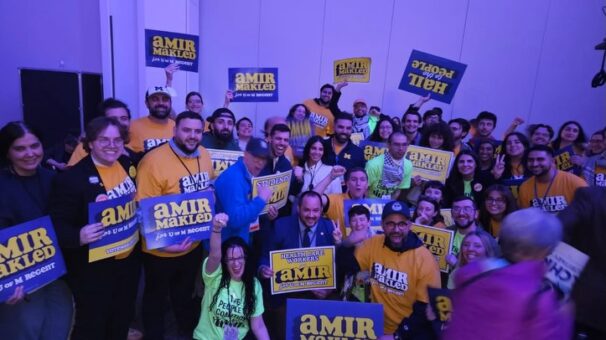
The People’s Coalition was Makled’s other key endorsement, an organization that has credited its coordinated grassroots campaign for turning out thousands of additional delegates to vote in their pro-people slate. The coalition arose from a failed campaign two years earlier to elect Huwaida Arraf. Their singular goal at the time was to replace Denise Ilitch. This time around, the coalition took a new tack, broadening its platform to include a range of pro-working-class issues, such as quality public education and affordable healthcare. To achieve victory, they endorsed a slate of candidates and gathered a broad base of support among multiple campaigns and interest groups, including the Democratic Party’s Progressive Caucus, which endorsed an identical slate. All but one of their endorsed candidates claimed victory that night.
The speaker who nominated Jordan Acker struggled to deliver his statement against a tidal wave of boos. In stark contrast, the UMich student body president’s nomination speech for Makled was greeted with raucous cheers. The results of the UMich regents’ race were the last to be announced, and victory was declared for Makled and Brown. At the end of Makled’s acceptance speech, his campaign organizers led chants of “Free Palestine” as they filed backstage.
The prosecution rests
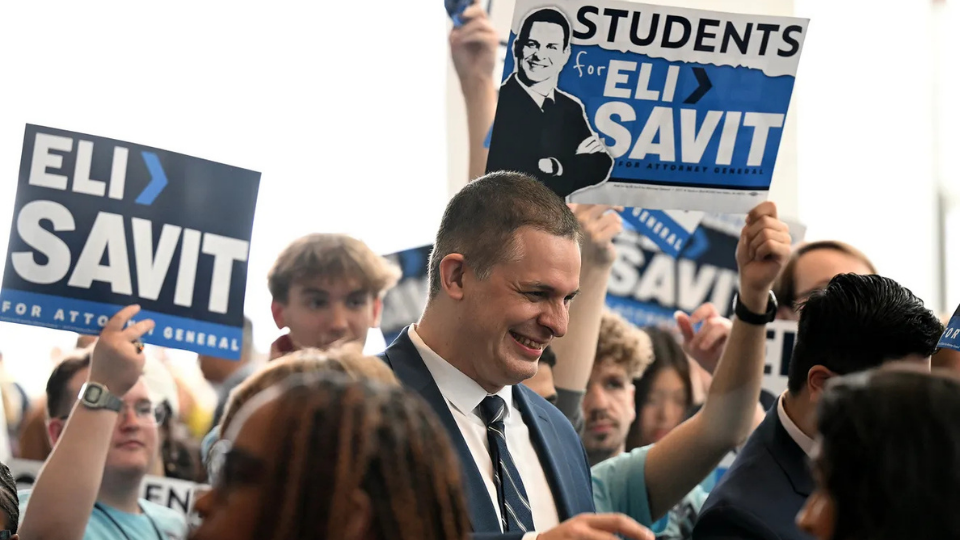
Another close race was the one that would decide which Democratic candidate would run to replace Dana Nessel as Attorney General. This seat was of particular interest to proponents of free speech and the rights of immigrants, as the Attorney General is often tasked with the prosecution of protestors and collaboration with immigration enforcement. The showdown was between Oakland County Prosecutor Karen McDonald and Washtenaw County Prosecutor Eli Savit. McDonald received significant corporate backing, including over $200,000 from the University of Michigan Regents. Yet it was Eli Savit who won the day.
In addition to endorsements from the People’s Coalition, the Progressive Caucus, and multiple college chapters of the Young Democrats, Savit was able to flex a moderately progressive, anti-establishment record. In his time as a county prosecutor, Savit led multiple lawsuits against major polluters, prioritized rehabilitation over incarceration for drug offenses, and recently drew national attention for a lawsuit from the Trump administration for lack of cooperation with ICE, and refused to prosecute peace protestors despite intense pressure from the University of Michigan administration. This is a dramatic departure from the attitude of current Attorney General Dana Nessel, who in 2025 personally ordered early morning FBI raids of the homes of several peace activists, later bringing felony charges against them for alleged acts of minor vandalism.
The path forward
In the aftermath of the convention, a burning question remains: How exactly did progressives secure such a decisive victory over an entrenched Democratic establishment? Many organizers point to the work of the People’s Coalition. In a statement, the People’s Coalition suggests that its success was the result of gathering a large coalition of voters from across the Party’s political spectrum. “This outcome reflects a coalition and a movement that brought together progressives, leftists, centrists, and many who don’t fit neatly into any label—united instead by shared priorities, a belief in a people-first agenda, and a commitment to pushing back against corporate and special interest group influence in our politics.”
The coalition focused not on candidates’ personalities but on a range of strong, people-centered stances on key issues, with a particular emphasis on affordability. “These wins show what’s possible when people focus on real issues instead of labels,” said Rima Mohammad, co-founder of The People’s Coalition. “We saw a beautiful, diverse coalition come together around simple but urgent priorities that affect daily life.”
Strong messaging was not the only tool in the coalition’s pocket. In addition to a decisive platform, the effort was backed by energetic, sustained organizing by over 70 volunteers. “These results came from real organizing and real trust,” said Arika Lycan, another of the coalition’s co-founders, “We built early, stayed consistent, and stayed focused on what people actually care about– and that’s what brought people out.”
Some argue that the results of the state convention should be a wake-up call for Democrats loyal to the corporate establishment. In the 2024 election cycle, people-centered policies like affordability seemed to take lower priority, with candidates instead favoring pro-corporate talking points. Notably, this resulted in Democrats failing to secure Michigan in the general election. As the midterms approach, there is a sentiment that Michigan Democrats need to promote people-first policies. Part of that strategy also means abandoning the long-held tradition of subverting socialist candidates. Recent polling and elections suggest that the American public is expanding its political philosophy and embracing left-populist messaging. Tapping into this expansion would mean Michigan Democrats not shrinking back in fear of their base’s sentiments.
We hope you appreciated this article. At People’s World, we believe news and information should be free and accessible to all, but we need your help. Our journalism is free of corporate influence and paywalls because we are totally reader-supported. Only you, our readers and supporters, make this possible. If you enjoy reading People’s World and the stories we bring you, please support our work by donating or becoming a monthly sustainer today. Thank you!
CONTRIBUTOR