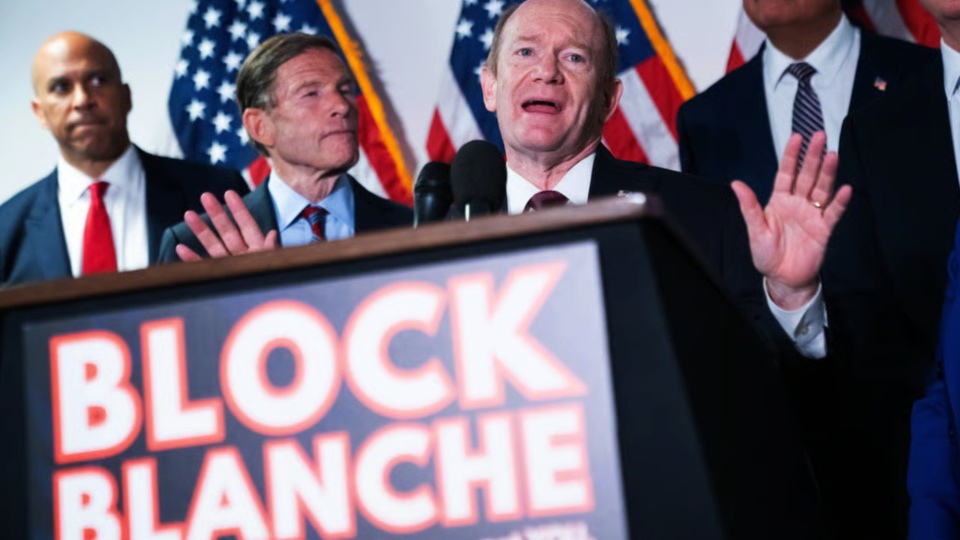
WASHINGTON— Democratic Senators on Wednesday bombarded Donald Trump’s former personal attorney and acting U.S. Attorney General Todd Blanche on controversies ranging from voting rights, to the massive scandal involving serial sexual offender Jeffrey Epstein, to Trump’s pardons last year of all 1,600 U.S. Capitol invaders of who participated in his 2021 coup attempt.
One of the major reasons Trump is pushing for confirmation of Blanche to the post of attorney general permanently, however, did not receive as much attention as it could or should have gotten, according to supporters of democracy and free elections. Blanche as attorney general could be in a position to ensure the execution of Trump plans to control the results of the 2026 midterm elections.

There are fears that a loyalist like Blanche could weaponize the Justice Department to carry out investigations into alleged voter fraud and adopt restrictive measures, such as removal of voters from the rolls, challenging mail-in ballots, or even prosecuting election officials for not following Trump policies.
Objections to Blanche didn’t move the Senate Judiciary Committee’s ruling Republicans on July 15, however, in the first of two days of hearings the nomination. Republicans control the committee, 12-11. But one Republican, Texan John Cornyn, whom Trump and far-right state Attorney General Ken Paxton defeated in the party primary months ago, wouldn’t commit to voting for Blanche.
Another piece of Trump’s attack on free midterm elections is expected to unfold Thursday night as the president delivers a prime-time speech about alleged problems with voting machines and “foreign interference.” Some see moves like the speech as an effort to create an atmosphere of national distrust in elections which Trump can use, according to Democratic commentators like James Carville, to seize voting machines or even declare martial law. He was restrained from doing that in 2020 by members of his own administration.
Perhaps one of the truest statements about Trump’s nomination of Blanche came from Sen. Thom Tillis, R-N.C. “As Attorney General, you have to work for the president and do what you’re told to do,” Tillis told Blanche.
By a tradition not set until 1975 after Watergate, the attorney general, and by extension the Justice Department, is supposed to be impartial and non-partisan, especially where a president is concerned. Trump has ended that, ordering persecutions of political “enemies.” Blanche said that the Justice Department is part of the administration and that therefore he had no problem following the president’s orders.
There have been partisan attorneys general in the ensuing 51 years, including Edwin Meese under Republican Ronald Reagan and John Ashcroft, who is scheduled to testify on July 16, under Republican George W. Bush. Ashcroft, however, resisted Bush White House pressure.
Blanche’s back and forth with the senators flies straight in the face of the impartial goal posted on the Justice Department’s website. The department’s credibility has dropped during Trump’s time in office, accompanying a mass exodus of career attorneys who treasure the Constitution.
But then, as panel Democrats repeatedly pointed out, Trump defies that goal—in everything from the pardons to a supposedly now-dead $1.776 billion “slush fund” to pay “victims” of prior “weaponization” of the department during the Democratic Biden administration.
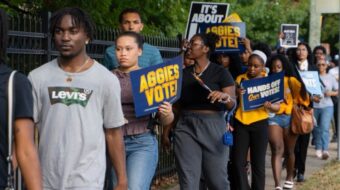
Another indicator of Trump’s intention to spoil the midterm elections was his elimination this month of the bi-partisan Election Assistance Commission. Moves like that hurt the ability of the federal government to assist states in carrying out fair elections.
Getting that body out of the way, for example, would, under Blanche as attorney general, allow implementation of massive, sweeping citizenship checks at the polls in line with Trump’s mass deportation agenda, although the number of non-citizens who’ve attempted to vote is essentially zero. Blanche refused to say during the hearings whether he would not send in officials to polling places to conduct citizenship checks.
As Blanche ducked, dodged, and refuted doubting Democrats, he also alerted the country that the special “anti-crime” task force from several DOJ agencies now in Memphis, Tenn., including the U.S. Marshals Service, the FBI, and the Drug Enforcement Administration, would expand nationwide.
That task force also includes ICE and Border Patrol agents and enjoys cooperation and support from Tennessee’s Republican government and law enforcement. Task force members have killed two African-American men since late May and four overall.
The NAACP in Memphis is demanding an independent investigation, and the issue will likely arise at the civil rights group’s national convention in Chicago next week.
“What we have done” in Memphis “should be a poster child for a lot of cities in this country,” Blanche told Sen. Marsha Blackburn, R-Tenn. But even as he spoke, ICE killed another person of color, in Fort Lauderdale, Fla., after shooting a 35-year Latino Houston resident and a young father in Maine just days earlier.
In a statement the Democrats doubted, Blanche said he doesn’t believe Trump has asked him to do anything illegal during his Justice Department tenure. If Trump did, Blanche said at one point, he’d say “no.”
Committee Democrats made it clear they will vote against Blanche, who earned $1.2 million in three years as Trump’s personal attorney before he became deputy attorney general and then acting attorney general after Trump fired Pam Bondi in April 2026.
“Our president has a well-documented history of attempting to unjustly influence public officials for his own personal benefit,” said Sen. Cory Booker, D-N.J. He reached all the way back to Trump pressuring Georgia’s Secretary of State, Brad Raffensperger, to “find” 11,780 more pro-Trump popular votes in 2020, to give Trump the state’s electoral votes—by a one-ballot margin.
“You see nothing wrong with the president treating the Department of Justice as his own personal law firm” and with “using it to suppress the votes of American citizens,” added Sen. Mazie Hirono, D-Hawaii.
“You also championed that slush fund” which the U.S. Capitol invaders could draw on, said both Hirono and Sen. Sheldon Whitehouse, D-R.I., a former prosecutor and state attorney general. But while Blanche kept repeating the trust fund is dead, he wouldn’t commit to signing an official statement saying so.
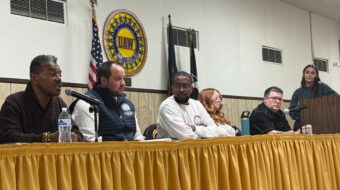
With a single one-sentence exception, workers and their issues did not come up during Blanche’s hearing. The exception was when Sen. Dick Durbin, D-Ill., said that among Blanche’s offenses was approval of the Justice Department’s long vendetta against Kilmar Abrego Garcia, the union sheet metal worker and father.
The Trump administration deported Abrego Garcia to a notorious hellhole prison in El Salvador, and his arrest and fate became a cause celebre for organized labor. It took a U.S. Supreme Court order—which Blanche and DOJ resisted—to free him. A federal judge has since cleared Abrego Garcia.
The party lineup on the panel and in the Senate appears to put Blanche’s nomination on a path to eventual confirmation. The panel’s partisan lineup is 12-11 Republican, with one GOP vacancy. The Senate has 53 Republicans out of its 100 members.
The Senate Democrats aren’t the sole foes Blanche faces. More than 1,200 former Justice Department officials have signed a letter saying he should not be attorney general. So did former Chicago Mayor Lori Lightfoot, whose city bore the brunt of ICE attacks, too.
Dani Bensky, an Epstein victim, planned to testify on July 16. So did Elizabeth Oyer, the former chief pardon attorney for the Justice Department, who resigned in protest when Trump demanded she OK pardons for his supporters.
And Norm Eisen, an attorney who co-founded the Democracy Defenders Fund, says Blanche’s performance on the slush fund issue alone proves he is ethically unfit to be attorney general.
“There has never been a nominee for U.S. attorney general as ethically compromised as Todd Blanche. Under his leadership, the DOJ has prioritized pursuing personal vendettas, abusing prosecutorial power for political retribution, and stonewalling the Epstein investigation.
“The attorney general’s highest obligation is to the Constitution and the American people, not to the personal or political interests of any president…. When forced to choose between the rule of law and Donald Trump, Todd Blanche chooses Trump.”
We hope you appreciated this article. At People’s World, we believe news and information should be free and accessible to all, but we need your help. Our journalism is free of corporate influence and paywalls because we are totally reader-supported. Only you, our readers and supporters, make this possible. If you enjoy reading People’s World and the stories we bring you, please support our work by donating or becoming a monthly sustainer today. Thank you!
CONTRIBUTOR