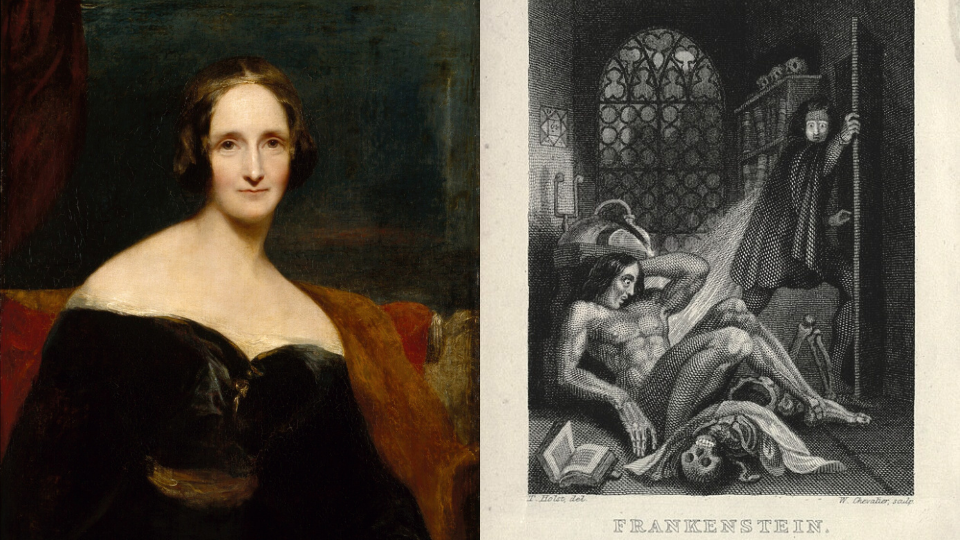
Yet another Frankenstein film has made its way to the screen. Despite critical acclaim and projected awards, it has little in common with Mary Shelley’s novel. Readers interested in Shelley’s political vision and the historical pressures that gave rise to the book are far better served by turning to the original text. To mark the 175th anniversary of Mary Godwin Shelley’s death, we revisit this novel.
Mary Shelley’s Frankenstein—written in 1816, when Mary was eighteen, and published two years later—emerged during a period of political conservatism in post-Napoleonic Britain. Fear that revolutionary ideas from France might cross the English Channel fostered an increasingly repressive social climate. The legacy of the French Revolution, followed by years of war and economic crisis, produced widespread unrest and prompted the British state and its allies to suppress ideas perceived as destabilising.
Radical politics, religious dissent, and new scientific theories about life and matter were regarded as threats to social order. Materialist models in particular, which explained life through body, sensation, and experience, as well as early evolutionary approaches, came under sustained conservative attack. Journals such as the Quarterly Review denounced materialism and anti-scriptural science as threats to the established Church and as deeply system-destabilising. Debates about the nature of life were treated as politically suspect, leading to renewed calls for censorship and prosecutions for blasphemy. Popular unrest was further fuelled by economic hardship, industrial change, and movements for political reform, and included the Luddite uprisings (1811–19).
Shelley’s novel must also be understood in the light of her family background and intellectual inheritance. As the daughter of William Godwin, the leading English radical philosopher of the 1790s, and Mary Wollstonecraft, a pioneering advocate of women’s rights, she grew up immersed in debates about reason, perfectibility, gender equality, and social reform. Mary Wollstonecraft, who died days after giving birth to Mary, was the author of A Vindication of the Rights of Woman (1792). Frankenstein reflects this legacy. The novel engages seriously with contemporary radical science, presents life as a product of material processes without divine intervention, and derives human development from sensation, environment, and experience. In doing so, it explicitly aligns itself with materialist modes of thought that were under fierce attack in Britain.
The Shelleys’ and Byron’s exile on the Continent underscores this pressure: Percy Bysshe Shelley’s outspoken atheism and radicalism made England an increasingly hostile territory for him. After leaving Britain in 1816, Mary and Percy Shelley never returned during his lifetime. From Switzerland and later Italy, they observed British repression; Shelley and Byron produced some of their most radical works, while Mary Shelley wrote Frankenstein.
Frankenstein was conceived in the summer of 1816 on the shores of Lake Geneva, within the exiled circle around Percy Bysshe Shelley, Lord Byron, Claire Clairmont, and Byron’s personal doctor, John William Polidori. Persistent bad weather—the “Year Without a Summer”—forced the group to spend long evenings indoors, filled with conversations about philosophy, natural science, and the nature of life. After collectively reading German Gothic fiction (especially the recent collection Fantasmagoriana [1812]), Byron proposed a literary competition: everyone should write a ghost story.
This prompt gave rise to two texts of lasting significance: Mary Shelley’s Frankenstein and Polidori’s tale The Vampyre (1819). Polidori’s text established the modern literary archetype of the aristocratic vampire, Lord Ruthven, portraying him as a metaphor for a dangerous, blood-drinking feudal lord and thereby directly paving the way for Bram Stoker’s Count Dracula (1897). Viewed in its historical context, this tale too is highly politically charged. While Byron and Percy Shelley’s own texts remained fragments, Mary Shelley transformed her vision into a philosophical novel that far exceeded the original “ghost story” and became a foundational reflection on science, power, responsibility, and social exclusion.
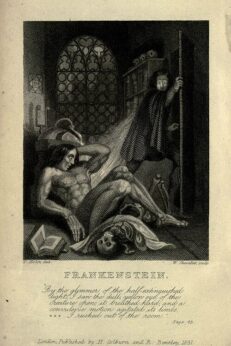
One of the most famous stories in world literature, Frankenstein tells the story of Victor Frankenstein, a young scientist driven by curiosity and the desire to transcend natural limits, who animates a Being from assembled body parts. Rejecting the Being at the moment of its animation, Victor abandons his creation and leaves it to its fate. The Being initially behaves kindly, acquires language, literature, and human conduct, and carefully prepares for its first encounter with people. Repeated rejection, cruelty, and Victor’s persistent neglect eventually drive it to seek revenge on its creator.
The novel’s settings, Geneva and Ingolstadt, function as fundamentally opposed political spaces. Geneva, Victor’s place of origin, embodies the dialectical legacy of the Enlightenment: it is both a stronghold of repressive Calvinism and the birthplace of Jean-Jacques Rousseau, whose philosophy radically challenged that order. The city thus represents a tense field of bourgeois duty, familial obligation, and the unrealized potential of radical social designs. Shelley counters this with Ingolstadt as a deliberately chosen site of rupture. In contemporary British perception, the city was inseparably associated with Adam Weishaupt’s Illuminati order, which conservative circles—stoked by pamphlets such as John Robison’s Proofs of a Conspiracy (1797)—regarded as the epitome of a Jacobin-atheist world conspiracy.
By having Victor Frankenstein establish his laboratory precisely here, at the epicenter of the feared “conspiracy of reason,” his seemingly private experiment becomes politically charged. His secrecy, solitary pursuit of creative omnipotence, and deliberate circumvention of established institutions mirror the conspiratorial practices attributed to the Illuminati. Shelley thus situates Victor’s ambition within a space of revolutionary transgression that links scientific creation with social re-creation. Victor’s failure lies not in his pursuit of knowledge, but in its irresponsible execution, his decisive abdication of duty.
In the original 1818 edition, Shelley finally performs a remarkable reversal: it is not Victor Frankenstein, but the Being he creates, who proves to be the reflective observer, consistent moralist, and analytical thinker. Victor’s failure lies not in his pursuit of knowledge, but in its irresponsible implementation. Shelley’s tone towards Victor is often ironic or quietly contemptuous; he appears intellectually reckless, emotionally immature, and incapable of sustained responsibility. Shelley dramatizes the collapse of Frankenstein’s godlike ambition: “But now that I had finished, the beauty of the dream vanished, and breathless horror and disgust filled my heart” (Chapter 4). What follows is a decisive abdication of responsibility.
By contrast, the Being functions as an attentive scientific observer. It carefully documents its development and systematically reflects on sensation, language, emotion, and social relations. Its gradual learning unfolds through sensory experience, observation, imitation, and engagement with literature (Plutarch, Goethe’s Werther, Milton’s Paradise Lost). This process mirrors contemporary physiological and pedagogical research, particularly theories that emphasize the shaping role of environment, nerves, and experience. Shelley thus links scientific attentiveness with ethical competence: in this respect, the Being succeeds where Victor fails. It follows processes through, observes consequences, and reflects on the moral implications of knowledge.
Crucially, Shelley presents the Being as fully human. It is a moral creature with a developing character. Naturally benevolent, it performs good deeds in secret, restrains its anger, and approaches its first attempt at human contact thoughtfully, hoping that reason and compassion will overcome prejudice. Its moral goodness endures repeated rejection and violence; only the systematic denial of recognition and care—primarily by Victor—ultimately transforms its desire for compassion into revenge. Its plea for a female companion is expressed as a claim to natural justice, sociability, and mutual affection, and Victor’s destruction of the half-finished female marks a decisive betrayal that completes the Being’s isolation.
Shelley reinforces this critique through the novel’s structure. After Elizabeth’s murder—Victor’s bride—the narrative reverses the roles of pursuer and pursued: Frankenstein becomes the obsessed hunter, mirroring the Being’s earlier quest for compassion. Victor thus suffers the fate he had imposed on the creature, should he create a companion—exile from the “civilized” world into the wilderness. It is no coincidence that their final chase takes place in the Arctic, a region of eternal ice associated in Shelley’s Europe with political stagnation and restorative conservatism. Walton conveys the perspective of this society. The Being is granted nearly the last words of the novel: in an extensive account of its perspective, it confesses its crimes, expresses remorse, and declares its intention to withdraw from the world, while Victor dies unrepentant, clinging to his self-justification.
The novel closes with the tragic insight that neglect, isolation, and the refusal of responsibility by individuals and society can destroy even the most promising moral beginnings. The monstrous, Shelley suggests, lies not in the creature’s origin, but in Frankenstein’s abdication of scientific, social, and ethical duty.
Read in this light, the novel’s subtitle, The Modern Prometheus, articulates on the level of myth the same political problem embedded in Victor’s education and ambition. Mary Shelley frames Frankenstein with Milton’s Paradise Lost, using as her epigraph Adam’s challenge to his maker: “Did I request thee, Maker, from my clay / To mould me man?” The question shifts judgment away from the creator’s authority towards his responsibility and towards the rights of the created. The Being’s grievance is therefore as political as it is moral: it is denied recognition, community, and justice; it embodies the radical claim that authority without responsibility generates violence. The epigraph thus positions Frankenstein as a critique of illegitimate power and aligns scientific creation with contemporary debates about tyranny, equality, and revolutionary reform.
Finally, the novel situates its concerns within the broader horizon of imperial and expansionist ambitions. Victor’s friend Clerval’s idealistic desire to improve living conditions in India (clearly representing the thinking of the British Empire), and Walton’s Arctic expedition in search of a Northwest Passage—still largely unexplored in 1816—evoke the glorification of expansion, mastery over nature, and empire. Victor embodies the dangers of this mindset: while seeking to penetrate the secrets of life itself, he lacks the ethical and social resources required to wield such power responsibly. By contrast, the Being cultivates discipline, reflection, and moral restraint, carefully navigating social encounters and ethical choices. Only sustained exclusion and rejection transform this moral potential into violence.
The Being’s response to societal abuse prefigures Heathcliff in Emily Brontë’s Wuthering Heights, some thirty years later. Heathcliff’s trajectory similarly exposes societal hypocrisy and confronts readers with their prejudices. In different registers, both women challenge the norms of British bourgeois society, issuing a powerful plea for radical rethinking.
We hope you appreciated this article. At People’s World, we believe news and information should be free and accessible to all, but we need your help. Our journalism is free of corporate influence and paywalls because we are totally reader-supported. Only you, our readers and supporters, make this possible. If you enjoy reading People’s World and the stories we bring you, please support our work by donating or becoming a monthly sustainer today. Thank you!
CONTRIBUTOR