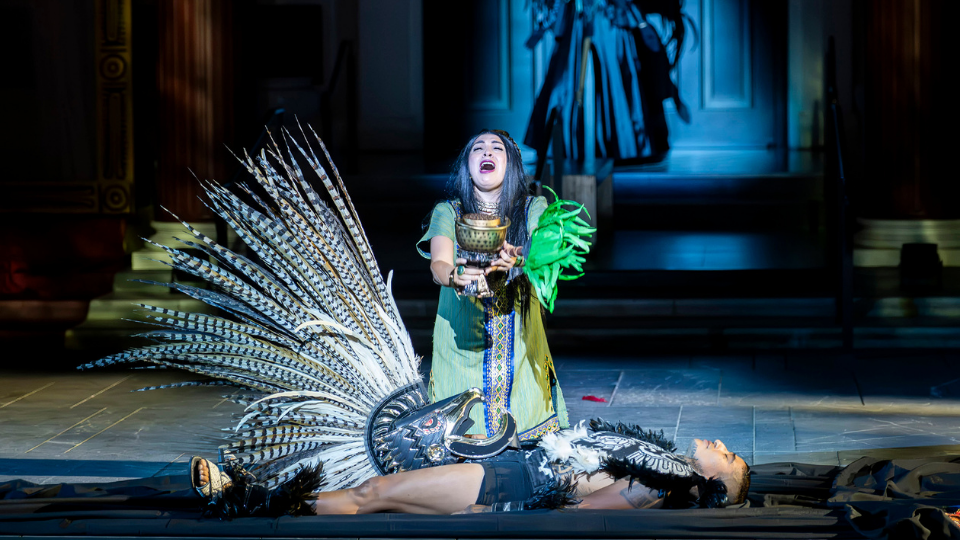
The Latino Theater Company and Getty Villa Museum’s stunning co-presentation of Antigone: In the Language of Kings is arguably the theatrical event of the year for Los Angeles’ theatergoers. In this very Angeleno Antigone, LTC’s associate artistic director and playwright Evelina Fernández has transplanted Sophocles’ 5th century B.C. Greek tragedy from Thebes to pre-Columbian Tenochtitlan, capital of the pre-contact Aztec Empire in Mexico. Relocating a story from one culture to a completely different milieu on the other side of the world can be an extremely tricky proposition. However, Fernández and helmer Jose Luis Valenzuela, LTC’s artistic director, and the Latino Theater Company’s cast of 20-ish thespians (including a “koro” or chorus) flawlessly executed the transition without a hitch.
In the play’s press release Fernández notes: “We want to share the beauty of ancient Aztec literature, culture and rituals that most modern audiences are not familiar with. These traditions carry a profound poetry and wisdom that still speak to the human experience across centuries.”
I don’t pretend to be an expert in either ancient Athens or Tenochtitlan, but resetting this gripping drama may also work so well because of the universality of Sophocles’ themes. Indeed, in 2024 the Autry Museum’s Native Voices presented an Indigenous adaptation, Antíkoni, by Nez Perce playwright Beth Piatote, set in contemporary times and dealing with the sensitive subject of repatriation.
In particular, Sophocles demands respect and reverential treatment for the dead. Following a civil war fought for the Theban throne, Tenochtitlan’s hubristic Grand Poobah Tlahtoani Klion (Cástulo Guerra as the monarchical character Sophocles called “Creon”) refuses to allow the slain Polynices (played by Pollo), whom he vilifies as an enemy of the state, to be buried with solemn funereal rites. Polynices’ unyielding sister Antíkona (Esperanza América as the eponymous Antigone, daughter of the ill-fated Oedipus) openly defies the ruler in order to pay homage to her brother, and is among the theater’s first feminists.
The antagonistic Antíkona’s act of defiance ignites a collision course between the establishment and the upstarts that is at the heart of this drama imaginatively rendered onstage with choreography (by Urbanie Lucero), live music (Christopher Garcia is the Mesoamerican instruments director; John Zawelski the sound designer; Maesa Pullman the choral director), projections (by Yee Eun Nam), eye-popping period apparel (Catarina Copelli is the cosmic costume designer), searing/ “seering” lighting designed by “Lee” Xinyuan Li, and more. The amphitheater’s mise-en-scène is stellar in what is truly a spectacular stage spectacle one simply must behold with your own orbs. This is a production staged on the outdoor boards that is truly worthy of the 20th anniversary of the Getty Villa’s Outdoor Theater. Kudos to scenic designer François-Pierre Couture.
Especially striking is the venerable Valenzuela’s visualization of death, epitomized by a female figure on stilts (Tiffany Bonita Litz) in a sweeping black robe that literally sweeps up the corpses (it really has to be seen in order to be believed, and is truly a grand directorial touch – I hope when I die Jose Luis will direct my funeral!). Veteran thesp Sal López (Stanley Kubrick’s 1987 Full Metal Jacket) portrays the spectral Aztec priest Tetzahuitl arrayed in splendid raiment. Given how tense the storyline is, Ric Salinas of Culture Clash provides some comic relief as Chachalacani (I suspect he does not have a Greek counterpart in Sophocles’ grim original).
Not only does this version of Antigone seamlessly span two continents, but also the centuries. I’d say that Fernández and Valenzuela—a creative force that has had an incalculable impact on the L.A. stage, giving voice to the voiceless—are champions of the people who are slyly using Sophocles’ almost 2,500-year-old tragedy to lampoon another mad monarch, Donald Trump. In the show’s press release Valenzuela asserts: “Antigone is a timeless story of resistance, conscience and the struggle for justice”—one we continue to undergo today.
The Latino Theater Company’s riveting one-act, 75-ish minute production (sans intermission) is rendered in English, Spanish and Nahuatl (the Aztecs’ language), with English and Spanish supertitles. As busy as Fernández, Valenzuela, the cast and crew were in presenting this super-imaginative Mesoamerican pageant, I suspect that the busiest member of the creative team was none other than Fermín Herrera, the Nahuatl consultant.
Not only was Sophocles’ masterpiece mounted under the stars at Getty Villa’s amphitheater, but stars turned out for the premiere, including actors Edward James Olmos and Mimi Kennedy. Along with the rest of the theatergoers, they witnessed a full spectrum stage that used not only dialogue and plot but dazzling visual and aural effects to bring the Greek tragedy across cultures and centuries in order to say something as topical as if Sophocles just wrote it on his laptop. As a critic, I’ve had the pleasure and privilege of watching The Latino Theater Company and the Getty Villa’s annual “Outdoor Classical Theater” productions for decades, and I’m happy to say that this anti-Trump Antigone is the best one yet. Don’t miss it. Bravo!
Antigone: In the Language of Kings takes place 8:00 p.m. on Thursdays, Fridays, and Saturdays through October 3 at the Getty Villa’s Outdoor Classical Theater, 17985 Pacific Coast Hwy., Pacific Palisades, CA 90272. Tickets: (310)440-7300 or https://www.getty.edu/calendar/oct-antigone/.
We hope you appreciated this article. At People’s World, we believe news and information should be free and accessible to all, but we need your help. Our journalism is free of corporate influence and paywalls because we are totally reader-supported. Only you, our readers and supporters, make this possible. If you enjoy reading People’s World and the stories we bring you, please support our work by donating or becoming a monthly sustainer today. Thank you!
CONTRIBUTOR