
NEW YORK—With Thanksgiving and the following Chanukah-Christmas-Kwanzaa season fast approaching—and with retailers anticipating their usual bonanza of frenzied customer buying—workers at Starbucks and Amazon are fighting back against holiday exploitation.
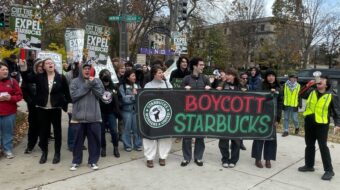
The Starbucks workers were first out of the box, as their “coffee truck tour” began its drive with stops at New York’s City Hall and the Empire State Building on Nov. 15. It followed a call last month by Starbucks workers to customers for a nationwide boycott.
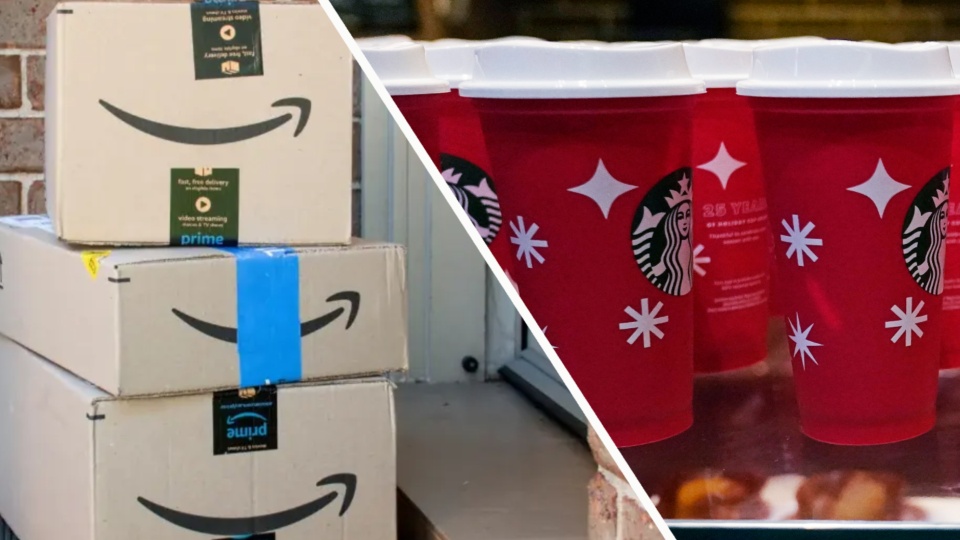
The coffee truck tour headed for Chicago, Atlanta, and Los Angeles. The next day, Nov. 17, was Starbucks’s annual “Red Cup Day” promotion, with special cups for all its customers. The coffee truck has its own, union-brewed special coffees, including the Solidarity Spice Latte, an original drink designed for the tour.

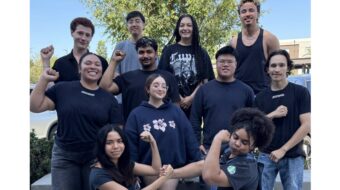
Starbucks is not special for the 12,000 baristas in more than 700 stores which have voted to go union against the Seattle-based coffee giant. The first Starbucks workers to unionize, in the Buffalo area, have yet to achieve a contract. Nor have any of the others.
That’s almost five years after the workers, aided by organizers from Starbucks Workers United—a Service Employees International Union sector—and legal advice from the American Federation of Teachers, voted to unionize.
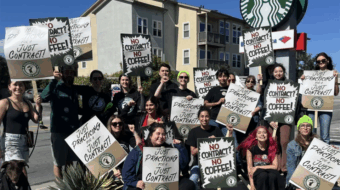
The Starbucks workers seek a $17/hour minimum wage, minimum staffing levels of three full-time workers per store, more-predictable shifts, better working conditions, and a disciplinary system where firing is only for proven just cause, not management whim.
The Manhattan rally at the start of the coffee truck tour drew support from Julie Su, the city’s first-ever Deputy Mayor for Economic Justice and the former acting Labor Secretary during Democratic President Joe Biden’s administration.
Union leaders and heads of progressive groups joined her. All pledged to have their members stop buying Starbucks coffees until the firm bargains in good faith and reaches a master contract with SWU and elected representatives from the local stores. Other Starbucks baristas, meanwhile, descended on 40 college Starbucks outlets nationwide demanding they leave campus.
Prime exploitation
Starbucks workers might be the first to take their cause to the public during prime shopping season, but they are being joined by the exploited employees at Amazon.
Their firm’s founder and majority owner, multibillionaire Jeff Bezos, stonewalled their organizing efforts and set records for unfair labor practices. Now, Amazon has extended its Black Friday sale, now running from Nov. 19 through Nov. 30. That’s going to mean higher and faster workloads for staff at warehouses and on delivery routes.
In response, not only are the Amazon workers fighting back, but so is a new consumer movement in their favor, Fight Amazon Fight Oligarchy.
“What began as a single day of heavy sales has been stretched to 12 days,” the Amazon workers said in an appeal for support on ActBlue. “Amazon workers will have to work at a brutal pace, in grueling conditions, for nearly two weeks, including full weekends,” to meet company quotas, their announcement says.

Both federal and state job safety and health officials have cited Amazon more often for violations than any other warehouse firm and shipper in the U.S. Federal data show Amazon employs one of every four warehouse and shipping workers in the U.S., but accounts for more than a third of all safety and health violations.
It also has yet to come to an agreement with the workers who unionized at its JFK8 warehouse on Staten Island, N.Y., after the COVID-19 pandemic. The firm’s refusal to give out information or protect its workforce from the spread of coronavirus led to the successful drive by the then-independent Amazon Labor Union, now the semi-independent ALU Local 1 of the Teamsters.
But when workers unionize, Amazon spends heavily on union-busters, including $26.6 million in 2025 alone. The union-busters can lie, threaten, and illegally interrogate and spy on workers, among other offenses. They can also, with a wink and a nod to Amazon managers, tell them of labor law and its mild penalties for violators.
Meanwhile, there was a Teamsters breakthrough at another Amazon warehouse, and this one the company can’t stop, because it’s in Detta, British Columbia. Canadian labor law, set province by province, is generally more pro-worker than U.S. labor law. At the Detta warehouse, it kicked in.
The Associated Press reported an impartial arbitrator imposed a wall-to-wall contract on Nov. 16 for the Canadian union Unifor, when the two sides could not reach agreement on their own. A prior arbitrator ruled in July 2025 that Amazon so flagrantly violated B.C. provincial labor law that a fair election was impossible, so Unifor automatically won. The warehouse has 700 workers.
No paywalls at People’s World
At People’s World, we believe news and information should be free and accessible to all, but we need your help. Our journalism is free of corporate influence and paywalls because we are totally reader-supported. Only you, our readers and supporters, make this possible. If you enjoy reading People’s World and the stories we bring you, please support our work by donating or becoming a monthly sustainer today. Thank you!
CONTRIBUTOR