Oscar-winning screenwriter Albert Maltz had been on the Hollywood blacklist for eleven years when, in early 1959, producer Otto Preminger called to offer him a contract for the screenplay of Exodus, a potential blockbuster based on the bestselling novel by Leon Uris.
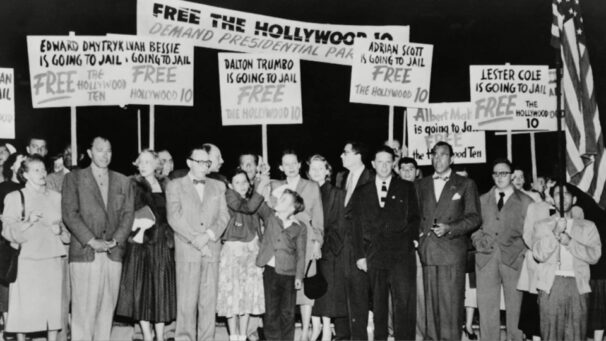
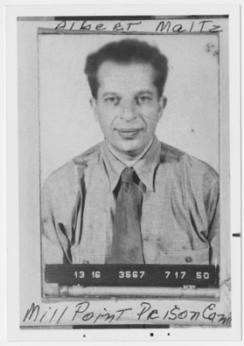
Maltz was ecstatic. As one of the notorious Hollywood Ten, a group of film industry figures who challenged the constitutional legitimacy of the House Un-American Activities Committee, he had been sentenced to a year in prison in 1950 and had been a pariah ever since, exiled in Mexico and largely forgotten.
That summer, Maltz made rapid progress on the Exodus screenplay. In mid-September, Preminger had a visit with Maltz to hear the plot, which Albert narrated from beginning to end while the fifty-four-year-old film mogul listened raptly and was tremendously moved, wiping tears from his eyes.
Freshly inspired, Maltz worked on. Then, while he was polishing the final scenes in December, Preminger called out of the blue with an absolute thunderbolt: “I’m sorry,” he said, “I’ve decided not to use your screenplay and to hire another writer. I’m hiring Dalton Trumbo.”
Holding on to the writing credit for Exodus would have been a crucial victory for Maltz. Instead, it was Trumbo who first “broke the blacklist.”
The publicity over Exodus gave Frank Sinatra an idea, reminding him that the man he once called “the best goddam writer around” was available. In January 1960, Maltz got a call from Martin Gang, Sinatra’s lawyer, asking if he knew a book called The Execution of Private Slovik, by William Bradford Huie. Sinatra was planning to make it into a film and wanted Albert for the script. Maltz read the book and was certain it would make a great screenplay. In February, he came up to California for a talk with Frank.
In Los Angeles, Sinatra mentioned that there was an up-and-coming TV actor he’d noticed, Steve McQueen, who’d be perfect for the lead role. Maltz hadn’t watched American television for years and didn’t know the name, but Sinatra told him to catch the next episode of Wanted: Dead or Alive, in which McQueen played an enigmatic antihero. Maltz did so. “Oh yes,” he said. Things were falling into place.
But the hiring of Trumbo for Exodus, a historical epic about the rescue of Holocaust refugees and the founding of the state of Israel, was not nearly as difficult as hiring Maltz for Private Slovik, a shocking exposé about the excruciating and politically charged tragedy of the only American G.I. executed for desertion since the Civil War. Eddie Slovik, a gentle young pacifist from a disadvantaged background, was court martialed and sentenced to death by firing squad, supposedly as a deterrent, under the authority of General Dwight D. Eisenhower during the final months of World War II.
Sinatra could not have been unaware that putting this story in the hands of a communist writer was guaranteed to infuriate their mutual conservative enemies in Hollywood and the Hearst Press, not to mention Republicans in Congress. Yet an advance announcement was something Sinatra believed important. He had “hated” the reactionary right since he was a kid, he told Maltz, and he wanted to take their blacklist and shove it down their throats. If they didn’t like it, Frank said, they would run into the “goddamdest buzzsaw that they had ever seen.”
It was Sinatra and Maltz who were about to run into a buzzsaw. The first sign of trouble came in the form of a phone call a few days later from Sinatra’s legal office, asking Maltz if he could wait for the press release about his hiring until the New Hampshire presidential primary was over on March 8. Sinatra was a well-known supporter of John F. Kennedy, then running for the Democratic nomination. “I wouldn’t mind waiting at all,” Maltz said.
On March 20, Sinatra announced that Albert Maltz was “the best man for the job” of the Private Slovik script. One day later, under the headline “Sinatra Defying Writer Blacklist,” the stunned New York Times correspondent Murray Shumach handled the historic news with a studied calm: “Frank Sinatra has flouted the blacklist tradition of Hollywood by hiring a writer who, for political reasons, has not been permitted to write movies under his own name. . . .This marks the first time that a top movie star has defied the rule laid down by the major movie studios. . . Mr. Sinatra’s position may become a precedent in helping undermine the blacklist.”
A day later, Shumach reached the singer by phone in a Miami hotel to ask about the “curious” rumor that, due to his support for Kennedy, Sinatra had considered keeping news of his association with Maltz secret. Following the megastar’s denial, the Times reporter asked if he was fearful of the reaction in Hollywood. “We’ll find that out later,” Sinatra mused, “We’ll see what happens.”
In right-wing outlets of the powerful Hearst conglomerate, what “happened” was best described twenty years later by Maltz himself: “In great big black letters, top of the page, the Hearst press treated it as though there had been some natural calamity like a volcanic eruption and the death of millions of people.” The conservative National Review went so far as to intimate that Sinatra’s performances and records should be boycotted, and that Maltz should be shot.
The American Legion and other veterans’ groups seemed to feel little need to directly attack Maltz; they were after the bigger of the two fish. The Legion’s national commander, Martin McKneally, was quoted in multiple Hearst organs: “Sinatra is tearing down a fence that the responsible heads of the motion picture industry erected to protect the public.” He called for legislative expansion and strengthening of the blacklist.
Then the fervently Republican gossip columnist Hedda Hopper jumped into the fray, informing her thirty-five million-strong readership that “On returning from New York I found more than a hundred letters on my desk protesting Frank Sinatra’s hiring of Commie Albert Maltz.” About the saga of Private Slovik, she warned that “other nations—those who hate us . . . will revel in an ugly story about our country.” Regarding the singer’s support for Senator Kennedy, she added, sensibly, “Has he thought of the harm this could do him?”
For Maltz, the most traumatizing product of the regression to extremist language not heard since the heyday of McCarthy was the threat of another subpoena: “A Senate Investigating subcommittee, fearful of renewed attempts by the Communist Party to infiltrate the motion picture industry, is expected to send investigators to Hollywood within a week,” warned multiple Hearst outlets under the headline, “U.S. Probe Looms on Reds in Films.” In 1947, Albert had had nine allies against right-wing hatred; this time, he was alone in the storm.
Sinatra’s admonition to the public to “wait and see” how his film turned out, along with the assertion that he stood by Maltz, only briefly kept the wolves at bay, among them John Wayne, whose reckless and feverish anti-Communist activity was already legendary. Contacted by a reporter for a comment, the Duke put the onus on Kennedy, snapping, “I don’t think my opinion is too important. Why don’t you ask Sinatra’s crony, who’s going to run our country for the next few years, what he thinks of it?”
London-born actor Peter Lawford, Kennedy’s brother-in-law and a member of Sinatra’s “Rat Pack,” told Kitty Kelley in an interview for her 1986 Sinatra biography that it was Joseph P. Kennedy who finally changed Sinatra’s mind about Maltz, with help from the Catholic Church. JFK’s father, a documented fascist sympathizer, “got nervous” when the anti-Kennedy forces in New Hampshire had begun to smear his son as “soft on Communism” even before the Maltz hiring. After the hiring, so did Boston’s Cardinal Cushing and New York’s Cardinal Spellman, who raised their concerns with the Kennedy patriarch. “That’s when old Joe called Frank and said, ‘It’s either Maltz or us,’’’ Lawford recalled, “so Frank caved in, and dumped Maltz that day.”
After Sinatra fired Maltz on April 8, a unified front of Hearst Press outlets warned readers not to feel sympathy for the scorned screenwriter:
“Hard-core Communists have proved to be beyond the pale. Communist writers give up their independence when they become Reds. The American people will applaud Mr. Sinatra’s decision. We hope he will now get himself a true American writer.”
Sinatra didn’t lift a finger to get a new writer—his Private Slovik film project was dead forever, and so was Frank’s dream of a Best Picture Oscar. As Sinatra’s valet-confidante George Jacobs remembered, it almost killed Frank to be humbled by Joe Kennedy, a chauvinistic anti-progressive. After a three-day Jack Daniel’s binge, during which Sinatra destroyed the office of his Beverly Hills home, tore up scripts, and kicked over bookcases, Frank decided to continue campaigning fanatically for Senator Kennedy.
By the end of April 1960, the controversy had formally ended, with Maltz the main victim. Sinatra’s feelings were another matter—he was still smarting from the relentless trolling by Hollywood conservatives like Ward Bond, Robert Taylor, and the biggest, badass protofascist of all, “Duke” Wayne.
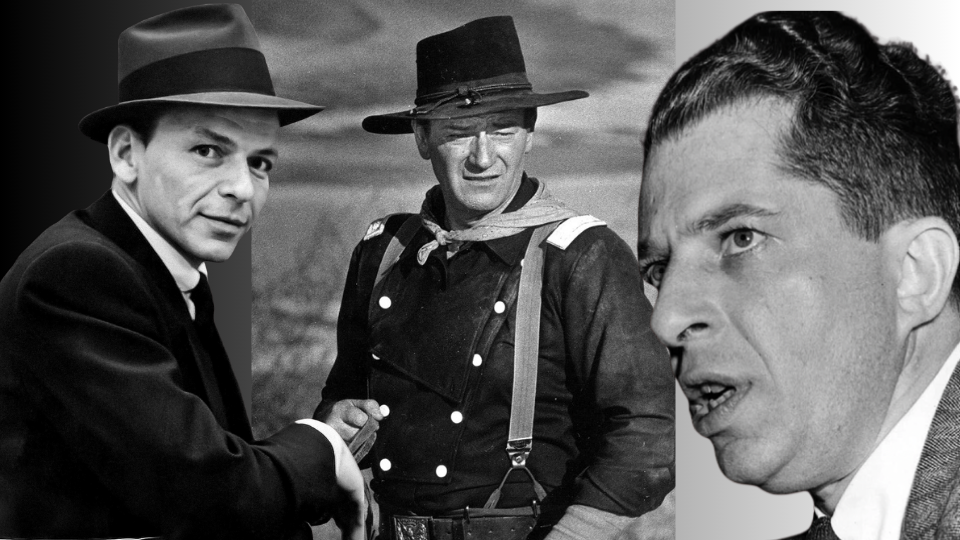
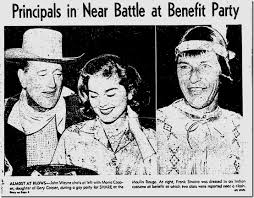
On May 13, Sinatra and Wayne—two of “filmland’s biggest stars”—publicly exchanged “verbal blows” during a charity show and western-themed costume party at the Moulin Rouge nightclub on Sunset Boulevard. According to witnesses, the altercation had been signaled during the party’s music show when Sinatra, garbed as a “Red Indian squaw” replete with wig and headband adorned with a white feather, stalked off stage just as Wayne, dressed as a cowboy, of course, approached the microphone. Wayne’s public criticism of the Maltz hiring was still fresh in Sinatra’s mind—even more so because tabloid columnists were mocking him and spreading the rumor that the Duke’s widely circulated dig at Kennedy back in March was the single factor that had broken “Frankie’s” resistance.
Long after midnight, as the party broke up and guests headed to the exits, Sinatra, somewhat drunk like everyone else and still wearing his Indian girl costume, spotted Wayne in the crowd and made a beeline for the Duke, who was lumbering along in his full western regalia, including neckerchief and ten-gallon hat.
In a scene redolent with cultural implications, Sinatra, standing barely 5-foot-7 and weighing maybe 150, placed himself squarely in the path of the 6-foot-4, 220-pound Wayne, and the two came face to face.
“You seem to disagree with me,” Sinatra stated loudly.
“Frankie, what the hell did you walk away from me for?”
“Well, you cried,” Sinatra said. “You blasted off your mouth.”
“You mean the Maltz thing?”
“Yes,” Sinatra replied.
At this moment, according to biographer James Kaplan, Sinatra shoved Wayne, and Wayne shoved him back. Friends stepped in to separate them. Accounts differ about what happened next. An AP reporter stated that Sinatra, with his feather bobbing and his costume enhancing the bizarre spectacle, “immediately began berating Wayne for publicly opposing the hiring of Albert Maltz.”
For Sinatra, known to be high-strung, the incident was not out of character. But it’s unfortunate that, in newspapers from L.A. to New York and even Paris (where the heights and weights of the combatants were given in centimeters and kilos) the paparazzi focused on the sloppy post-party confrontation rather than the interesting power dynamics of the event itself.
From his defeat and shaming as a sympathizer for a “Russia-loving” screenwriter, Sinatra had been reminded that the film industry was controlled by reactionary forces. Knowing he would see his conservative nemesis at the soiree, Sinatra dressed to impress—and to send messages of defiance.
Since the event had a western theme, John Wayne had the privilege of essentially coming as himself, the undisputed cowboy king and supreme symbol of white American manhood. His contribution to the singing portion of the evening (yes, Wayne sang) was the ponderous cowboy standard “Red River Valley.”
The song Sinatra performed, “The Lady is a Tramp,” is a satire on the reigning norms of elite society. It can be performed by a male singer to express admiration for an independent and free-thinking woman who is shunned by status-loving socialites who label her. In the 1957 film Pal Joey, Sinatra had used the piece in just this way, as a tribute and show of understanding for the courageous individuality of Rita Hayworth’s character. The song has also been performed by female iconoclasts and outsiders with overtones of proud defiance. In the hands of non-white, non-WASP and non-conformist artists such as Ella Fitzgerald and Lena Horne (African Americans), Pat Suzuki (Japanese American), Sophie Tucker (Jewish-American), and Lady Gaga (LGBT icon), “The Lady is a Tramp” has been purposed as a manifesto of rebellion against the patriarchy.
By arriving at the Moulin Rouge dressed as a Native woman, Sinatra showed a type of norm-defying courage that confirmed his role as a cultural enemy of Wayne while also pushing the boundaries of the evening’s western-themed expectations.
In costume, Sinatra could sing in the first person a set of lyrics that displayed his seething animosities. “I never bother with people I hate/ That’s why this lady is a tramp.” His ventriloquized identity constituted an alternative history and a challenge—an act of explicit resistance to Wayne’s hulking cowboy persona.
The text of Sinatra’s subversive jeering at the white male winners who wrote American history might have read, I don’t want to be you. I’m here to erase you. Put simply, Sinatra was calling out the bigots for what they’d done to him and to Maltz, making a self-evident analogy that equated political censorship and blacklisting with genocidal imperialism. Sinatra’s criticism of the political order was therefore deep and far-reaching, so deep and far-reaching as to plausibly encompass that order’s treatment of Private Eddie Slovik as well.
With the passing of decades, the Slovik-Sinatra-Maltz-Kennedy affair comes into focus as a pivotal moment—a convoluted morality play that emerged directly from mid-century ideological conflict.
In retrospect, we might consider more deeply, for example, that the furor over Private Slovik, amazingly, impinged on the careers of three U.S. Presidents. Eisenhower tried to stop the publication of Huie’s book and later lied about his role in Slovik’s execution. If, as was claimed by many, “Uncle Sam” wasn’t happy about Sinatra’s movie-making plans in spring 1960, that Uncle Sam was the Eisenhower administration.
Regarding JFK, it is a truth universally acknowledged that Kennedy would not have won the extremely close 1960 election, and “Camelot” would never have happened if Dad Kennedy hadn’t forced Ole Blue Eyes to fire one of the best American screenwriters. And who knows what red-hating Nixon, as thirty-fifth rather than thirty-seventh President of the United States, might have done to the American Left beginning on Inauguration Day 1961.
Sinatra paid a price for his resistance to Cold War shibboleths, but neither his career nor his massive earning power was ever endangered. Albert Maltz laughed when he learned of his firing while away on a research trip, but soon “felt more blacklisted than ever.” As his friends in the leftist press noted, he now had “the dubious honor of being blacklisted twice.” Albert’s wife, Margaret, at home in Mexico, wrote a letter to her husband that tried to cheer him up. “Maybe you’ll get your name on a script yet,” she mused, but she chose not to sugarcoat reality: “Although probably you’ll be the last one because of the Sinatra business.”
We hope you appreciated this article. At People’s World, we believe news and information should be free and accessible to all, but we need your help. Our journalism is free of corporate influence and paywalls because we are totally reader-supported. Only you, our readers and supporters, make this possible. If you enjoy reading People’s World and the stories we bring you, please support our work by donating or becoming a monthly sustainer today.
CONTRIBUTOR