Finally, a Stephen King film adaptation that isn’t Carrie, The Stand, or The Shining. Instead, moviegoers are being treated to perhaps one of the author’s most brutal and politically overt works with The Long Walk. The new dystopian survival horror film imagines a world in the not-so-distant future in which fear, repression, and fascism are the order of the day, and bloodshed is televised under the guise of increasing public “morale.”
The simple yet engrossing film is carried by strong performances and eerie echoes of the path our own society may find itself walking. It’s not a movie for the faint of heart, as it pulls no punches when it comes to the violence, which holds its own messaging. The filmmakers implore us not to turn away from the screen. It’s not the most fun time spent at the movies, but it will no doubt be impactful for many.
Based on the 1979 novel of the same name by King (under his pseudonym, Richard Bachman), The Long Walk takes place in a United States ruled by a totalitarian regime, where a walking contest known as “The Long Walk” is held annually. Participants, all young men and known as “Walkers,” must maintain a speed of at least three miles per hour or risk public execution. The contest is televised nationwide to help increase patriotism and pride. The walk ends when only one walker is left alive. The last one standing, or walking rather, receives a huge amount of money and the ability to be granted one request for whatever they want.

Throughout the film, as we experience the walk with the 50 young men chosen from the random lottery, we are treated to their stories, motivations, and dynamics. Bonds are formed even while knowing that all but one of them must die for the contest to end.
The Long Walk is full of symbolism and socially relevant themes. If one is looking for escapism with this King adaptation, they will want to look elsewhere, as the movie definitely holds a mirror up to our current society and its extreme political division. Similar to stories like Lord of the Flies and The Lottery, there is an exploration of the human condition under times of strife and survival. Yet, The Long Walk puts it into the context of not only the internal but also the external factors that helped to bring “The Long Walk” about, the compulsion of the young men to “volunteer” for what is almost guaranteed death, and the world in which they live that has come to normalize such an extreme form of violence and brutality.
Many of the young men volunteer in hopes of improving their own lives and those of their loved ones. And while the premise of the walk might seem fantastical, one can’t help but make the comparison between the motivation of the fictional walkers and the thousands of young people who join the military every year in our own reality for similar reasons. 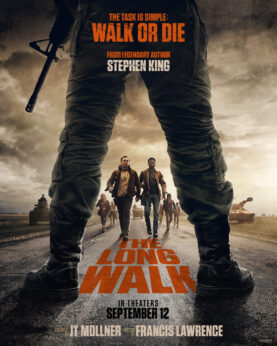
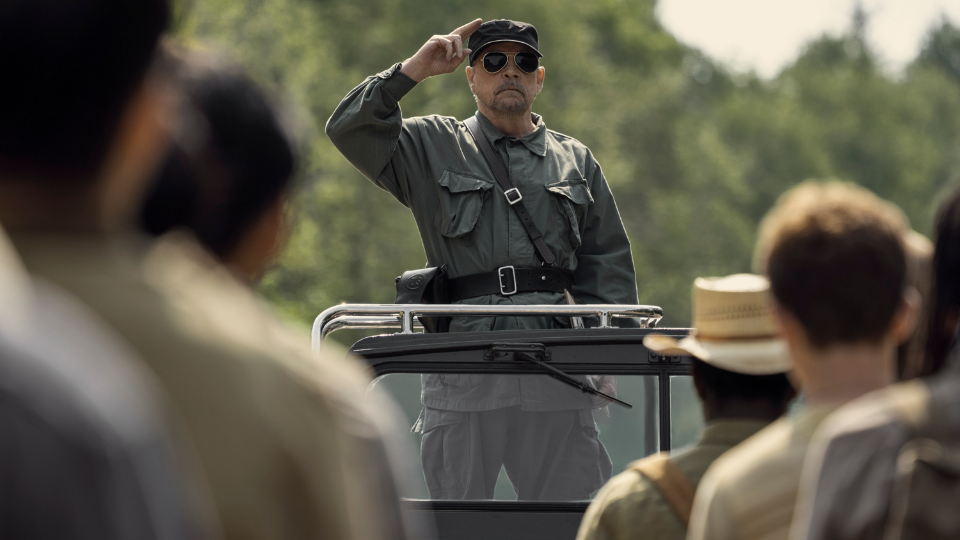
Many are coerced, through systemic oppression and poverty, to volunteer for missions on behalf of a government that often sends them to die in battle. They do it in the hope of perhaps surviving and living a slightly better life. There’s a clear divide between those at the top and the many who become cannon fodder for military pursuits under the guise of “democracy.” This is driven home in the film through the mysterious character of The Major, played to great effect by Mark Hamill. He’s the leader who oversees The Long Walk but does not participate. He gets to ride along in his tank, shouting empty patriotic slogans, and one by one, the young men who can’t keep their three-mile pace are gunned down for all the world to witness.
The film’s biggest strength is the chemistry among its cast. David Jonsson as Peter McVries is the breakout star, giving a simultaneously charismatic and heartbreaking performance. Other notable actors include Cooper Hoffman as Raymond Garraty, Garrett Wareing as Stebbins, and Ben Wang as Hank Olson. Yet, it truly is the combined ensemble that brings the greatest value to the film, as even the smallest parts have the most intense impacts as audience members grow attached to each character, experiencing the dread of knowing that each and every one of them, except the lone winner, will meet a painful and violent end.
Director Francis Lawrence is no stranger to adapting stories involving dystopian societies. After all, he is the visionary behind the popular dystopian science fiction film series The Hunger Games. Yet, what Lawrence is able to convey with this more direct, pared-down setting is truly a testament to his skill as a filmmaker.
There aren’t a lot of bells and whistles in this movie. For its 108-minute runtime, The Long Walk features the actors walking, their dialogue, and many of their violent deaths. And still, it never has a truly dull moment. This is due to Lawrence’s insistence on roping the audience into the emotional rollercoaster of the story. The director, through the engrossing dialogue and the performances he pulls from the actors, creates an intimacy between the film and the audience, not allowing passive or casual viewing. This is a great feat in a modern world of short attention spans and distracting smartphones.
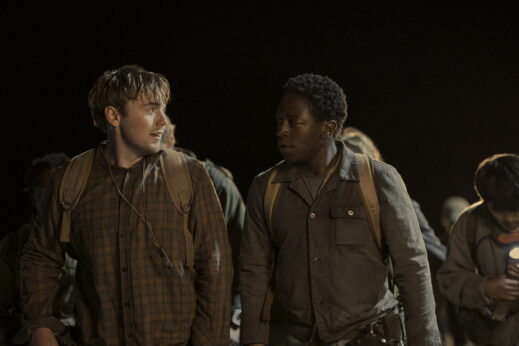
Also, the theme of masculinity, mental health, and the indoctrination of young men is an undercurrent in the film. There have been many studies and debates over the last few years regarding what is seen as a “crisis” of men being drawn into extreme ideologies, the isolation they face, and their poor mental health. What are often dismissed as individual problems are increasingly being recognized as the product of a capitalist system that benefits no one but the top 1%. The Long Walk has a wide array of male characters all grappling with a fascist society that has done a number on them in various ways. It’s interesting to see how the filmmaker approaches this issue, showcasing their personalities in a way that avoids outright vilification or judgment, instead exploring how they came to harbor the anger and despair that color much of their struggles during the walk.
Overall, the film hits all the right marks when it comes to storytelling, performance, pace, and vision. The ending, for many, will feel too ambiguous and muddled, especially as so much leading up to that moment is crisp and direct. Nonetheless, that doesn’t detract too drastically from a powerful film that will leave many stunned and/or deeply reflective in their seats. Be prepared to feel heavy emotions at a time when many in the world want us to be desensitized to violence and tragedy.
The Long Walk opens in theaters September 12, 2025. The trailer can be viewed here.
We hope you appreciated this article. At People’s World, we believe news and information should be free and accessible to all, but we need your help. Our journalism is free of corporate influence and paywalls because we are totally reader-supported. Only you, our readers and supporters, make this possible. If you enjoy reading People’s World and the stories we bring you, please support our work by donating or becoming a monthly sustainer today. Thank you!
CONTRIBUTOR