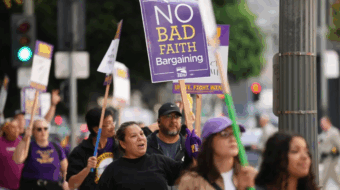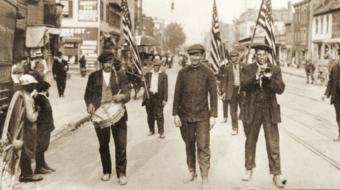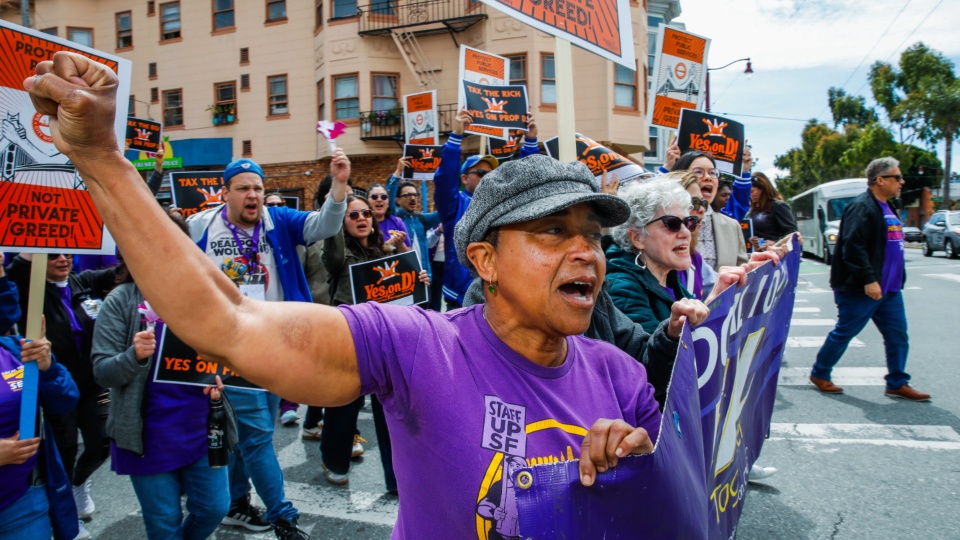
The billionaires, and now trillionaire Elon Musk, didn’t accumulate their vast fortunes through “good ideas” nor through their own “hard work.” They, and many others before them, did so by dismantling one of the key institutions that give workers a fighting chance: unions.
Over the past five decades, big business has poured billions into anti-union consultants and union busters, pro-corporate political lobbying, and labor law loopholes, all to ensure that the gains and surplus of workers’ economic productivity would flow straight to the top and never “trickle down.”
That wealth, of course, is not even created by the bosses in the first place. It is created by labor and nature. Every dollar of profit and every shareholder dividend comes directly from the surplus value extracted from the working class during the production process, whether it’s a good or a service.
Workers who build cars, stock shelves, or deliver packages produce far more value in a day for the capitalist than the wages they take home. The gap between what workers produce and what they are paid in wages is the lifeblood of the capitalist system. It depends on capturing as much of that surplus as possible, and the single greatest obstacle to that capture has always been organized labor.
A new report released this month from the Economic Policy Institute, “The Case for Tripling Union Membership,” puts numbers behind what workers already experience in our daily lives: When unions lose power, our class suffers massively. And when unions fight back and win, the gains ripple through every corner of our lives.
 According to the report, tripling existing union membership from 10% to 30% would raise the median worker’s pay by 14.5%—more than $7,700 a year, or nearly $270,000 over a 35-year career. For a working family, that’s enough to cover 85% of the cost of raising a child from birth to 17, or of sending two kids to a four-year state college. Around the country, those wage gains would shift $1.2 trillion annually from the capitalist class directly to working people’s pockets and would reverse a full third of the entire increase in wealth inequality since 1979.
Furthermore, tripling union density would close racial wage gaps by more than one-third, and would also cut the number of uninsured nonelderly people by about a quarter, not just through negotiated employer plans or collective bargaining agreements, but because unions fight politically for public benefits like Medicare for All and Medicaid expansion.
One of the report’s key points is what they called the “spillover effect.” When union density is high, non-union employers are forced to raise wages to dissuade workers from organizing their shops or simply to compete for talent on the job market. For example, in the 1950s and ’60s when a third of private-sector workers were organized in unions, workers generally shared in productivity gains whether they were organized or not. But today, with union density at a dismal 10%, that link between productivity and wage growth has all but been severed.
Importantly, the report also notes that when union density is below 15%, each additional percentage point of new union organization has a muted effect on overall wage growth for the working class. But when it is above that 15% density threshold, the payoff multiplies significantly. They state that just a one-point increase yields more than four times the wage boost.
In other words, the working class has been stuck in a “low-density trap” where unions can’t yet exert the kind of power on the entire labor market that they did in the post-war era when union density was at its highest.
A roadmap—and a missing piece
The EPI report lays out a potential policy path to begin with that includes passing the PRO Act and the Public Service Freedom to Negotiate Act; repealing “right-to-work” laws in the 27 states that have them; and establishing a public-sector duty-to-bargain in the 24 states that lack it.
They also propose default collective bargaining at any employer where CEO pay exceeds typical worker pay by a ratio of 100 to 1. If enacted today, that single provision would grant immediate collective bargaining rights to 30 million workers—roughly one-fifth of the current private-sector workforce.
All of this is of course achievable, but only if the labor movement is willing to match the scale of the problem with the scale of solution needed. At its recently concluded convention, the AFL-CIO committed to organizing two million new workers by 2031, a welcome step up from its previous one million goal set the convention before.
But let’s just compare that two million to the 56 million unorganized workers who, according to survey data, would vote YES for a union tomorrow if given the chance. Two million is a fraction of the current demand. And the EPI report’s own modeling shows that even removing all state-level anti-union laws—repealing right-to-work and establishing public-sector bargaining—would only get us to 14.4% union density nationally.
The AFL-CIO’s resolution also raises deeper questions. How do we organize when the NLRB has been weaponized against workers, when courts are stacked with corporate allies, and when the state itself—regardless of which party holds nominal power—remains hostile to working-class organization?
And beyond the political obstacles, there’s also the question of will. How likely are the federation’s affiliates to commit the resources, staff, and sustained movement that’s needed? The path to massively increasing union density runs directly through all these obstacles and challenges, not around them.
What the EPI report demonstrates, though, is that rebuilding union power is not just necessary but possible. The capitalist class knows what’s at stake for their interests of profit maximization. That’s why they continue to fight every organizing drive, every union election, and every contract negotiation.
Bosses understand that when workers organize unions, they don’t just win better pay but they begin to build power. The question for our class is whether we’re ready to match their intensity with our own.
We hope you appreciated this article. At People’s World, we believe news and information should be free and accessible to all, but we need your help. Our journalism is free of corporate influence and paywalls because we are totally reader-supported. Only you, our readers and supporters, make this possible. If you enjoy reading People’s World and the stories we bring you, please support our work by donating or becoming a monthly sustainer today. Thank you!
CONTRIBUTOR