Upon learning of the landslide electoral triumph of a fascist political party in a province that was once part of socialist Germany, these foreboding words immediately came to mind: “The womb is fertile still from which that crawled.” It is the concluding line from Bertolt Brecht’s brilliant 1941 denunciation of the Hitler regime, The Resistible Rise of Arturo Ui.
What happened in the German state of Saxony-Anhalt in this week’s election, with the far-right AfD (Alternative for Germany) party gaining 43.5% of the vote, is certainly a somber vindication of Brecht’s warning. But why there, and why now? The answers are not readily apparent, but neither are they inscrutable.
First, the resistible rise of the AfD was not resisted sufficiently or effectively enough. In fact, the prevailing policies of Germany’s ruling parties—whether the CDU (Christian Democratic Union) or SPD (Social Democratic Party of Germany)—actually served to propel alienation, angst, and anger among the masses. This is particularly true for the provinces of the former German Democratic Republic, all of which have significantly higher support for the AfD than their counterparts in the west.
The tactic of imposing a firewall (Brandmauer) of non-cooperation around the AfD proved to be a poor choice for the resistance. After 30 years of being largely treated as second-class citizens, to be functionally defined as some sort of political leper for their party preference only strengthened the resolve and resentment of AfD voters in the east.

Germany remains, as before, a deeply divided country. The reunification (die Wende) decades ago did little to integrate, let alone unify, east and west. “Ossies” and “Wessies” largely live in separate political and economic universes divided by colonial-like snobbery on the one side and legitimate grievances on the other.
What was once a gap in living standards has become a chasm. The annual GDP per capita in Bavaria, for example, is $68,619, while in Saxony-Anhalt it is $42,471, the lowest of all provinces. Eastern German employees earn about 80%-86% of the income levels of their western counterparts.
Employees in the western state of Baden-Württemberg earn on average 23% more than workers in Mecklenburg-Vorpommern, where provincial elections will be held on Sept. 20 and where polls indicate the AfD will get at least 37% of the vote.
The unemployment rate in eastern Germany sits around 8.1%, whereas in the west it is about 6.1%. Poverty rates in the east, now well over 20%, have consistently remained higher than in the west, now under 15%.
Despite these economic woes, the current embattled chancellor, Friedrich Merz, and his CDU cohorts have proposed major rollbacks in the social safety net, stricter rules for sick leave, cuts to family benefits, and plans to alter pension payments.
“The welfare state as we have known it,” proclaimed the multimillionaire Mertz, “can no longer be financed.” Mertz, a corporate lawyer and former head of Germany’s branch of BlackRock, the world’s largest asset management company with over $15 trillion in assets, is an unabashed cheerleader for monopoly capitalism, as expressed in his book, Daring More Capitalism. Militarism is also high on his imperialist agenda.

His proposed military budget for 2027 is $125 billion, an increase of 33% from 2026. As he stated at the onset of his political career in the national government: My “government will provide the Bundeswehr with all the financial resources it needs to become the strongest conventional army in Europe.”
Not surprisingly, his CDU party crashed in the Saxony-Anhalt election, receiving only 16.7% of the vote, a 20.4 point drop from the previous election. It, along with the SPD, is projected to register colossal losses in the coming Mecklenburg-Vorpommern election, as well.
A glimmer of hope in the east for anti-fascist and anti-capitalist forces emerges from Berlin. Polls there indicate that the Left Party (Die Linke) is projected to receive about 20% of the vote on Sept. 20, the highest of all political parties on the ballot.
There is a very real possibility that a prominent leader of the Left Party, Elif Eralp, will become the next mayor of Berlin, replacing the disgraced CDU mayor Kai Wegner. Eralp is the daughter of politically active trade unionists in Turkey. She continues that legacy of activism with her outspoken opposition to racism and for affordable housing.
“I don’t want large real estate firms to determine which direction Berlin develops,” declared Eralp in her progressive campaign. “I believe a different Berlin is possible, one in which everyone is able to afford housing.”
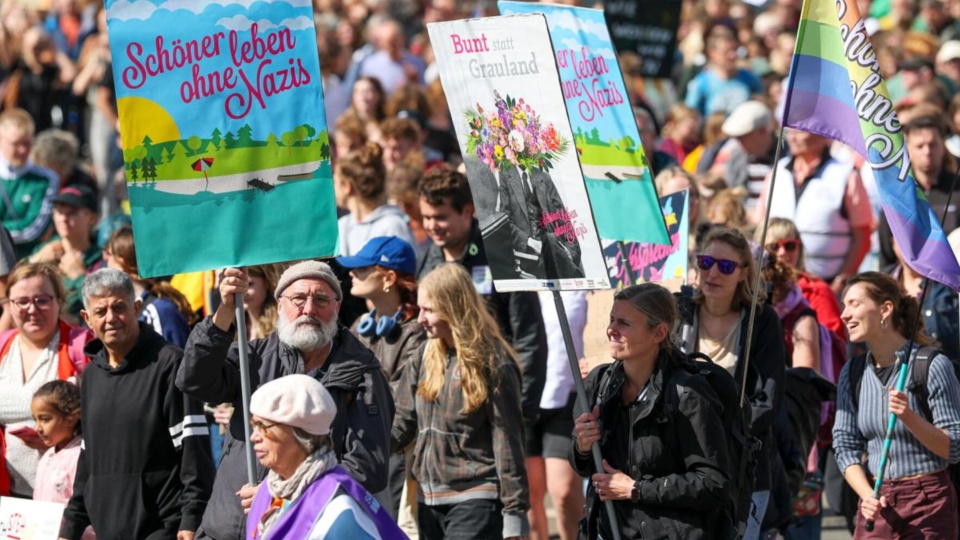
More hope for the future comes from the massive anti-fascist protests promptly held in the wake of the AfD victory in Berlin, Potsdam, Münster, Göttingen, Dresden, Frankfurt, Aachen, Bamberg, Darmstadt, Halle and elsewhere.
One protest sign read “The rainbow has no color brown.” Brown, of course, refers to the party color of the original NSDAP, the Nazis. The AfD officially associates itself with blau (blue). It is perhaps worth noting that in common German parlance when someone is said to be blau, they are totally drunk.
For those intoxicated by a lust for power, now dangerously rejuvenated, sobriety in politics is no alternative. That means for the rest of Germany, the overwhelming majority of whom firmly reject fascism as the future, the mandate is clear: Solidarity Forever!
The womb from which the AfD crawled must be made infertile, forever.
We hope you appreciated this article. At People’s World, we believe news and information should be free and accessible to all, but we need your help. Our journalism is free of corporate influence and paywalls because we are totally reader-supported. Only you, our readers and supporters, make this possible. If you enjoy reading People’s World and the stories we bring you, please support our work by donating or becoming a monthly sustainer today. Thank you!
CONTRIBUTOR