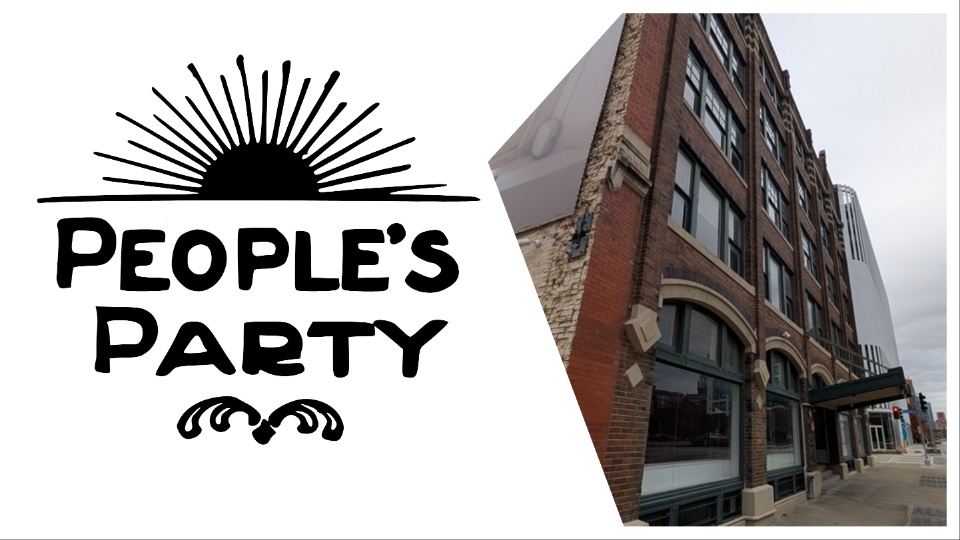
I often walk down Jackson Street in downtown Dallas. I pause at a seemingly deserted six-story building at 800 Jackson to look through the windows. An ancient hand-operated iron printing press and an age-lined wooden compositors cabinet are there every time I look, and I wonder how long they may have been on that site. Perhaps since 1892? Then my reveries take over.
As I remember, 800 Jackson was the address of the state office of the People’s Party of Texas. Around 1892, they had 2,000 chapters in Texas and nearly a dozen newspapers. The main newspaper was Southern Mercury. Is it possible that I am staring at the very printing press and compositors cabinet that they used to print out the angry demands of the farmers’ movement in Texas?
 I have an old paperback copy of Roscoe Martin’s book, The People’s Party in Texas: A Study in Third Party Politics. It was published by the Texas Historical Society in 1970. It is full of facts, but sad. It makes an historical case for the futility of third-party efforts against the two-capitalist-party system imposed on America since the Civil War.
As I stare through the dingy window, I reach out for the collective memories of those thousands of Texas farm families who created and built the greatest electoral threat to capitalism that the state has recorded. From 1892 to 1908, they won significant majorities in many Texas counties but couldn’t win statewide.
They weren’t limited to Texas. The Populist Movement swept through the South in the late 19th century. Its roots were Farmers’ Alliances, the Knights of Labor, the Greenback Party, the Prohibition Party, the Anti-Monopoly Party, the Labor Reform Party, and the Union Labor Party. They came together somewhere in Dallas, perhaps at 800 Jackson, to form the People’s Party of Texas in February of 1892.
Unlike the Populist Movement in other states, in Texas the movement was deliberately anti-racist. Roscoe Martin says, beginning on page 92:

“…[O]rganizers went out to effect the organization of negro Populist clubs; negro orators made hundreds of speeches to colored and mixed audiences in the Black districts, the colored leader J.B. Rayer of Calvert, Texas, being especially active in this work; colored picnics and barbecues were arranged, with the dinner preceded and followed by Populist orations; colored days were designated for white Populist cap meetings; and the negro was given official recognition at the hands of populist officers which he had not theretofore received—for example, he was summoned for jury service. In short, the People’s Party went out to the limit of its means after the colored vote; it recognized the importance of that vote; and it worked long and diligently in its effort to convert it to Populism.” [I used Martin’s punctuation and capitalization.]
Those thousands of multi-racial Texas farmers fought for collective bargaining, federal regulation of railroad rates, an expansionary monetary policy, and a national banking system administered by the federal government. Here is a quote from the main leader at their founding convention: “The interests of rural and urban labor are the same; their enemies are identical.”
What great and courageous people they must have been! I imagine, as I stare at the tiny printing equipment in the window, all the newspapers they printed, paid for, and distributed. Some of them were The Pitchfork, Pioneer Exponent, Texas Advance, Texas Triangle, Hempstead Weekly News, People’s Party Herald, Halletsville New Era, Texas Herald, Weekly News, and The Comanche Chief.

It was always an uphill fight for the farmers and working families. Industrial capital and financial capital were in the ascendancy.
Small farms were beginning to disappear as a way of life. In 1896, the “Middle Roaders,” who wanted to maintain their independence, fought hard against the “Fusionists,” who wanted to join the Democratic Party and support William Jennings Bryan for President. The Fusionists prevailed, and the entire Populist Movement, including the Texans, was swallowed whole by the Democratic Party.
I assume the old building at 800 Jackson is just waiting to be torn down, like the deserted Greyhound station across the street. The two buildings hold a lot of histories of their own.
All through the winter of 1987-88, we organized rallies every Friday night in solidarity with striking Greyhound drivers. Those were some times! The cavernous bus dome still seems to echo with our lusty union chants.
The old building at 800 Jackson is not the original. It was built in 1913 and was a hat factory.
I don’t know, but I can imagine that one of Dallas’ most dramatic union organizing drives occurred there. Around 1936, Milliners were among the very first to try to organize legions of women for the Congress of Industrial Organizations as it tried to penetrate anti-union Dallas. Many of those women went to jail where they sang “Solidarity Forever” at the top of their lungs! But those are other stories for another time.
We hope you appreciated this article. At People’s World, we believe news and information should be free and accessible to all, but we need your help. Our journalism is free of corporate influence and paywalls because we are totally reader-supported. Only you, our readers and supporters, make this possible. If you enjoy reading People’s World and the stories we bring you, please support our work by donating or becoming a monthly sustainer today. Thank you!
CONTRIBUTOR