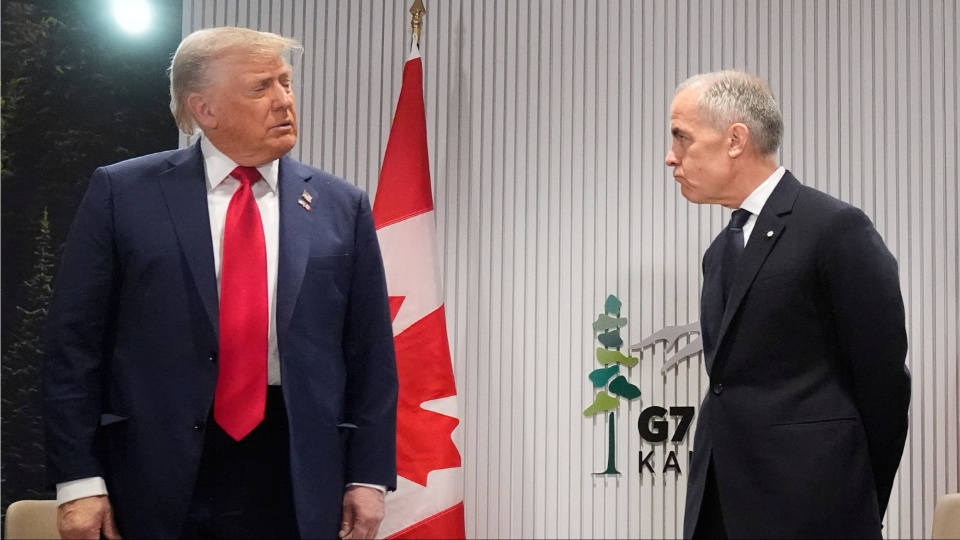
When Canadian Prime Minister Mark Carney walked away from the negotiating table with Donald Trump on the night of Aug. 21, it was because U.S. negotiators had slapped down a list of demands that read less like a trade agreement proposal and more like a colonial surrender treaty.
In the days that followed, leaks from Ottawa exposed the scale of the capitulation Trump sought to impose:
- veto power for a U.S.-dominated review board over foreign investment in Canadian ports, telecoms, pipelines, and power grids;
- automatic Canadian adoption of whatever sanctions and tariffs U.S. imperialism imposes on third countries, eliminating any independent Canadian foreign trade policy;
- guaranteed U.S. access to and price caps on the lithium, nickel, cobalt, and uranium being extracted from northern Canada;
- total repeal of Canada’s Digital Services Tax and Online News Act, a gift for U.S. tech and corporate media giants;
- the dismantling of Canadian-made content broadcasting regulations, with Quebec’s French-language protections singled out for elimination;
- the scrapping of government procurement preferences to buy Canadian-made products;
- the gutting of the dairy, egg, and poultry supply management system that protects Canadian farmers from U.S. agribusiness corporations;
- the exclusion of Canadian auto assembly plants from tariff relief and the rewriting of rules of origin in order to force the erasure of the Canadian auto industry;
- extended patent monopolies for U.S. pharmaceutical firms that would drive up drug costs for Canada’s public health systems;
- guaranteed U.S. priority access and price guarantees on Canadian oil, gas, hydroelectricity, and nuclear power;
- binding Arctic and NORAD military spending commitments by Canada with the requirement that the country purchase more U.S.-made weapons;
- and lowered customs thresholds granting American retailers duty-free access to Canadian consumers at the expense of local businesses.
It’s little wonder the Canadian leader ordered his bargaining team to pack up and come home.
U.S. imperial strategy under Trump
Read individually, each item comes off as one more entry in the typical corporate wish list that accompanies any U.S. trade negotiation. Added together, though, they amount to something bigger: a demand that Canada hand over its economic sovereignty—control of its own resources, its own culture, its own foreign policy, and its own industrial base—to a foreign power.
None of this should come as a shock to readers who have followed our coverage of the Trump trade wars since the start of the president’s second term. This is a strategy playing out in real time, the result of one faction of the ruling class trying to solve capitalism’s long profitability crisis not through competition on a global market but through the old imperialist playbook of spheres of influence and consolidated blocs.
Trump and the MAGA faction represent capitalists who believe their profits depend on a sealed-off Western Hemisphere fortress where competition is suppressed and U.S. capital calls the shots.

Whether by outright invasion (as in Venezuela), election interference (as in Honduras and Bolivia), or support for local right-wing forces (as in Argentina and Ecuador), much of Latin America has already been brought onside. Canada, a close ally and continental neighbor already deeply integrated into U.S. supply chains, is simply another piece on the board which Trump thought would be easy to move.
This is also consistent with the broader “America First” doctrine of global domination laid out in the administration’s national security strategy and with the pattern we’ve seen at the “Shield of the Americas” alliance and Trump’s effort to push Europe to help re-colonize the Global South. It is the same logic behind the administration’s Cold War strategy against China: Carve the world into manageable blocs and force close allies to fall even tighter in line.
Trump’s imposition of tariffs on Canada has made big headlines in the mainstream press, but the attacks on Canadian sovereignty have taken other quieter forms, as well. The White House used trade war threats to pressure Ottawa into supporting the blockade of Cuba, for instance, and bullied the Canadian mining firm Sherritt out of the island entirely.
Trump’s team has also been caught encouraging Alberta separatism, a blatant reminder that Washington is willing to meddle in Canada’s internal politics, not just its trade policy. Add August’s demand list to that record, and it becomes obvious that Trump’s approach to Canada was always about subordination.
Grand geopolitical strategy aside, there is also an electoral clock ticking for the president. Trump and the Republicans are heading into the 2026 midterms with inflation still squeezing household budgets, layoffs mounting, and the Iran war showing the fragility of U.S. military power.
A humiliating foreign policy record, a cost-of-living crisis at home, and soaring profits for billionaires and trillionaires are not an appealing package to sell to voters.

Picking a fight with an “easy” target like Canada—a mid-sized, historically accommodating neighbor with a military budget a fraction of the Pentagon’s—lets Trump manufacture the appearance of toughness and “winning” without having to confront a rival capable of actually punching back.
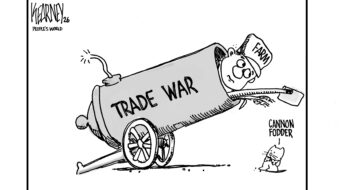
Workers and their families, however, are the ones left paying the price for his political theater. The practical result of Trump’s trade wars for working people on both sides of the border is layoffs, price hikes, and retaliatory tariffs—not the revival of good manufacturing jobs the MAGA base was promised.
Canadian workers in the auto, steel, aluminum, and agricultural sectors are already absorbing the shock, while Canadian governments and employers use the trade war as a ready-made excuse to demand concessions, freeze wages, and cut services, just as capital has always done on both sides of a tariff fight.
Trading one ruling-class project for another?
Carney’s response to the collapse of talks has been to pivot toward Europe. In mid-September, the prime minister traveled to Strasbourg, France, to welcome European Commission President Ursula von der Leyen’s proposal that Canada become the EU’s first “associate member,” telling the European Parliament that a Canada-EU alliance would “create a beacon for other democracies.”
Trump responded by calling the idea “laughable” and threatening more tariffs against the EU if it goes forward—further proof, if any were needed, that the president regards even the mildest assertion of Canadian independence as an act of defiance to be punished.
None of this is new for Carney. Long before the August talks collapsed, he had already confessed that the “rules-based order” of the neoliberal globalization era was, in effect, a lie—an admission that the postwar system Canadian capital had relied on for stability was breaking down under the weight of U.S. unilateralism.
His Strasbourg speech last week was that same analysis put into motion: If the old order built around U.S. leadership is finished, Canadian monopoly capital needs a new patron, and European finance capital is offering itself as an alternative anchor.
Carney’s tough approach to Trump is earning praise from liberal commentators and winning him public support in opinion polls, which show 65% of Canadians back his policies. But the left in Canada is warning workers shouldn’t mistake Carney’s European turn for liberation.
The Communist Party of Canada has argued Carney’s vision of “middle powers” banding together is not a foreign policy of peace and respect for the sovereignty of nations. It is a strategy crafted for the benefit of Canadian and European finance capital, aimed at realigning Canadian monopoly capital with Brussels rather than breaking with imperialism altogether.

Canada remains, in the party’s words, “an imperialist country in its own right, closely allied with U.S. capital,” and Carney’s real project is not resistance to empire but repositioning within it.
Drew Garvie, the party’s leader, and Adrien Welsh, national secretary of the Communist Party of Quebec, spoke on Canadian television from Ottawa recently, denouncing the Carney government’s turn to military spending as economic stimulus. They said his approach, which includes beefing up Canadian arms sales to Europe, “serves weapons manufacturers and banks.”
The social democratic NDP insists that whatever comes next, there must be “swift and substantial aid to…workers and industries” hit by U.S. tariffs and a push toward an economy that prioritizes housing, health care, and the cost of living over corporate concessions to Washington.
The NDP is struggling to find its feet, however, in the face of Carney’s popularity, with party leader Avi Lewis tailing the prime minister, saying “no deal is better than a bad deal” and that Trump “is weak and cannot be trusted to abide by an agreement.”
The deeper lesson is that neither Trump’s bloc-building bullying nor Carney’s elite-driven pivot to Europe offers Canadian or American workers a real way out.
Both are, at bottom, ruling-class projects—one betting on naked coercion to shore up a declining U.S. empire, the other a gamble on a new set of transatlantic monopoly alliances to hedge against it.
What neither Trump nor Carney is offering is what workers actually need: cross-border solidarity, public investment that serves people rather than shareholders, and an end to the ever-repeating cycle in which capital, whichever flag it flies, extracts sacrifice from workers and calls it patriotism.
That fight is the one that will determine who actually “wins” this trade war.
As with all news-analytical articles published by People’s World, the views represented here are those of the author.
No paywalls at People’s World
We hope you appreciated this article. At People’s World, we believe news and information should be free and accessible to all, but we need your help. Our journalism is free of corporate influence and paywalls because we are totally reader-supported. Only you, our readers and supporters, make this possible. If you enjoy reading People’s World and the stories we bring you, please support our work by donating or becoming a monthly sustainer today. Thank you!
CONTRIBUTOR