

SPECIAL STARBUCKS STRIKE EDITION OF PEOPLE’S WORLD: A new 4-page PDF of a special “Starbucks Strike Edition” of selected People’s World articles is ready for you to download, print, and distribute on Starbucks picket lines and in coffee shops in your local area. 11″x 17″, double-sided, and in full color. Click here to download.
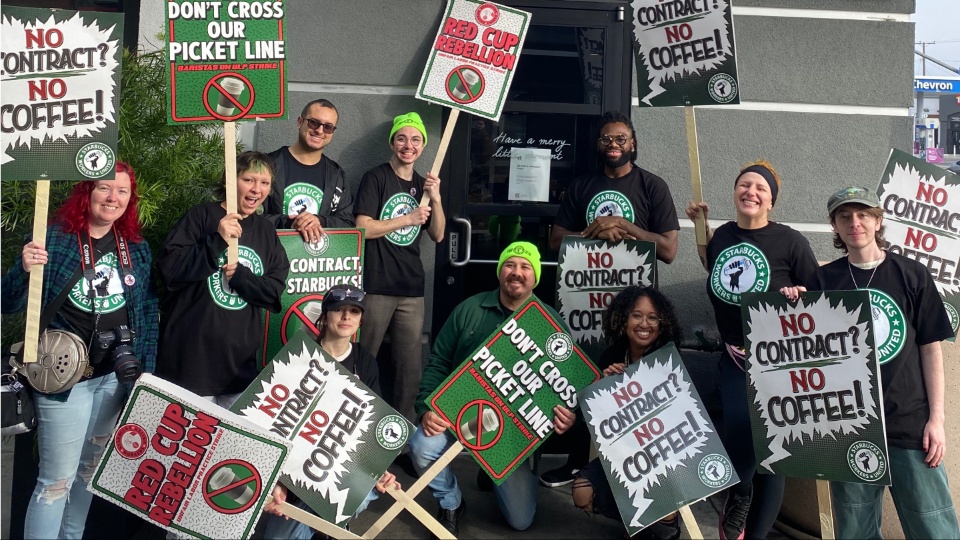
More than 1,000 baristas launched a “Red Cup Rebellion” unfair labor practice strike this morning, protesting Starbucks’ union-busting and failure to finalize a fair union contract. The strike begins at more than 65 stores across 40 cities and comes after six months of Starbucks refusing to offer new proposals to address workers’ demands for better staffing, higher pay, and resolution of hundreds of unfair labor practice charges.
“We’re turning the Red Cup Season into the Red Cup Rebellion,” said Dachi Spoltore, a barista for five years from the Amos Hall location in Pittsburgh, who walked out on strike. ”We’re striking for a fair union contract, resolution of unfair labor practices, and a better future at Starbucks. For every one barista on strike, dozens more allies and customers have pledged to honor the picket line and not buy Starbucks while we are on strike.”
Workers at two non-union stores in Chicago told People’s World that they are “watching today’s developments closely.” One added that they were also hoping to eventually unionize their stores.
With no set date to end the strike, baristas across more than 550 current union stores are prepared to continue escalating to make this the largest, longest strike in company history if Starbucks fails to deliver a fair union contract and resolve unfair labor practice charges.
“If Starbucks keeps stonewalling a fair contract and refusing to end union-busting, they’ll see their business grind to a halt,” said Michelle Wisen, Starbucks Workers United spokesperson and 15-year veteran barista, “No contract, no coffee is more than a tagline—it’s a pledge to interrupt Starbucks’ operations and profits until a fair union contract and an end to unfair labor practices are won.”
“Starbucks knows where we stand. We’ve been clear and consistent on what baristas need to succeed: more take-home pay, better hours, resolving legal issues. Bring us NEW proposals that address these issues so we can finalize a contract. Until then, you’ll see us and our allies on the picket line.”
November 10 letters backing workers and sent to the company from 26 senators, led by Bernie Sanders, Ind-Vt., and 87 House members, organized by the four co-chairs of the Congressional Labor Caucus, plus Progressive Caucus Chair Pramila Jayapal, D-Wash., whose district includes the company’s Seattle headquarters, may fall on deaf ears.
Further, in both workers’ and unions’ experience, first contracts are always the toughest to win. Not only do they follow organizing drives, which bring out corporate hatred of workers and unions, but firms stall and stall and stall, hoping to wear the workers down.
Which is what Starbucks, having first stalled on even talking with the workers at all, is now doing.
CEO Brian Niccol, continuing and increasing anti-union stands crafted by company founder and chief stockholder Howard Schultz, refuses to reply to worker demands on the key issues of pay, short-staffing, and—for the many part-timers—more and more regular hours.
Bargaining, even with the help of mediators, halted six months ago. The workers in their grass-roots campaign, aided by organizers and legal help from Starbucks Workers United, a Service Employees sector, had to file more than 125 charges of bad faith bargaining and illegal retaliation since then.
“Starbucks partners around the country are experiencing the same systemic problems,” the workers say on the Starbucks Workers United website. “Every day across the U.S., we’re dealing with issues like short staffing, unpredictable scheduling, low pay, rising healthcare costs, harassment, broken equipment, and unfair discipline.
“That’s why baristas began taking action to stand up to management. Through worker-to-worker organizing, it was possible to address systemic issues by taking a unified stand—and that we can only lock in lasting change through a fair union contract.”
Since the first Starbucks workers began unionizing in Buffalo, N.Y., four years ago, the company has committed more than 700 unfair labor practices, the formal name for labor law-breaking. They range from backtracking on already agreed-upon tentative contract provisions to outright refusal to bargain to illegally firing pro-union workers.
The lawmakers backing the workers, all Democrats or independents, are urging the firm to settle.
“We are writing to express concern regarding Starbucks’ failure to reach a fair first contract with its baristas,” wrote 26 senators, led by Sanders, the Senate’s longest supporter of workers and unions.
“We have heard of a troubling return to union-busting, which impeded the ability of Starbucks workers—many of whom are our constituents—to exercise their statutory and constitutional right to organize.”
The firm has also closed 500 U.S. stores, claiming poor sales. But while workers have organized 3% of Starbucks’s stores, unionized stores represent 14% of the closures.
“We are troubled by reports that since you started your role as CEO in September 2024, the company failed to put forward a serious economic proposal, backtracking on the previously agreed-upon path forward,” the senators wrote. The 87 representatives made the same points.
“Starbucks is not a poor company. Last year, Starbucks made over $3.6 billion in profit and paid out nearly $5 billion in stock buybacks and dividends. In the first three quarters of this year, Starbucks made $1.7 billion in profit and paid out over $2 billion in dividends.
“And last year, you made $95 million in compensation for the four months you worked in 2024, roughly 6,666 times more than your average worker was paid for the entire year.”
By contrast, the total cost of the workers’ salary and benefit demands on Starbucks would equal less than 1% of the firm’s U.S. average daily sales.
In their letter to Niccol, the representatives, led by House Congressional Labor Caucus co-chairs Steven Horsford, D-Nev., Debbie Dingell, D-Mich., Mark Pocan, D-Wis., and Donald Norcross, D-N.J., plus Progressive Caucus Chair Jayapal, D-Wash., added other points.
“Given that it is the policy of the United States to encourage collective bargaining under the National Labor Relations Act, we urge Starbucks to end its union busting and bargain in good faith to reach a fair contract with its employees,” they wrote.
While Starbucks and the workers achieved “33 tentative agreements to date,” Starbucks started to withdraw them when Niccol took over 14 months ago. It has also “failed to put forward a serious economic proposal, backtracking on the previously agreed-upon path forward.
“This prompted Workers United to file an unfair labor practices charge alleging Starbucks’ failure to bargain in good faith and undermining the representative status of the union.”
“Starbucks has the money to reach a fair agreement with its workers. Accordingly, we want to know how Starbucks, in accordance with the law, will reverse course from its current posture, resolve its existing labor disputes, and bargain a fair contract in good faith with these employees,” both letters from lawmakers concluded.
For over six months, Starbucks has stonewalled union baristas by refusing to put forth new proposals to address their core demands:
- Better hours to improve staffing in our stores. Understaffing is rampant, leading to longer wait times as customer orders stream in. Yet too many baristas still aren’t getting enough hours to pay the bills or meet the threshold for benefits. Starbucks needs to invest in increasing barista hours.
- Higher take-home pay. Too many baristas struggle to get by, while executives make millions. Starbucks needs to put more money toward baristas’ take-home pay.
- Resolution for hundreds of outstanding unfair labor practice charges for union busting. The coffee giant has committed more labor law violations than any employer in modern history. Starbucks needs to fully resolve legal issues impacting baristas.
Union stores in the following cities began the strike today: Anaheim, CA; Long Beach, CA; San Diego, CA; Santa Clarita, CA; Santa Cruz, CA; Scotts Valley, CA; Seal Beach, CA; Soquel, CA; Colorado Springs, CO; Lafayette, CO; Des Plaines, IL; Evanston, IL; Geneva, IL; Alpharetta, GA; Roswell, GA; Chanhassen, MN; Minneapolis, MN; Saint Louis, MO; Brooklyn, NY; New York, NY; Columbus, OH; Lewis Center, OH; Reynoldsburg, OH; Upper Arlington, OH; Worthington, OH; Beaverton, OR; Damascus, OR; Eugene, OR; Gresham, OR; Portland, OR; Dickson City, PA; Lancaster, PA; Philadelphia, PA; Pittsburgh, PA; Austin, TX; Dallas, TX; Denton, TX; Farmers Branch, TX; Mechanicsville, VA; Richmond, VA; Redmond, WA; and Seattle, WA.
We hope you appreciated this article. At People’s World, we believe news and information should be free and accessible to all, but we need your help. Our journalism is free of corporate influence and paywalls because we are totally reader-supported. Only you, our readers and supporters, make this possible. If you enjoy reading People’s World and the stories we bring you, please support our work by donating or becoming a monthly sustainer today.
CONTRIBUTOR



MOST POPULAR TODAY

Israeli military attempts to kill war correspondent Steve Sweeney

Trump’s Postmaster General says USPS may shut down in a year
Praising Trump’s war, monarchist forces hijack Iranian diaspora

Strategic retreat or strategic pivot? The state of the Target boycott

More reading suggestions for Womens History Month: Women workers, and writers