When most people think about automation in the workplace, they think of robots replacing workers. The reality, as a new report from UNITE HERE shows, is more complicated. Technology can replace jobs, but it can also transform them. Under capitalism, however, that transformation is usually designed to squeeze more value out of workers while giving us less control over our work.
But as in all things, there’s another possibility. When workers have control over the tools that we collectively produce, technology can be shaped to serve our needs and make our jobs and lives easier, and not just increase corporate profits.
The report from UNITE HERE, co-released with the AFL-CIO Tech Institute, draws on interviews with union leaders, workers, and academic researchers. It offers insight into how workers and their unions can go on the offensive against automation—not by fighting a losing battle to stop its implementation, but by winning the power to shape it and use it for our collective interests.
The hospitality industry, which UNITE HERE largely represents, has long been at the top of lists predicting automation-related job loss, the report states. Rather than mass layoffs, however, most technologies deployed in hospitality have transformed how work is done rather than eliminated it entirely. The problem is that without worker input, new technology often makes jobs harder, more stressful, decreases staffing levels, and increases overall exploitation.
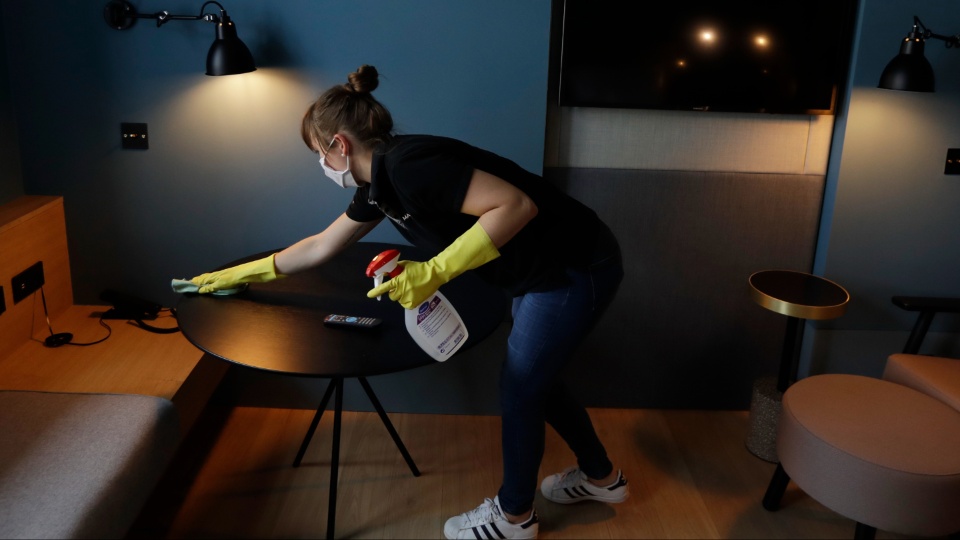
Consider hotel housekeeping. Housekeepers spend their shifts pushing loaded carts over carpet and carry the industry’s worst injury record. Traditionally, housekeepers worked from a paper list and set their own pace and order, shifting between lighter stayover rooms and heavier checkout rooms depending on what they found when they arrived.
Then came an app that fed them one room at a time and dictated the sequence. VIP rooms jumped the queue regardless of where they sat on the floor, so workers found themselves retracing hallways and doubling back on elevators, still pushing the heavy carts. The app “stripped them of a whole set of control and autonomy,” said Culinary Union research director Zach Poppel.
“It was basically putting a smartphone in the hand of a housekeeper as a way to give assignments,” said UNITE HERE Local 226 organizing director Johanna Dalton.
Rather than trying to bargain over specific technologies one by one—a losing game in a rapidly changing industry—the union took a different approach, what the report calls “bargaining to bargain.”
In 2018, contracts covering nearly 100,000 hotel workers were set to expire. The union fought for, and won, contract language that created a process it calls “midcycle bargaining.” Under the new language, management must give up to six months’ notice before deploying new technology, provide the union with information about what it does, and negotiate before implementation.
The contract language also defined technology broadly. It covered everything from robots to software, apps, and AI, and required management to negotiate over both “labor-replacing” and “labor-transforming” technologies. Additionally, it included job capture language ensuring new jobs created by such technology would remain in the bargaining unit, require employer-paid training, and include recall and severance protections for any displaced workers.
Naturally, the hotel bosses resisted these demands. As former UNITE HERE President D. Taylor recalled, “I don’t think it was a coincidence that the last issue settled in Las Vegas, as we geared up for a strike, was technology, and the last issue in the Marriott strike was technology.”
That Marriott strike lasted over 100 days across seven different cities. The workers eventually won. By the end of 2019, the union had expanded technology rights to about 25 percent of its overall membership. Today, that figure is roughly two-thirds, now under union president Gwen Mills.
Bargaining is only one part of the fight, however. The union also partners with academic researchers to study how new workplace technologies actually affect workers in their everyday lives, as well as working directly with tech-developers to build tools that benefit and serve workers.
The results are impressive. In Las Vegas, housekeepers gathered their own data to win back the right to plan workflows for their rooms. Delivery drivers at a major tech company turned a monitoring system into a safety program, with coaching and joint review of routes and workloads taking the place of disciplinary action. And when casinos rolled out automated drink dispensers, cocktail servers documented the bartending work they were still performing, thereby securing the largest arbitration awards in the union’s history and making the machines a losing proposition for the companies.
“When technology controls workers, they don’t feel good, they get burned out,” said Mirtha Rojas, a UNITE HERE member in Las Vegas. “When workers control technology, they feel more confident and more respected. But to win that respect, the workers have to stand up. We have to take what we know and turn it into power.”
The union argues that any serious bargaining over technology has to start with understanding what the technology actually does and how it reshapes the job. That means workers must be at the bargaining table since they know the existing workflow and can spot problems before they arise.
Under capitalism, technology is not some neutral tool. In class society, it is developed and deployed to serve the interests of the class who ultimately owns it—in this case, to increase profits, reduce labor costs, and tighten control over the working class. That’s why the same technologies that could make work safer and easier, including shortening the work week, often end up making it harder and more stressful instead.
But, as the UNITE HERE report shows, workers are not powerless in the face of technological change. By organizing our coworkers into unions, getting involved in the bargaining process, and using our collective power, we can force the bosses to give up total control over how new technology is implemented and win legitimate protections against both unwanted surveillance and job loss.
“UNITE HERE shows what has been true since the dawn of the labor movement—unions have the power to influence how technology is used in the workplace,” said Lauren McFerran, executive director of the AFL-CIO Tech Institute. “Our hope is that the UNITE HERE model can assist other unions in confronting the challenges presented by AI and other technology head-on and bargaining for a better future.”
“We live in a time when the richest people in the world are looking to further consolidate their wealth and power, and they are using tech to do it,” said UNITE HERE president Gwen Mills.
“If you listen to Silicon Valley, tech is always perfect and inevitable, and those of us who raise concerns are anti-progress,” she said. Mills credited Taylor with recognizing nearly a decade ago that without worker input, innovation would simply enrich billionaires at working people’s expense. “We still have a long way to go to achieve technological innovations that uplift all humanity rather than benefit a few, but I believe that we have a model of how to get there.”
No paywalls at People’s World
We hope you appreciated this article. At People’s World, we believe news and information should be free and accessible to all, but we need your help. Our journalism is free of corporate influence and paywalls because we are totally reader-supported. Only you, our readers and supporters, make this possible. If you enjoy reading People’s World and the stories we bring you, please support our work by donating or becoming a monthly sustainer today. Thank you!
CONTRIBUTOR