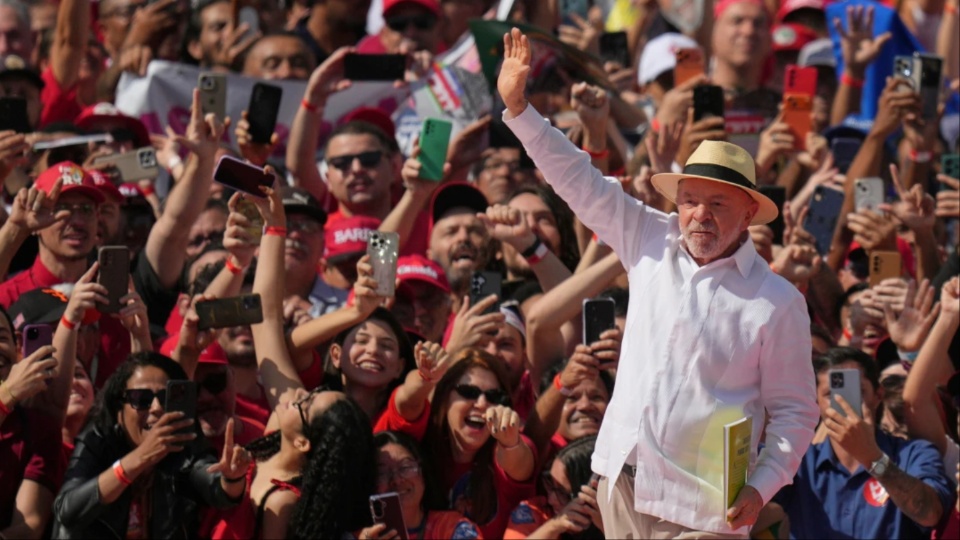
Brazilians go to the polls this weekend in what will be a crucial election for the country and the wider region. The contest pits the incumbent President Luiz Inacio Lula da Silva against the far-right Flavio Bolsonaro—son of the former President Jair Bolsonaro, who is currently serving a 27-year sentence, convicted of plotting a coup to overturn the result of the 2022 election.
Of all the elections in the Americas this year, this is the one whose outcome matters most to Washington, and it’s the one it has worked hardest to influence. Brazil—a top-10 economy, a founder of BRICS and a driver of the multipolar order—is the last large country in South America that, under Lula, refuses to fall in line with Washington. It is one of the final pieces and also a potential turning point in Washington’s strategy for the capture of the Americas.
In his speech at the opening of the 81st United Nations General Assembly on Sept. 22, Lula denounced foreign interference in the region’s elections and brought it under international scrutiny to prevent an institutional rupture before it could materialize. “Brazilian democracy belongs to Brazilians. Brazil will remain a sovereign country,” he declared
Opinion polling currently shows a technical tie. Datafolha (Sept. 22–23) has Lula at 40% and Flavio Bolsonaro at 36% in the first round, and 47% to 45% in a runoff. This represents a step in the wrong direction: A month ago, Lula led by five points.
U.S. money in Bolsonaro’s campaign?
Ten days before the first round, Meta temporarily disabled Lula’s Facebook advertising account, preventing his campaign from running ads on the platform. Lula’s campaign challenged the decision, saying no justification had been provided. The account was restored later that same day. Meta had offered no public explanation for the suspension at the time of reporting.
The most serious suspicion, however, concerns potential foreign financing of Flavio Bolsonaro’s campaign through Rockbridge, a U.S. network created in the orbit of U.S. Vice President JD Vance and major Trump-aligned donors, which has channelled anonymous donations to far-right campaigns.
Andre Marinho, the son of Flavio Bolsonaro’s substitute senator, authored a 22-page strategic memorandum bearing the words “Flavio Bolsonaro: 2026 Campaign” and met with Vance in Washington. The document envisaged a future Bolsonaro administration aligning with the U.S. over critical minerals and building supply chains explicitly designed to reduce the partnership with China. Marinho acknowledges writing the document but says it was a personal brainstorming exercise, never presented to U.S. officials or shared with the campaign.

An investigation found that Marinho incorporated a Brazilian branch of Rockbridge in Wyoming—Rockbridge Brazil Ltd.—and that a businessman whom Marinho introduced to Rockbridge subsequently became involved in Flavio Bolsonaro’s campaign operation in Sao Paulo; the businessman acknowledges his ties to Rockbridge but denies channelling any funds.
On Sept. 23, the Workers’ Party (PT) and its allies formally asked both the Superior Electoral Court and the Supreme Court to investigate whether foreign money has reached the campaign. Foreign campaign financing is prohibited under Brazilian electoral rules, which strictly regulate permissible sources and require campaign funds to be identified and declared.
Brazil in the crosshairs
In a report, Brazil’s own intelligence agency (ABIN) has rated U.S. pressure on the election at a “critical level,” calling it “gradual, combined, and adaptive,” with U.S. Secretary of State Marco Rubio central to it.
In the U.S. itself, the interference has been recognized at official level. Thirty-one members of Congress, Sen. Bernie Sanders among them, wrote to Rubio on Sept. 25 accusing the administration of “a sustained, multifaceted campaign of interference and destabilisation in Brazil.”
The U.S. campaign against Brazil was spelled out in black and white by the White House itself. A July 2025 executive order declared a national emergency, claimed that Brazil’s government had “unjustly charged Bolsonaro with multiple crimes,” and imposed tariffs of up to 50% on Brazilian goods—a campaign developed openly with the support of the Bolsonaro family.
After the original tariffs were struck down in February 2026, Washington imposed new 25% tariffs on a range of Brazilian products in July, followed by an additional 12.5% levy justified by alleged failures to combat forced labor.
The pressure has extended beyond trade and sanctions. On May 28, the U.S. designated the PCC and Comando Vermelho, two of Brazil’s largest criminal organizations, as foreign terrorist organizations, placing Brazil within the same counterterrorism framework as al-Qaeda and ISIS. According to the congressional letter, the designations came shortly after Flavio Bolsonaro had “reportedly” asked Trump for them.
Celso Amorim, Lula’s chief foreign-policy adviser and a former foreign minister, warned this could provide a pretext for intervention. He noted that expansive interpretations of “terrorism” and “narco-terrorism” had already been used to justify military operations elsewhere.
The broader doctrine was made explicit in August, when the U.S. State Department released a video declaring that “American dominance in the Western Hemisphere will never again be questioned.” Amorim described the message as an attempt “to relativize the sovereignty of Latin American countries in general, including, of course, Brazil.” The warning came as Brazilian analysts were also expressing concern over the expansion of the U.S. military presence in its immediate neighborhood.
Pink tide ebbing
The “pink tide” has not simply receded through the free choice of Latin American electorates. Its retreat has taken place amid direct U.S. interference in some of the region’s most closely contested elections.
The left in Latin America has suffered a series of defeats over the course of the last year, including the replacement of a progressive government in Bolivia by the right-wing, pro-U.S., and pro-Israel candidate Rodrigo Paz; the election of the Pinochet-nostalgic Jose Antonio Kast in Chile; Nasry Juan Asfura in Honduras; Daniel Noboa in Ecuador; Keiko Fujimori in Peru; and, most recently, the quasi-fascist Abelardo de la Espriella in Colombia.
Several of these electoral contests were extremely close; the U.S. had a hand in many of them, and in others besides. In Argentina, ahead of Javier Milei’s midterm elections in October 2025, the U.S. Treasury extended a $20 billion currency swap to prop up the peso, with Trump spelling out the terms at a White House meeting with Milei: “If he loses, we are not going to be generous with Argentina.”
In Honduras, two days before the November 2025 presidential election, Trump announced that he would pardon former President Juan Orlando Hernandez—a leader of Asfura’s own National Party, serving 45 years in a U.S. prison for helping to traffic hundreds of tons of cocaine—and warned that if Asfura lost, “the United States will not be throwing good money after bad.”

In Colombia, Trump endorsed de la Espriella ahead of the run-off, denounced his opponent Ivan Cepeda as a “radical left Marxist,” and greeted a result decided by less than one percentage point by predicting a “much better relationship” between the two countries.
Meanwhile, the Trump regime has imposed—by brutal (and flagrantly illegal) military means—a punishing defeat on Venezuela, kidnapping President Nicolas Maduro and dictating the terms of an agreement that hands control of roughly 20% of the country’s oil resources to a Pentagon-backed concession. The U.S. is maintaining a genocidal energy siege of Cuba, which last received a shipment of oil six months ago.
Foreign Policy magazine thus feels confident enough to declare that the “second pink tide has ended.”
Donroe Doctrine
This systematic, active erosion by the Trump regime of the left in Latin America was clearly signposted in the 2025 National Security Strategy, which states:
“We want a hemisphere that remains free of hostile foreign incursion or ownership of key assets, and that supports critical supply chains; and we want to ensure our continued access to key strategic locations. In other words, we will assert and enforce a ‘Trump Corollary’ to the Monroe Doctrine.”
The method in this madness is based on “enlisting regional champions that can help create tolerable stability”; a pledge to “reward and encourage the region’s governments, political parties, and movements broadly aligned with our principles and strategy”; and, of course, “a readjustment of our global military presence to address urgent threats in our hemisphere.” In summary, a full-court press against Latin American sovereignty.
This Donroe Doctrine represents the consolidation of the Americas as a secure rear base for a much longer confrontation with China. It involves controlling critical minerals, supply chains and strategic locations, and installing regional governments willing to limit Chinese investment.
Venezuela provides a live example. In 2023, China and Venezuela formed an all-weather strategic partnership—the highest diplomatic tier China maintains with any nation in Latin America. Enormous Chinese investment in, and trade with, Venezuela has been an important factor facilitating the country’s impressive social programs. Under the new agreement between the U.S. and Venezuela, however, China is being excluded from substantial parts of the country’s oil industry.
Why Brazil?
Brazil’s importance to Washington is inseparable from its relationship with China and the multipolar project. China has been Brazil’s largest trading partner since 2009 and buys more than a quarter of everything it exports; bilateral trade reached a record $171 billion in 2025.
When Washington’s new tariffs took effect in July, Brasilia turned East. In a telephone call on July 26, Lula and President Xi Jinping agreed to accelerate negotiations on a China–Mercosur agreement “that contemplates the necessary flexibilities”—a striking reversal, given that Brazil had spent years blocking such a deal—along with cooperation on artificial intelligence, satellites, critical-minerals processing, and fertilizers. China is also joining Brazil’s challenge to the U.S. tariffs at the World Trade Organization.
Lula summed up his attitude to Trump’s tariffs: “I’m not going to cry. If you do not want to buy from me, you can keep your things, and I will sell to someone else.”
The tariff schedule itself shows what Washington wants Brazil to be. Coffee, beef, orange juice, oil, and gas were exempted; manufactured goods were not. Everything the U.S. needs from Brazil flows in untaxed—the crops, the cattle, the hydrocarbons—while Brazil’s capacity to make finished goods for itself is punished. This is not a trade dispute; it is an attempt to pin Brazil permanently to the bottom of the value chain.
The Marinho memorandum slots neatly into this framework. Its vision of a Brazil aligned with the U.S. on critical minerals, with supply chains designed to exclude China, is the Trump Corollary’s “critical supply chains” and “regional champions” in practice.

Brazil’s weight is diplomatic as well as economic. It is a founder of BRICS, whose New Development Bank is headed by former President Dilma Rousseff. In 2024, with China, it launched the Group of Friends for Peace at the United Nations to press for a negotiated settlement in Ukraine. Lula has had the courage to call Israel’s assault on Gaza by its proper name: a genocide.
Flavio Bolsonaro, by contrast, announced his candidacy in Israel, pledged to move Brazil’s embassy to Jerusalem, and has been endorsed by Benjamin Netanyahu.
As an aside, it’s noteworthy that all the Trump-aligned leaders in Latin America—Milei, Asfura, de la Espriella, Kast, Noboa, Bukele, Pena, Paz, and Fujimori—are strongly pro-Israel.
Lula’s re-election is a matter of crucial importance for Brazil, for the region, and for the world. The PT government has been far from perfect and has frustrated many of its supporters with its relatively slow progress—in no small measure because it is constrained by a hostile, conservative-dominated Congress.
But it has taken Brazil off the UN Hunger Map, restored and expanded Bolsa Familia to some 21 million families, and refused to subordinate the country’s foreign policy to Washington. It has achieved perhaps as much as can be achieved in a country where the capitalist class remains the ruling class. That is why Brazil’s social movements, the Landless Workers’ Movement (MST) included, are united behind Lula whatever their criticisms: They know what the alternative looks like.
A victory for Flavio Bolsonaro would be a major step forward for the Donroe Doctrine, and Brazil’s seat in BRICS would be occupied by a government elected with Washington’s help. If Lula holds on, a country of 214 million people will have shown that tariffs, sanctions, terrorist designations, and foreign money can be faced down—a lesson the whole of the global South is paying attention to. As Lula told the general assembly on Sept. 22: “Brazil does not belong in anyone’s backyard.”
Morning Star
No paywalls at People’s World
We hope you appreciated this article. At People’s World, we believe news and information should be free and accessible to all, but we need your help. Our journalism is free of corporate influence and paywalls because we are totally reader-supported. Only you, our readers and supporters, make this possible. If you enjoy reading People’s World and the stories we bring you, please support our work by donating or becoming a monthly sustainer today. Thank you!
CONTRIBUTOR