MONTREAL—A brutal civil war is raging on the African continent in the nation of Sudan. The injection of illegal weapons and the jockeying of foreign powers for control over the country’s gold and other resources only adds to the misery of colonialism’s legacy and internal armed conflict. And suffering the worst of it all are the country’s children, women, and poor people generally.
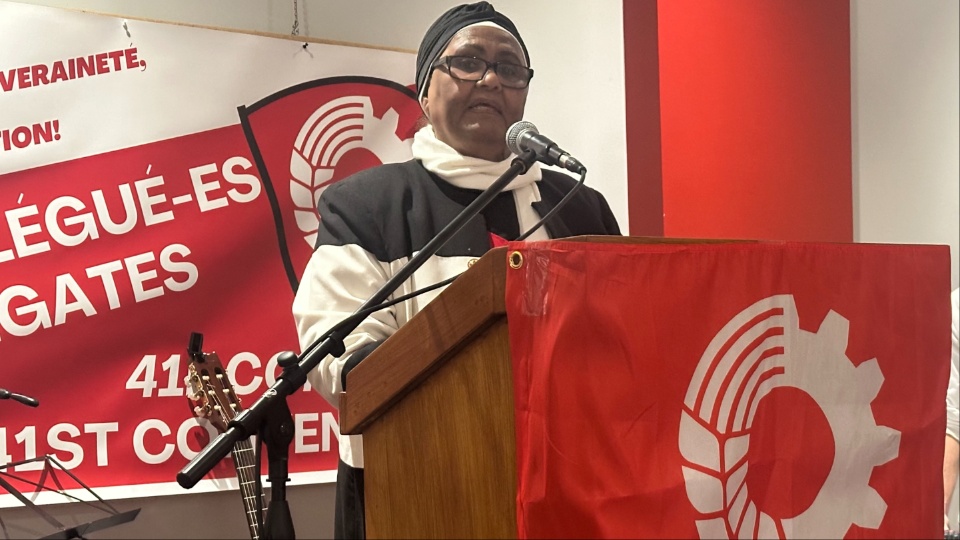
International help is desperately needed to halt hostile outside intervention and stop the killing. That’s the message that Salwa Saied wants the world to hear. She’s a longtime member of the Sudanese Communist Party (SCP), and People’s World had the privilege to speak with her on the sidelines of the convention of the Communist Party of Canada, held in Montreal, Dec. 5-7.
Using the word crisis to describe the current situation in Sudan would be an understatement, and the atrocities accumulate faster than anyone can keep up. Even as People’s World was interviewing Saied, she received a message on her phone from her comrades about an attack on a school back home that killed dozens of kindergartners and their teachers.
A ruthless anti-people war
She said her country is being torn apart by warring factions, none of whom are on the side of Sudan’s poor and working-class population. “Fascist forces, through their two wings, the Islamist movement and the Rapid Support Forces, have been waging a ruthless and large-scale war since April 15, 2023,” Saied said.
The civil war, which features fighting among and between paramilitary forces and the official state army, the Sudanese Armed Forces (SAF), is complicated by the actions of regional actors—most notably the United Arab Emirates—which has supplied arms to the RSF in exchange for access to gold from Sudan’s mines.
Saied and the SCP argue that the atrocities and aggression of the Islamist groups and RSF that have been witnessed over the last few years are “primarily aimed at obstructing the December 2019 revolution” in Sudan, which “demanded freedom, peace, justice, and democratic transformation.”

That revolution got its start with mass protests in December 2018 that eventually resulted in the overthrow of dictator Omar al-Bashir and the assumption of state power by the military. The Communist Party, in conjunction with the Sudanese Professionals Association and neighborhood resistance committees, participated in the protests.
The party had long opposed al-Bashir’s dictatorship and stayed in the streets with the people after he was gone, determined to not let the military cement itself in place. It saw the uprising as, essentially, a class revolt against military-Islamist rule that was eventually sabotaged by compromises made with the generals, resulting in a hijacking of the revolution.
Demands for a quick transition to civilian rule by the SCP, labor, and the other forces of civil society were quickly derailed following the launch of the revolution.
The first blow was the “Khartoum massacre” of 2019, which saw SAF and RSF forces—then united in the “Transitional Military Council” (TMC)—kill hundreds and rape dozens in an attempt to disperse the crowds who were still agitating in the streets demanding that the people themselves, not soldiers, should determine the country’s future.
The RSF is a holdover of past fighting, born out of al-Bashir’s genocidal suppression in Darfur in the early 2000s. Many of its troops are thus veterans of past war crimes and mass killing campaigns, so their participation in the Khartoum massacre and other atrocities came as no surprise.
RELATED STORIES:
> Foreign imperialism and domestic divisions collide to create catastrophe in Sudan
Hopes to salvage the revolution and for the people to re-seize the initiative from the TMC were dashed when a split occurred between the SAF and the RSF in 2023. Since then, the people of Sudan have been caught in the crossfire, leading to the mass displacement of at least 12 million and the deaths of uncounted numbers of people.
Complete social collapse
Saied said it is the details of that human side of the fighting which should spur the world to action. As a mother of four daughters herself, the situation of women in Sudan particularly pains her heart.
“You may have heard about documented genocidal atrocities, such as those that recently took place in the city of El Fasher and its surroundings. Those atrocities have shocked the global conscience with killings and mass rapes of women and sexual slavery.”
But, Saied said, “these have become daily practices for both sides in the war.” Another common tactic is the “enforced disappearance of thousands of citizens, including women and children.” Even if civilians manage to escape or survive, there is also a mental health disaster in the offing that will play out for years and across generations, as Saied warned there is a “total absence of psychological support for the victims.”
People don’t even have time to process the affect the war is having on their psyche, though, because many of them are devoting their days to scrounging for food to keep themselves alive. “There is a crisis of in obtaining enough food… famine stalks the country,” Saied said.
She provided People’s World with documents detailing some of the latest statistics compiled by the United Nations. Over 21 million face “food insecurity.” Another 14 million are determined to be in a “food crisis,” and 6.3 million have entered what the UN calls “a state of emergency food insecurity”—in other words, they’re starving to death.
Whether it’s hunger, disease, sexual assault, or gunshot wounds—the people of Sudan have nowhere to go for medical help when they need it. Saied’s documents show that 70% of the country’s health facilities are either destroyed or out of service.
“Cholera, malaria, and dengue fever have resulted in hundreds of deaths due to lack of healthcare, unavailability of lifesaving medications, and the nearly complete absence of medical staff,” Saied lamented.
These immediate disasters, already horrifying enough, are not the only problem Saied is worried about. There are also the calamities of the future that are currently in the works.
“One of the most notable features in this war, which has become known worldwide,” she said, “is the catastrophe it has caused for children.” She explained that there has been a “complete collapse of education institutions, depriving millions of children of their right to education, threatening the future of an entire generation.”
She said current estimates are that as many as 14 million children who should be enrolled in school are not in the classroom. “Affected schools and displaced people face significant difficulties in providing education, with the situation only expected to worsen if the conflict continues,” Saied told the World.
Many schools have been destroyed, while others have been repurposed as shelters for the people displaced from their homes by the war.
The kind of help that’s needed
Sudan’s Communists remain optimistic and have confidence in their people, despite the disaster that’s engulfed them. They’re asking for international help, but not the military variety of “assistance” that Western imperial powers or their regional accomplices are often eager to provide.
“Peace is primarily in the hands of the Sudanese people and their own living forces,” Saied said. “It is no longer hidden that the ‘Quad’ initiative is not a serious attempt to end the crisis.” The Quad refers to the consortium of the United States, Saudi Arabia, Egypt, and the United Arab Emirates, which claims to be working to achieve peace in Sudan.
Saied asserted that the Quad group’s main goal is to “contain the consequences” of the fighting in Sudan and “restore the balance of influence in the region.” The recent shift in rhetoric by these powers, whereby they express such concern for the humanitarian situation in Sudan, “does not reflect an ethical review” of their past positions and actions, she said.
Instead, the SCP believes the change is “a tactical necessity imposed by the resilience of the people, the exhaustion of the parties to the war, and the exacerbation of regional risks” to peace.
Saied said it’s important to remember that “all the major supporters of the warring parties in Sudan are allies of the United States.”
The SCP remembers well, she told People’s World, that “all of Washington’s dealings with Sudan have proven that the issues and aspirations of its people are merely pretexts employed to serve plans for sustaining dependency and facilitating resource exploitation.”
That’s why the most recent “roadmap to peace” did not deviate from the most minimal of objectives: “a fragile ceasefire, superficial settlements, and a nominal civilian government established outside the will of the Sudanese people.”

What’s needed is an immediate end to foreign interference, including shipments of arms and illicit finances to the warring factions; the termination of illegal outbound shipments of Sudan’s natural wealth, especially gold; and an urgent rush of food and health aid for its beleaguered people.
Saied urged Sudan’s friends and supporters to put these demands to their governments. “We need a campaign of solidarity by all the progressive and peace forces of the world to repel the imperialist assault and its regional agents against our country,” she said.
Sudan’s Communists hope that their “comrades in the world Communist movement will answer that call,” Saied said, and “do whatever they can to build an international movement to help win peace in Sudan and open the path for our people to decide our own future, free of interference and war.
We hope you appreciated this article. At People’s World, we believe news and information should be free and accessible to all, but we need your help. Our journalism is free of corporate influence and paywalls because we are totally reader-supported. Only you, our readers and supporters, make this possible. If you enjoy reading People’s World and the stories we bring you, please support our work by donating or becoming a monthly sustainer today. Thank you!
CONTRIBUTOR