Just east of Jerusalem in the West Bank, on the mountains overlooking the road down to the Dead Sea, lies the Israeli settlement of Ma’ale Adumim. Built illegally under international law, Ma’ale Adumim was first envisioned as far back as 1968, but its construction was only approved by the Israeli government in 1975—widely seen as retaliation for the Arab League’s recognition of the Palestine Liberation Organization (PLO) as the sole legitimate representative of the Palestinian people at the Rabat Conference that year.
The land on which Ma’ale Adumim sits was once home to the Jahalin Bedouin, a tribe originally displaced from the Negev in the early 1950s. After settling in the hills east of Jerusalem, they were again pushed out—this time by the construction and expansion of Ma’ale Adumim. In the 1980s and ’90s, more than a hundred Jahalin families were evicted, many forcibly relocated to an area beside the Jerusalem municipal garbage dump near Abu Dis.
These moves shattered their pastoral way of life, forcing many to abandon herding for wage labor—a modern form of dispossession and proletarianization. Today, Ma’ale Adumim is one of the largest Israeli settlements, noted for its manicured parks and flowers.
On its far eastern edge sits the neighborhood of Mitzpe Nevo, an exclusively religious community known for its high percentage of English-speaking settlers from the United States and the United Kingdom.
I remember visiting as a child, when a cousin—then a leader in the settlement movement—took my family to Mitzpe Nevo “to show us something important.” I expected him to point out the neighborhood’s luxurious apartments.
“Crown jewel” of settlement project
Instead, he led us to a lookout to the north side of the Dead Sea Road, where a vacant stretch of desert surrounded a lone traffic circle. “That,” he said, “is E1. It is the crown jewel of the settlement project.”
He explained that while international pressure had so far prevented Israel from building there, the day the government gave the green light for E1, it would be the “final nail in the coffin” for any Palestinian state. Decades later, that green light has come.
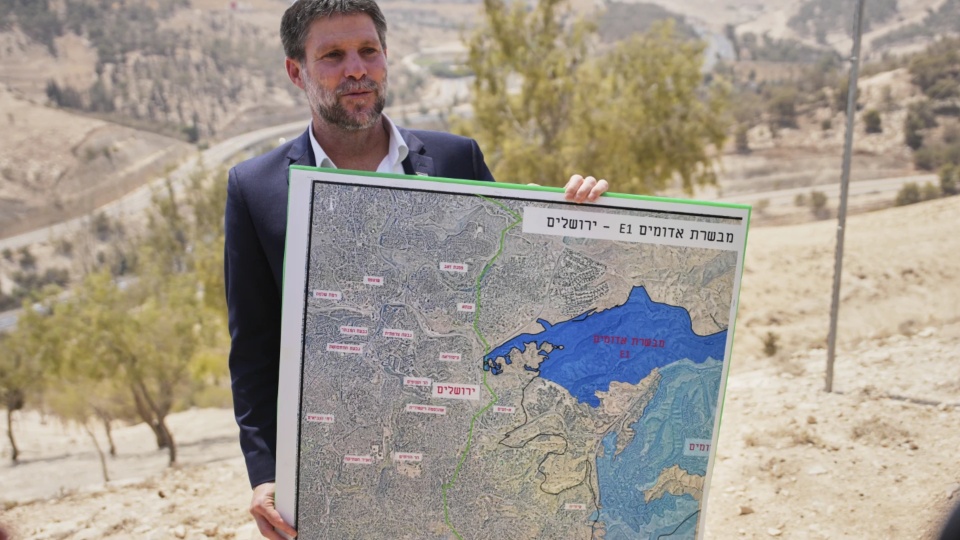
The importance of E1 to the settler movement and the “Greater Israel” project is twofold. First, together with Ma’ale Adumim, it would complete a ring of settlements encircling East Jerusalem—making it nearly impossible to divide the city and preventing it from serving as the capital of a future Palestinian state.
Second, along with other settlements along the Dead Sea Road, E1 would bisect the West Bank from west to east, ensuring there could be no contiguous Palestinian territory.
Bezalel Smotrich, Israel’s far-right finance minister and the official overseeing West Bank affairs in the Ministry of Defense, openly celebrated the decision for precisely these reasons. “Approval of construction plans in E1 buries the idea of a Palestinian state and continues the many steps we are taking on the ground as part of the de facto sovereignty plan that we began implementing with the establishment of the government,” he declared.
The decision was met with swift condemnation from governments around the world. Egypt, Jordan, and other Arab states were quick to respond. Jordan’s ambassador, Sufyan Qudah, called the move “illegal” and “a blatant violation of international law.” Egypt denounced Smotrich’s “extremist statements.”
Soon after, Western governments also voiced strong opposition. UK Foreign Minister David Lammy condemned the plan as “a flagrant breach of international law” that “would divide a future Palestinian state in two” and urged Israel to stop it immediately.
EU High Representative Kaja Kallas called the decision “a breach of international law” that “further undermines the two-state solution,” while a German Foreign Ministry statement warned it would “effectively split the West Bank in half and cut East Jerusalem off from the rest of the West Bank.” This is seen as particulaly notable as German governments have historically avoided publicly opposing the polcies of the Israeli governments.
Unsurprisingly, the United States—Israel’s primary financial and diplomatic enabler—has so far issued no condemnation.
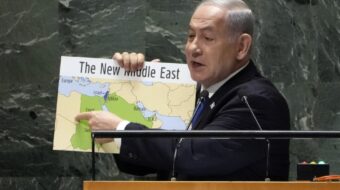
This escalation comes as Netanyahu has declared that the Israeli military will fully occupy the Gaza Strip and forcibly depopulate entire cities. Smotrich has already announced plans to build new Israeli settlements on the newly seized land in Gaza.
In full view of the world, the Israeli government is taking deliberate, coordinated steps to ensure that the Palestinian people remain stateless and denied their human rights. From the West Bank to Gaza, the so-called “Greater Israel project” is being put into effect.
We hope you appreciated this article. At People’s World, we believe news and information should be free and accessible to all, but we need your help. Our journalism is free of corporate influence and paywalls because we are totally reader-supported. Only you, our readers and supporters, make this possible. If you enjoy reading People’s World and the stories we bring you, please support our work by donating or becoming a monthly sustainer today. Thank you!
CONTRIBUTOR