

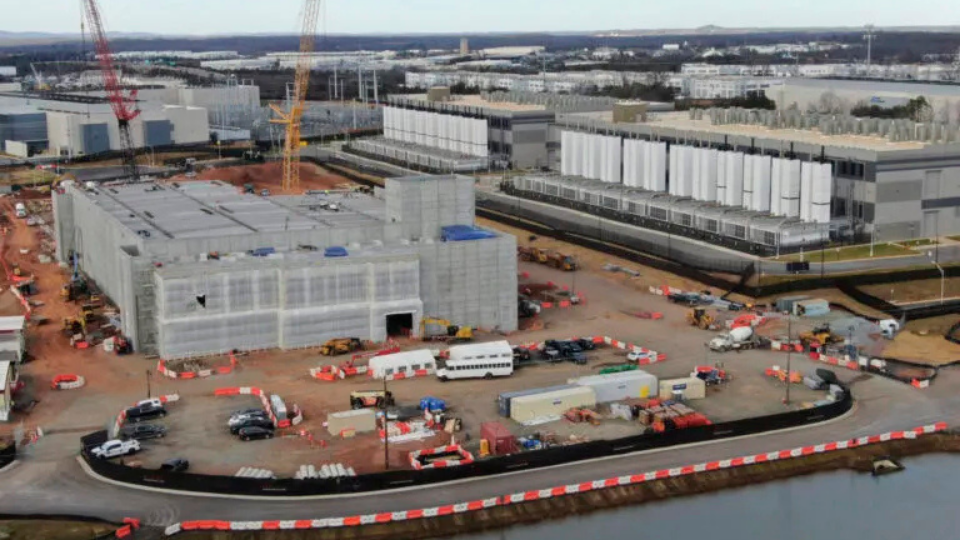
As flights take off from Washington’s Dulles Airport, few passengers realize what they’re looking at below. Sprawling across the landscape are hundreds of boxy, windowless buildings handling roughly two-thirds of the world’s internet traffic.
Nicknamed “Data Center Alley,” this region hosts the densest concentration of data centers anywhere on Earth, with projections suggesting that as many as 1,000 facilities could occupy nearly 20,000 acres of land in Northern Virginia and nearby parts of Maryland by the 2030s. At the national level, federal policy is accelerating a proposed $500 billion private-sector investment in AI data infrastructure under the Stargate Initiative.
The impacts of this growth are becoming increasingly difficult to ignore in the regions where facilities are most concentrated. As a resident of Arlington County, which is in Northern Virginia directly across the Potomac River from Washington, I initially suspected the sharp rise in my Dominion Energy electricity bill was linked to the rapid expansion of nearby data centers. However, further investigation into their impacts revealed a broader range of costs that are not widely understood by the public.
Although data centers underpin the global digital economy, their impacts are highly localized. Disparate health outcomes from air pollution, a drying Potomac, and intense noise pollution are among the many consequences falling disproportionately on hotspots like Northern Virginia, where development is outpacing infrastructure capacity and regulatory oversight.
Making Virginia the data center hub. Arlington County is home to several prominent American landmarks, including the Pentagon and Arlington National Cemetery, but unlike neighboring jurisdictions in Northern Virginia, it is not a major hub for data centers. They are clustered primarily in nearby Loudoun, Fairfax, and Prince William counties. More specifically, Loudoun hosts the highest concentration of data centers in the world.
Around the beginning of the dot-com era, roughly 80 percent of Loudoun County’s tax revenue came from residential property. The county faced ongoing fiscal strain, later intensified by the 2008 financial crisis, and as property values fell and tax revenues declined, local officials looked for a new source of revenue.
Loudoun County—and Northern Virginia more generally—quickly emerged as an ideal location for data centers given its proximity to Washington’s fiber-optic infrastructure, investments in the regional power grid, and low risk of major disasters. In 2021, the Federal Emergency Management Agency identified Loudoun County as the “safest county” in the United States based on exposure to 18 types of natural disasters.
State-level policy also helped drive data center growth—particularly Virginia’s 2009 sales tax exemption on data center equipment, which saves companies more than $130 million dollars each year. Nearly two decades later, Loudoun County is home to roughly 200 data centers. They generate nearly half of the county’s tax revenue, contributing more than $1 billion annually.
Accelerating growth. Even as Northern Virginia became increasingly saturated with data center development, new proposals continued to surge in response to the unprecedented growth in global data creation. Between 2010 and 2018, the amount of data generated worldwide increased nearly thirtyfold, from 1.2 zettabytes to 35 zettabytes—enough data to store over 36 million years’ worth of high-definition video. By 2025, that figure had risen to an estimated 175 zettabytes, reflecting not just rapid growth in artificial intelligence and cryptocurrency systems, but also a broader shift in how digital services operate.
Everyday activities—including web searches, email, streaming, and video conferencing—have historically depended on data centers to store and process information. However, these systems are increasingly relying on more computationally intensive applications, including AI models that must be trained on massive datasets.
Not only has the number of data centers increased, but proposed facilities are also, on average, five times larger than existing data centers in Virginia.
The Potomac in trouble. Perhaps nowhere are the stakes higher than in the Potomac River watershed. Data centers require enormous volumes of water for cooling, around 100 million gallons per year for a single mid-sized facility. For perspective, this is roughly equivalent to the annual use of about 1,000 US households. However, what is often unacknowledged is not the amount of water used, but where it comes from. Water withdrawals are highly localized, meaning that global digital demand is placing concentrated pressure on a single river basin. While someone is querying an AI chatbot online in Asia or Latin America, they may be leaving a digital footprint on a data center in Virginia.
Locally, that resource pressure is intensifying. Water is already heavily allocated to local industry and agriculture, and data center demand has risen roughly 250 percent in just four years. In Northern Virginia alone, data centers consumed nearly 2 billion gallons of water in 2023, a 63 percent increase since 2019.

And while data centers represent only a small fraction of the region’s water-consuming facilities, they consume a disproportionate share of supply, drawing roughly 9 percent of annual withdrawals from the Potomac River and up to 12 percent during peak summer months.
That footprint is expected to grow rapidly. By 2035, data centers could account for as much as a quarter of total water demand in the Washington metropolitan area. Some projections estimate withdrawals reaching 200 million gallons per day, approaching the volume of Washington’s Tidal Basin, a reservoir covering more than 100 acres near the National Mall.
Drought conditions, exacerbated by shifting climate patterns, are making the situation worse. As of April 2026, the US Drought Monitor classified most of Loudoun County and 92 percent of Virginia as experiencing severe drought conditions.
Large-scale water withdrawals can accelerate groundwater depletion, outpacing the natural recharge that occurs slowly through rainfall filtering into soil and bedrock. As reserves decline, less water flows into the streams and tributaries that feed the Potomac, increasing pressure on an already strained watershed. As of last month, the river was at its lowest level for this time of year in 130 years. Citing the rapid expansion of water-intensive data centers, the nonprofit conservation group American Rivers recently ranked the Potomac as the most endangered river in the United States.
Disproportionate pollution outcomes. The surge in development is also straining the region’s energy system. The PJM Interconnection, the largest grid operator in the United States, projects that nearly all electricity demand growth through 2045 will come from data centers. Local utilities, including Dominion Energy, have indicated that meeting this demand will likely require continued reliance on coal and expanded natural gas capacity, particularly as policy shifts in the current administration have purposely slowed the deployment of renewable energy.
Virginia’s energy mix complicates this challenge. The state already generates 54 percent of its electricity from natural gas, with a smaller share from coal, and imports more than one-third of its power—more than any other US state—from coal-heavy regions. This mix produces significant methane emissions, and rising data center demand is expected to intensify these impacts during periods of peak usage, including grid emergencies or heat waves.
To maintain reliability, data center operators have turned to backup diesel generators. Virginia now has more than 4,000 of these units, which are primarily used during outages and routine testing. Although not constantly active, they collectively operate between 35,000 and 51,000 hours each year, emitting harmful pollutants such as nitrogen oxides, particulate matter, and carbon monoxide.
A 2026 Virginia Commonwealth University study found that emissions from these generators in Northern Virginia have risen sharply. However, these figures represent only a small share of the total emissions permitted under existing data center air quality permits, meaning actual output could increase substantially if facilities operate their generators at full capacity.
This worst-case scenario is plausible during periods of grid stress. In January 2026, for instance, extreme cold from winter storm Fern caused record electricity demand in Virginia, placing significant strain on utilities. In response, PJM Interconnection requested federal approval for data centers to operate on their diesel backup generators so additional power could be redirected to the grid.
The health implications are significant. One analysis estimates that emissions from a single Loudoun County facility, the Vantage Data Center, could cause between $53 million and $99 million in annual health damages, including premature deaths and increased rates of respiratory and cardiovascular illness. If future emissions remain at their current levels, the facility could cause an estimated 17 to 33 premature deaths over five years and 102 to 195 deaths over 30 years.
These impacts are not evenly distributed. When researchers at the university compared this air pollution data with regional census maps, they found that communities with fewer resources were more likely to experience higher exposure to data center-related air pollution.
Admittedly, Loudoun County is often recognized as the wealthiest county in the United States, with a median annual household income just over $170,000. However, this overall prosperity masks significant inequality. Many workers in lower-wage sectors, such as hospitality, earn roughly $34,000 per year, and about 16 percent of students in Loudoun County Public Schools qualify for free or reduced-price meals.
The areas facing the highest estimated impacts in Loudoun County closely align with communities recognized as low-income populations or communities of color under the Virginia Environmental Justice Act.
More than just an inconvenient noise. Along with air pollution, data centers also generate persistent noise pollution, typically characterized as a constant, low-frequency hum. Noise levels near facilities often range from 40 to 59 decibels, comparable to moderate rainfall or the sound of a normal conversation.
For nearby residents, the result is not necessarily sharp or painful noise, but a constant mechanical presence that persists as long as the servers inside the data center remain operational. Low-frequency hums are particularly difficult to escape, because they travel more easily through walls and are harder to block with standard earplugs than higher-pitched sounds.
This continuous exposure is more than just a nuisance. The US Environmental Protection Agency recommends outdoor noise levels remain below 55 decibels to protect public health, yet data centers near residential areas often approach or exceed that threshold. Short-term effects include sleep disruption and stress, while long-term exposure has been linked to cardiovascular, cognitive, and mental health risks. Children are especially vulnerable, with studies showing that chronic noise exposure can impair their concentration, reduce reading comprehension, and negatively affect academic performance.
The future of data centers. With these impacts in mind, it is not surprising that public support in Virginia has declined sharply. According to a Post-Schar School poll, only 35 percent of voters now say they would be comfortable with a new data center in their community, down from 69 percent in 2023.
But as demand for digital infrastructure grows alongside advances in artificial intelligence, data centers are unlikely to go away. What was once viewed as an economic asset for Virginians should now raise serious concerns. The region is no longer confronting the addition of a handful of facilities, but rather the prospect of hundreds in an oversaturated market. Managing this development responsibly requires moving away from reactive or antagonistic responses and toward deliberate planning, regulation, and the integration of these data centers into communities in ways that limit harm.
Virginia must establish a statewide review and permitting framework for large data center projects to complement local approvals and account for regional impacts. While localities compete to attract these facilities, the costs are distributed far beyond county lines. Areas that will not benefit from any data center tax revenue, and have little or no stake in review processes, will still see increased water demand and air pollution. Without state oversight, permitting often fails to assess aggregate impacts across municipalities, allowing projects to move forward under standards far less rigorous than those applied to comparable energy infrastructure.
Roughly two-thirds of data centers built since 2022 are in water-stressed regions. In those regions, data center policy should align incentives with sustainability. Tax benefits must be tied to clean energy use, discouraging expanded reliance on gas turbines and diesel generators. Reassuringly, technological solutions can improve water efficiency: for example, using recycled water from sewage plants for cooling or circulating cooling water through a closed-loop system. However, water remains relatively inexpensive, meaning companies face little financial pressure to conserve.
Northern Virginia once turned to data centers to stabilize its economy. But as demand for artificial intelligence, cloud computing, and streaming services accelerates worldwide, the scale of expansion threatens to overwhelm a region with the very infrastructure it helped pioneer.
As an Arlington County resident, I live eight miles from the nearest data centers in Fairfax and Loudoun counties, yet their impacts still reach my community. The water in my Arlington kitchen and downtown DC office both come from treatment facilities that draw directly from the Potomac River.
The institutions at the center of American power—the White House, the Capitol, and the Pentagon—all depend on the Potomac for water. The nation’s highest officials breathe air that sometimes carries pollution downwind from Loudoun County. But most of the nearly 6.5 million people who call the Washington metropolitan area home have little say over the data center decisions that are already affecting their daily lives.
Bulletin of the Atomic Scientists
We hope you appreciated this article. At People’s World, we believe news and information should be free and accessible to all, but we need your help. Our journalism is free of corporate influence and paywalls because we are totally reader-supported. Only you, our readers and supporters, make this possible. If you enjoy reading People’s World and the stories we bring you, please support our work by donating or becoming a monthly sustainer today. Thank you!
CONTRIBUTOR




MOST POPULAR TODAY

Warnings sound: Trump ready to stage what amounts to a full-fledged coup

Workers walk: Almost 100K California employees struck for a day

Grenada marks 40 years since the assassination of revolutionary leader Maurice Bishop

As Israeli lawmaker advocates rape of Palestinians, U.N. report details detainee torture

In spring 1894, the jobless marched on Washington from every direction