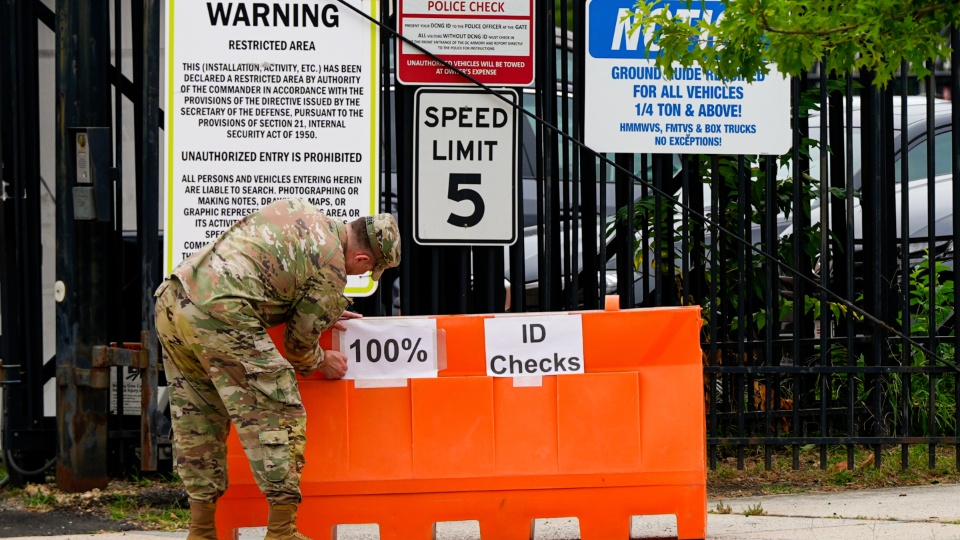
WASHINGTON—President Donald Trump has made good on his threat to impose military rule on the nation’s capital. After ranting for days about a supposed—but factually unfounded—crime crisis engulfing D.C., Trump announced Monday evening that his administration is federalizing the District’s police force and deploying 800 National Guard troops to “re-establish law and order.”
The Communist Party USA is warning that the impact of this assault on D.C.’s self-governance goes beyond just Washington, however. In a statement issued Tuesday, the CPUSA was stark in its assessment, telling Americans everywhere, “Your town might be next.”
The president’s own words provided back-up for the Communists’ charge. Speaking to the media Monday, he listed out potential next targets: “We have other cities also that are bad, very bad. You look at Chicago, how bad it is. You look at Los Angeles, how bad it is. We have other cities that are very bad. New York has a problem. And then you have, of course, Baltimore and Oakland.”

Like D.C., every single one of the cities on Trump’s hit list are governed by Black mayors and have populations that are majority people of color, and in the case of Baltimore, majority Black. Others could join it, such as Philadelphia.
The racial dynamics of Trump’s maneuvers—especially his attacks on young people as the supposed source of the threat to public safety—are barely concealed.
“Local ‘youths’ and gang members … are randomly attacking, mugging, maiming and shooting innocent citizens,” Trump claimed last week after Department of Government Efficiency (DOGE) staffer Edward Coristine, the 19-year-old infamously known as “Big Balls,” was allegedly assaulted by a group of teenagers in D.C.
Trump alleged that D.C. youth do not fear law enforcement “because they know nothing ever happens to them,” a situation he says will be solved by unleashing National Guard soldiers on the streets and ending cashless bail, a priority pushed by his new U.S. Attorney for D.C., anti-immigrant Fox News host Jeanine Pirro.
Trump’s singling out of young people in the capital—along with his earmarking of the homeless and immigrants in D.C.—fit with what the CPUSA statement characterized as “his lifelong pattern of racist targeting of Black youth, immigrants, and the unhoused.” He intentionally chooses those populations who are already most vulnerable to “police terror,” the party said.
Beyond being patently motivated by racial stereotypes, Trump’s supposedly crime-focused campaign against D.C. also flies in the face of statistical reality.
His executive order seizing control of D.C. alleges that “crime is out of control” and that “rising violence” endangers government workers, citizens, and tourists; disrupts public transit; and impairs “the proper functioning of the Federal Government.” It claims that D.C. is “one of the most violent jurisdictions” in the country and “among the top 20% of the most dangerous cities in the world.”
Data published by the Metropolitan Police contradict Trump and show that violent crime has been steadily dropping in Washington for years, interrupted only by a post-pandemic spike from 2020 to 2023. According to numbers from the Department of Justice, violent crime in the District is down 35% since 2023, and the baseline has returned to the pre-pandemic trend of decline, putting the violent crime rate at its lowest point in 30 years.
Statistics only tell part of the story, however, a reality that Trump is trying to leverage to gain support for his scheme. A recent Washington Post-Schar School poll of D.C. residents shows that public perceptions about safety among residents are lagging the decline of the short-term post-pandemic spike in crime.
Half of residents still feel crime is an “extremely serious” or “very serious” problem in the city, though this is a drop from the 65% who thought so last year. Concerns are higher among Black and lower-income residents, with Black women the most worried, at 65%.
Respondents to the poll felt, however, that D.C.’s crime rates—and their movement up or down—is not that different from other cities in the U.S. “I think D.C. has had similar drops in crime over the past couple years as other places, and so much of that has to do with larger conditions,” one resident told pollsters.
Trump uses coded language, however, to oversimplify problems that come from having higher population densities and economic crises and instead attributes them to race. Because of police harassment and violence, many know of the dangers of “driving while Black,” but, as one observer put it, Trump escalates that to “living in a city while Black.”
His rhetoric won’t convince the people who live in D.C., though. The same WaPo-Schar poll, which is already three months old, showed that 77% of residents were opposed to Trump’s threats to take over Washington. Another 80% were extremely concerned about the Republican Congress reducing the city’s budget. With this week’s actions by the White House, the numbers are no doubt higher.
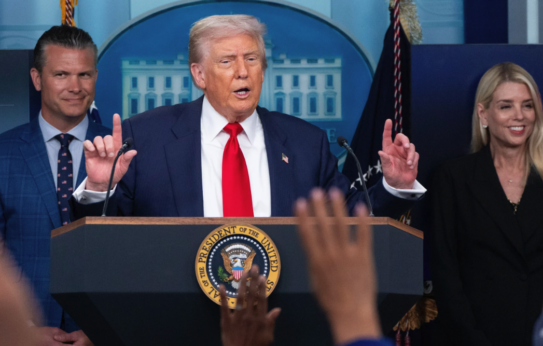
They see Trump’s claim as a pretext to repeal Home Rule—the limited political autonomy granted to the District’s 700,000 residents by a 1973 law—and establish military rule over a democratic and progressive city.
Lo, a member of the Metro D.C. Club of the CPUSA, told People’s World that the Trump takeover “is not a protection from crime, rather it is a show of force—taking away the little amount of control the people of D.C. had over their police force.”
“I think that this move by Trump is the next step in his efforts to control and contain minority communities,” Gabe, another member of the CPUSA club there, said. “Just like how Reagan used his ‘war on drugs’ cover to attack Black and brown people, Trump is utilizing the excuse of crime and homelessness to attack those very same communities with a militarized force.”
He predicted that the full extent of Trump’s takeover will be seen in places like D.C.’s historic Shaw neighborhood—a hub of Black social and cultural life—rather than in higher-income and whiter areas like Georgetown. Gabe said there is an “obvious racist subtext” behind the president’s actions and that, unfortunately, such mass policing activity will be rolled out to “other cities with large minority populations.”
With his crime hook, Trump is also distracting attention from the economic crisis that has engulfed D.C. because of his attacks on the federal workforce—the largest employer of African Americans—and the fact that the MAGA-dominated Congress has stripped over a billion dollars from the city’s budget.
D.C., because of its unique status under the Home Rule Act and its lack of statehood, is the easiest target for Trump and could become the prototype for what he’d like to do in other large cities.
That’s part of why the Communist Party, in its statement, said the Trump takeover of D.C. is a “step in the direction of fascism” and shows that the president is inching “closer to dictatorship.”
The party is emphasizing the need for unity to defend Home Rule and win statehood in the case of D.C., and to save democracy nationwide, it says the next immediate step is to maximize turnout for the Aug. 28 March on Wall Street and at Labor Day protests.
“First, they ignored the courts, then they set up the ‘Alligator Alley’ concentration camp, now they’re sending in the army,” CPUSA National Co-Chair Joe Sims said Tuesday. “If they came for L.A. in the morning and D.C. at noon, guess who they’re coming for at night? The time to fight back is now.”
We hope you appreciated this article. At People’s World, we believe news and information should be free and accessible to all, but we need your help. Our journalism is free of corporate influence and paywalls because we are totally reader-supported. Only you, our readers and supporters, make this possible. If you enjoy reading People’s World and the stories we bring you, please support our work by donating or becoming a monthly sustainer today. Thank you!
CONTRIBUTOR