Nazi beats Communist. Speaking in oversimplified terms, one could argue that’s what happened in Chile’s presidential election on Dec. 14. But as with every electoral contest, vote totals are but a snapshot, a moment in time in a still-unfolding struggle.
The defeat of Communist Party candidate Jeannette Jara is a stinging blow—not just for the left and labor in Chile, but for working people everywhere who needed a win as the right wing marches onward and capitalism’s cost-of-living crisis worsens around the globe.
Jara’s loss to extremist José Antonio Kast—son of an exile from Nazi Germany and defender of late Chilean dictator Augusto Pinochet’s “order”—represents a serious setback. Kast, a champion of corporate power, scored 58% to Jara’s 42% in the run-off vote. It would be an error, however, to simply read this result as a rejection of the ideas of socialism, of worker rights, or of democracy.

What happened in Chile was not a collapse of the left or the labor movement, but rather a warning about the political terrain that workers are fighting on internationally. It is an opportunity to study what strategies and tactics have worked and see what lessons can be applied across borders.
As Jara said in her concession speech, “It is in defeat that we learn the most.”
Her campaign emerged from years of mass struggle: the 2019 social explosion against inequality in Chile; a powerful women’s movement determined to defend abortion rights and end gender-based violence; the resurgence of organized labor; and the unfinished battle to bury the fascist Pinochet-era constitution once and for all.
As minister of labor in Gabriel Boric’s progressive government, Jara already proved what it means to govern on behalf of workers. She showed what it looks like when the working class starts to exercise political power: hikes in the minimum wage, stronger collective bargaining laws, and using the state to confront corporate bosses who treat employees as if they’re disposable.
Her candidacy—which was the result of popular front-style coalition politics—represented continuity with those struggles and the hope that they could be carried forward with a confident and capable left-wing woman in the country’s highest office.
The hope was real. As one young supporter, 20-year-old student and worker Isadora Hernandez, put it ahead of the vote, “It’s the first time a candidate has represented me so much.”
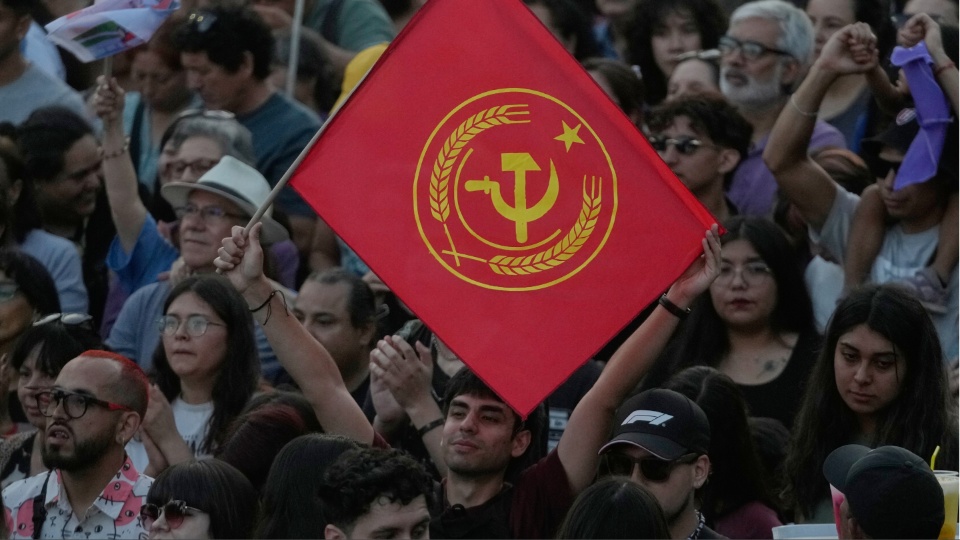
Millions of people voted for Jara knowing exactly who she was: a Communist, an ally of trade unions, a woman committed to dismantling Chile’s extreme concentration of wealth. In a deeply polarized election with the whole world watching, more than four in ten voters cast their ballots for her.
That fact alone should silence those who argue that left politics are out of touch with ordinary people, like the Wall Street Journal, which hailed Kast’s win as proof that the socialist left “never had the social or political support” to remake a capitalist economy like Chile’s.

Despite the pompous ranting of this ruling class media mouthpiece, there’s no getting around the fact that Kast did indeed win—by what would typically be called a “landslide” margin. He did it—as have so many right-wing leaders—by mobilizing fear.
This election was decided less by competing economic visions than by anxiety: fear of crime, fear of instability, fear of social change itself. The right has learned how to weaponize those fears effectively. If this election had been a contest of one economic platform against another, it’s hard to imagine Kast would have carried the day.
He offered no real solutions to the country’s yawning wealth gap or the economic insecurity felt by the working class. Instead, he dished up a program of repression, scapegoating, and nostalgia for the “order” of the fascist era under Pinochet.
Kast took a page from Trump, pledging to “Make Chile Great Again” by expelling immigrants, unleashing the police to stamp out criminals, and getting the economy moving by freeing the hand of big business and staying on the good side of the man who occupies the White House.
That message—amplified relentlessly by corporate media, conservative institutions, and Kast’s international allies—found fertile ground among a large swathe of Chilean voters exhausted by crisis and frustrated with the slow pace of change.
The election was shaped by the historic and current dynamics of the class struggle in Chile, but the pattern of how it played out was not totally unique. From Argentina to the United States to Europe, the far right has advanced not because its ideas improve people’s lives or address the problems of capitalism, but because it exploits the disorientation and desperation created by neoliberal decay.
When public services are hollowed out, when wages lag behind prices, when jobs evaporate, when housing becomes unaffordable, fear fills the vacuum. If the left does not organize that anger into collective action fast enough, the right redirects it downward—toward immigrants, the poor, unions, and the left itself.
The Communist Party of Chile and its allies in the Unidad por Chile (Unity for Chile) coalition also faced significant structural disadvantages that cannot be ignored. The legacy of the fascist dictatorship still shapes the country’s public institutions, media, and economy. Major sections of the capitalist class yearn to have a strongman who’s in their pocket back in the driver’s seat, and they use their influence to steer public debate toward such an outcome.
The defeat of Chile’s constitutional reform process—driven largely by ruling class sabotage and misinformation—also left many voters cynical about the possibility of change through politics at all. Jara’s campaign was not simply fighting Kast, then; it was also combatting decades of ideological damage done by authoritarianism and austerity.
But here is what the right—whether it’s Kast or the editors of the Wall Street Journal—wants people to forget: The movements did not lose.
Trade unions in Chile remain organized and are preparing themselves to resist what the new government thows at them. The women’s and students’ mobilizations of the past few years have not died out. Indigenous people are signaling that their struggles for land and sovereignty will be stepped up.
Furthermore, the Communist Party and its allies did not vanish with Jara’s loss. Don’t forget: They just turned out 42% of the country’s voting population, but their power is found not just in ballot counts. The party is embedded in workplaces and neighborhoods across the country, and that infrastructure provides the foundation for the fight that will be needed against Kast and his backers—whether they’re found in Chile’s corporate boardrooms or in the Oval Office in Washington.

History teaches the lesson again and again that elections are moments, not endpoints. Salvador Allende lost multiple presidential races before winning in 1970, and even then, power was not conceded willingly by Chile’s ruling class or U.S. imperialism. Progress always comes through sustained struggle.
Kast’s presidency will no doubt test that tradition. His agenda threatens immigrants, women, organized labor, LGBTQ people, human rights, and democracy in general. Resistance will not be optional.
For the international left and labor movements, including here in the United States, Chile’s election carries urgent lessons. Electoral work must be rooted deeply in mass organization, community needs, and the realities of working-class life. Fear must not be confronted merely with technocratic reassurances from detached liberal political elites but with collective confidence built through struggle. And victories—when they come—must be defended against ruling class rollback.
Jeannette Jara did not lose because the vision of the coalition she led was wrong. She lost because that vision challenges entrenched power that will not yield without a fight. The task for workers in Chile and elsewhere is not retreat, but clarity about what’s happened and what to do next.
Chile’s working class did not disappear on election night; neither did its aspirations. The road forward under Kast will be harder, but the forces that produced Jara’s candidacy are still there—learning, organizing, and preparing for what comes next.
The country’s most infamous fascist son may have won the presidency, but he has not won the future.
As with all op-eds published by People’s World, the views expressed here are those of the author.
We hope you appreciated this article. At People’s World, we believe news and information should be free and accessible to all, but we need your help. Our journalism is free of corporate influence and paywalls because we are totally reader-supported. Only you, our readers and supporters, make this possible. If you enjoy reading People’s World and the stories we bring you, please support our work by donating or becoming a monthly sustainer today. Thank you!
CONTRIBUTOR