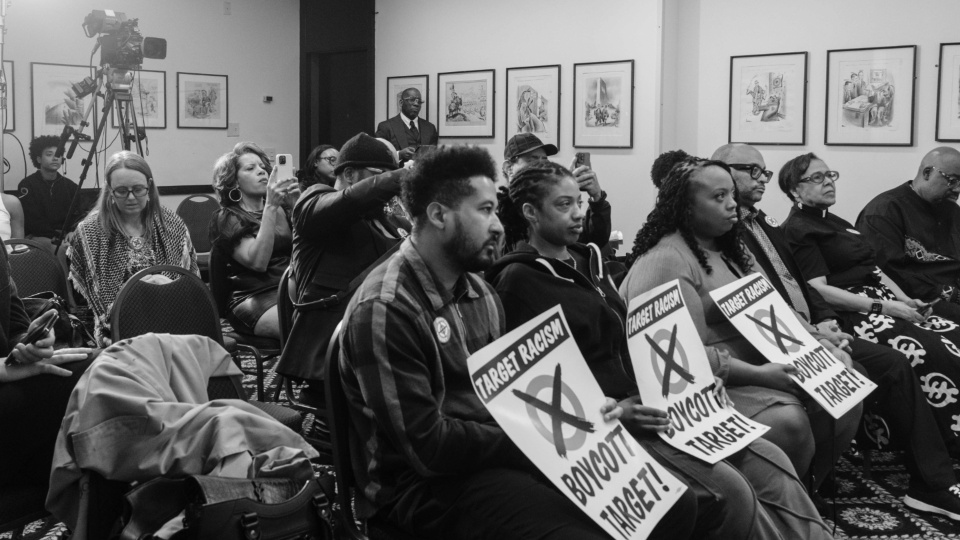
On Wednesday, March 11, the national leaders of the Target boycott—former Ohio State Sen. Nina Turner, Tamika Mallory, and Rev. Jamal Bryant, also known as the “Mothership Three”—held a press conference alongside the Boycott Target D.C. Coalition at the National Press Club in Washington to give the community and country an update on the state of the year-long Target boycott.
Over 400 days ago, Turner and her organization, We Are Somebody, called for a nationwide boycott of the retailer after an internal memo leaked on Jan. 24, 2025, saying the company would be rolling back its diversity, equity, and inclusion (DEI) goals and initiatives. Target had instituted the policies in the wake of the 2020 police murder of George Floyd a few blocks away from its headquarters in Minneapolis, Minn.
Turner later contacted Mallory, who heads the group Until Freedom, to jointly call for a boycott to begin on Feb. 1, 2025. Rev. Bryant of New Birth Missionary Baptist Church later called for a 40-day “Target Fast” during lent that lasted through Easter Sunday, transitioning to a full-fledged boycott supported by the Black church.
The campaign has now surpassed the longest and most successful previous Black-led boycott, the 381-day Montgomery Bus Boycott of 1955-56.

Despite a 27% drop in stock value, mass declines in both in-person and online foot traffic, three quarters of plunging sales, a 45% pay cut for its top executive, and the resignation of CEO Brian Cornell, Target remained silent for an entire year as to why it had rolled back its DEI initiatives and did not fulfill its pledge to invest $2 billion in Black-owned businesses.
Beginning in the fall of 2025, at the initiative of new CEO Brian Fiddelke, Target representatives finally began meeting with different groups of stakeholders around the country to begin a “dialogue” with the national boycott movement. Among those included were labor leaders, boycott leaders (including the coalition in D.C.), immigrant rights leaders, etc.—all under the guise of a sort of “apology tour” admitting to consumers and supporters of the brand that Target needs to do “a lot of work to repair its relationship with the Black community.”
At the Wednesday press conference, Rev. Bryant touted the accomplishments of the boycott while Turner and Mallory framed the conversation around how the movement came to be and thanked its tens of thousands of supporters who have participated. Bryant stated that meetings with the Target CEO and representatives have been productive and that concessions have been made from the corporation on three of the demands that were presented by the campaign one year ago:
- Target rebranded its DEI efforts as “Belonging,” while engaging in the same previous policies;
- Target has fulfilled 97% of its $2 billion investment commitment from 2020 and will be adding $100 million in addition; and
- Target has partnered with over a dozen HBCUs. $10 million was recently given to the Pensole Lewis College’s Business School in Detroit, for instance.
The fourth and final demand is that Target invest $250 million into Black banks. Rev. Bryant said Target is in conversation with the Black Bankers Association concerning investment into three Black-owned financial institutions. He noted, “Our generation needs to see victory, our generation has only seen settlements.” He continued by saying that this is the first step in the “new civil rights movement.”
At the closing of his remarks, Bryant responded to a question from a local reporter saying that this phase of the movement is coming to a close. He formally declared that the “Target Fast” portion of the boycott is effectively ending, specifying that the Target Fast is his entity and that Turner’s We Are Somebody and Mallory’s Until Freedom are separate organizations and will choose how they want to proceed.
Turner, standing alongside, stated that she would personally never step foot into a Target store again and demanded the company issue a public apology to the Black community.

Local D.C. leaders like Rev. Patricia Fears and Rev. Lewis Tait, Jr., claimed that the achievements outlined at Wednesday’s event represented a partial victory for the national boycott campaign, but they stood firm in their stance that Target still needs to meet local demands.
Those include investment into D.C.’s HBCUs, Howard University and the University of the District of Columbia (including its community college), and D.C.’s Black bank, Industrial Bank. They also disclosed that in a private meeting Target representatives admitted it had never invested into the D.C. community even though it has four stores in the District.
The local coalition plans to continue its boycott until Target pledges some investment into D.C. and comes out with a public apology, in line with Turner’s demand. Mallory noted that the energy, momentum, and success behind the boycott of Target needs to be directed toward more corporate targets.
She also said that there is still a lot more work to do to keep Target accountable to the community—including ICE staging in its parking lots and raiding its stores and having community oversight to ensure it stays committed to its pledges to the community.
At the conclusion of the press conference, headlines began popping up across different mass media outlets stating that the “Target Boycott Has Ended” and that Target made no concessions on DEI.
As activists who have been involved in the boots-on-the-ground effort of the boycott in Washington, D.C., and worked alongside the “Mothership Three,” we believe these headlines are misguided and meant to stir confusion and division among our community, Black people in particular.
Bryant specifically noted that he was “satisfied” with Target’s response and said that his component of the boycott movement (the Target Fast) will end effective immediately. It was clear that he was believed Target made key commitments and promises during meetings he had with their leadership.

In Bryant’s defense, movement leaders have historically had to determine when it’s the right time to make a strategic retreat. It’s not an easy call. One might reasonably argue that the movement is at its peak and that it is time to shift, but others see it differently—like local organizer Nekima Levy Armstrong in Minneapolis.
And Turner and Mallory have made it clear that they will both continue to boycott Target and still encourage people to do so until the retailer publicly acknowledges the harm it inflicted on the Black community. No stakeholder meetings will solve this problem. Target needs to publicly state why it was silent for a year, why it donated $1 million to Trump’s inauguration fund, and why it will not take a stronger public position against ICE and become a model 4th Amendment business.
Target has done real harm to the community, which was outlined most clearly in the commentary by other leaders following Bryant’s announcement.
If Target truly believed in “belonging” in the workplace, it would actively take an affirmative action approach by setting quotas for how many Black and brown executives it should have in its C-suite. It would take an active stance against ICE/CBP raids in its parking lots and stores.
Now, the question is, where does the movement go from here? Should pickets, protests, and occupations of stores continue? Or should there be a general retreat of the entire movement? Has Target learned its lesson? At this moment, the boycott movement is partially fractured by Bryant’s retreat and the media’s exploitation of that announcement.

Until all of the demands are met, including D.C.’s, the boycott of Target stores should continue. The movement should also expand to include the demands of ICE out of Minnesota, led by Unidos MN and other organizations. Maybe Target will learn a lesson once it sees a consistent two-year drop in sales and stock price. Maybe Target will learn a lesson when its workers begin union organizing due to their silence when it comes to ICE and DEI.
We hope you appreciated this article. At People’s World, we believe news and information should be free and accessible to all, but we need your help. Our journalism is free of corporate influence and paywalls because we are totally reader-supported. Only you, our readers and supporters, make this possible. If you enjoy reading People’s World and the stories we bring you, please support our work by donating or becoming a monthly sustainer today. Thank you!
CONTRIBUTOR