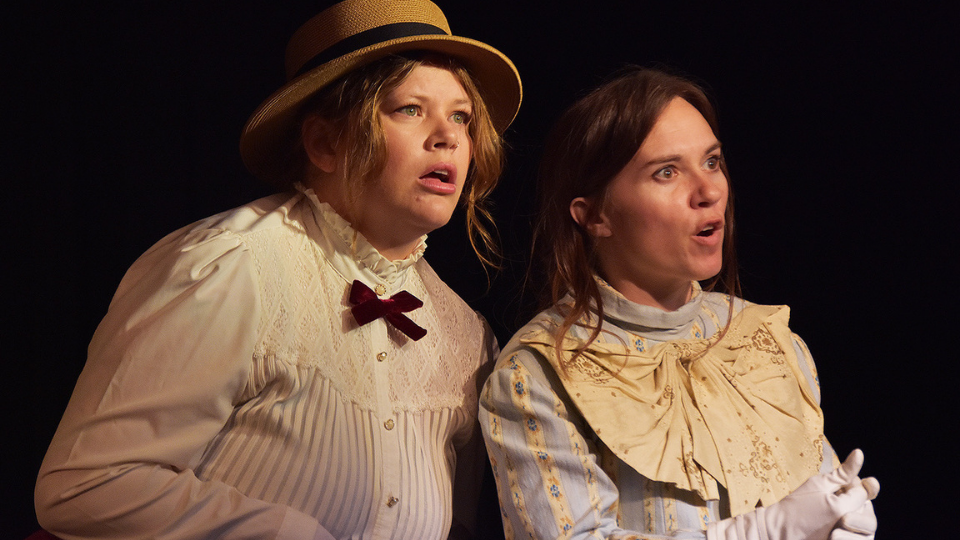
Playwright/director Arden Teresa Lewis’ outstanding Cassatt is simply a must-see for theatergoers enraptured by plays regarding artists, feminism, period pieces, art history, and more. Lewis’ bioplay dramatizes the life and career of the eponymous painter in a multimedia production that cleverly and creatively brings Mary Cassatt’s artwork and single-minded, resolute pursuit of her painterly avocation vividly to life.
A former dauber myself, I actually was greatly looking forward to seeing Cassatt and was not disappointed (unlike a recent Picasso one-man show that was a big letdown). I was proud of myself that the little I knew about Mary proved to be true: She was an American; likely the most prominent female painter among the predominantly French and male Impressionists (a word which Mary eschews during the two-acter); and that the subject matter of the 1844-born artiste revolved around concerns traditionally regarded as “feminine,” such as babies and children. Beyond confirming the scanty info I already possessed, Cassatt movingly, convincingly fleshed Mary out, and now my image of her has gone from being a mere sketch to a complete portrait, thanks to this insightful theatrical journey.
Western audiences are used to dramas depicting the struggles of tortured geniuses pursuing their unique visions, placing art above all else. Think of Kirk Douglas, who was Oscar-nominated for playing Vincent Van Gogh in 1956’s heartbreaking Lust for Life, for which Anthony Quinn, despite his brief screen time, won a Best Supporting Actor Oscar for his portrayal of Paul Gauguin. That Post-Impressionist who followed his aesthetic sensibility all the way to the South Seas has been depicted in many productions, notably 1942’s The Moon and Sixpence. Who can forget George Sanders’ thunderous response to Herbert Marshall at a Parisian café when asked why he deserted his family and career as a stockbroker: “I tell you, I’ve got to paint! I can’t help myself!” 
While there have been many dramatizations of male artists fighting against all odds to realize their artistic dreams, there have been far fewer about women talents’ crusades to become artists in their own right. In addition to battling to overcome conventional tastes and standards, they have to combat sexism, too. Interestingly, in 1988’s Camille Claudel, the title character, an aspiring sculptor and Rodin’s (Gerard Depardieu) lover, played by Isabelle Adjani, as well as wannabe dauber and Pablo’s (Anthony Hopkins) mistress Françoise Gilot (Natascha McElhone) in 1996’s Surviving Picasso, both must also transcend the shadows their acclaimed male partners have cast upon them.
In Cassatt, Samantha Gregory (who had a recurring role on NBC’s Good Girls) paints a portrait of Mary as a woman of steely resolve, determined to come what may and hell to pay to trailblaze her own path as an independent artist. At first, to follow her artistic aspirations, young Mary must defy her stodgy Pennsylvania family, in particular her father Robert, a banker (Daniel Korth in a multiple role; Saratoga Ballantine plays Mary’s mom). Finding 19th-century America to be too philistine and backwoods, she travels to more cosmopolitan Europe, where Mary earns a place beside the emerging Impressionist movement. As the invention of the camera has rendered the role of painting to create realistic representations and portraiture obsolete, painters are seeking new innovations, styles, and techniques to express themselves on canvas.
But even among her avant-garde comrades, who include Edgar Degas (Cecil Jennings) and Camille Pissarro (Daniel Korth), Mary is often, literally, the odd woman out. The patriarchal male painters wonder if a woman has the stamina to daub at an easel eight hours a day, or whether a “feminine” sensibility can grasp the depth of the human condition as profoundly as a man can, and other chauvinistic hogwash. Mary must summon all of her inner resources and talent to disprove and resist.
Before experiencing Cassatt, I had assumed Mary was a mater familia, a conventional petit bourgeois wife and mother, but Lewis’ drama set me straight. According to the biographical play, Mary never married, and she is never depicted onstage as having an explicitly romantic relationship with either gender.
Her interactions with Degas, famed for his exquisite oils and pastels of ballerinas and horses, are especially nettlesome, if not troublesome. The Impressionist praises her artwork—even if Mary is “only” a woman. At one point, Degas puts his finger on a central issue of the play, saying that while he could “marry” Mary, he could never “make love” with her. Cassatt’s quest to attain fulfillment and independence as an artist seems to have come at the expense of her own sexuality, or perhaps she sublimates her sensuality into her canvases.
During the two acts, it’s mentioned more than once that there’s something about Mary—a “hidden personality.” Was she hiding lesbianism? Sexual repression? Who knows (she’s shown burning many of her personal papers and letters)? I was surprised to see that the individual who painted such placid pictures was (like many male artistes!) temperamental, willful, and prone to outbursts of rage. To complicate matters, at some point, Mary becomes diabetic.
But she is also capable of compassion for others. In a telling, moving scene that says much about the nature of representation in the arts, while in post-Civil War America, Mary paints a portrait of her servant (Alexandria Sanders, who, like other members of the cast, plays multiple roles), a Black woman. At first, the servant demurs—portraits are for the hoity-toity and whitey. Aristocrats, not domestic workers, are worthy of the skillful placement of pigments. But Mary democratically disagrees, and what she does with the canvas after her servant reluctantly poses for her, then, but then eventually praises the picture, is quite touching and speaks very well of Mary: The oppressed must always stick together, solidarity.
Arden Teresa Lewis adroitly, nimbly helms her ensemble of ten. You can tell that Lewis co-won an Emmy Award (in 2024 for the documentary Leveling Lincoln, which she directed and co-wrote), as the multi-media Cassatt unfolds with a cinematic panache. Within old-fashioned frames hanging on the set’s walls, images of the paintings she and others daub appear (projection design by Gabrieal Griego). It’s very clever, as is the shadow-puppet play of silhouettes (projected animation with voiceovers) that recurs within a frame to help narrate the action. Another inventive technique occurs when the Impressionists face the audience while in the act of painting at their easels—their frames are empty, sans canvas, so that viewers can see the movement of their paintbrushes, as they catch the essence of airy light. Bravo!
Cassatt is set mostly in or near Paris at Mary’s home, Château de Beaufresne, during La Belle Époque, from about 1871 to 1914. I’m certainly no expert in the so-called “Beautiful Era,” but to my untutored eye, costume designer Salette Corpuz and production supervisor and set designer Jeff G. Rack seemed to visually capture the era’s essence for this period piece.
Theatre West’s excellent publicist, Phil Sokoloff, informs me that this venue does not specialize in plays about actual historical figures. However, in addition to Cassatt, over the years I’ve had the pleasure of seeing other bioplays about famous (and infamous!) artists, notably Romy Nordlinger’s Garden of Alla: The Alla Nazimova Story, and An Evening with John Wilkes Booth at Theatre West, that outpost of culture on Cahuenga Blvd.
Samantha Gregory is completely believable as Mary Cassatt, who, as she explains, tried to paint women as they really are, in real light. Mary may never have been an individual fully at ease with life, but she undoubtedly stood at an easel, rendering her immortal images to, as she put it, “touch with a sense of art some people.” You know, just as this bravura bioplay, that is not to be missed by art lovers, does.
Cassatt is playing Fridays and Saturdays at 8:00 p.m., Sundays at 3:00 p.m. through June 28 at Theatre West, 3333 Cahuenga Blvd. West, Los Angeles, CA 90068. Garry M. Kluger produced Cassatt for the Theatre West Writers-in-Residence Series. For reservations & info, go here or call (323) 851-4839.
We hope you appreciated this article. At People’s World, we believe news and information should be free and accessible to all, but we need your help. Our journalism is free of corporate influence and paywalls because we are totally reader-supported. Only you, our readers and supporters, make this possible. If you enjoy reading People’s World and the stories we bring you, please support our work by donating or becoming a monthly sustainer today. Thank you!
CONTRIBUTOR