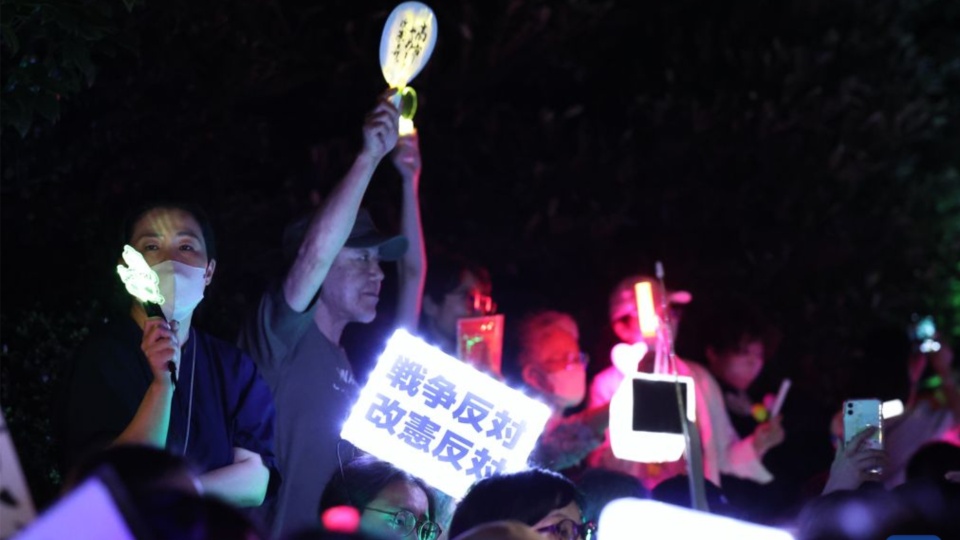
Braving scorching summer heat, 25,000 people rallied outside Japan’s National Diet building on July 20-21, part of a wave of protests at more than 270 locations across the country. The target of their anger: Prime Minister Sanae Takaichi’s push to gut proportional representation in the lower house of parliament, a move critics say is designed to silence women and opposition parties alike.
The rally, live-streamed to tens of thousands of other viewers, was the latest and largest mobilization against a bill backed by Takaichi’s Liberal Democratic Party and its coalition partner, the right-wing Japan Innovation Party (Ishin), that would strip 45 of the 176 proportional representation seats from the 465-seat House of Representatives—a roughly 10% cut. Under the proposal, those seats would disappear automatically unless a ruling-opposition panel struck a deal on broader electoral reform within a year.
Proportional representation seats, unlike single-member district seats, are allocated according to a party’s share of the national vote. That system gives smaller parties and independent voices a foothold in parliament they would otherwise be denied.
It also guarantees higher female representation, as it is usually the smaller parties that name more women to their lists. This aspect of the attack on democracy is generating particular outrage because the prime minister advocating is a woman.
Slashing those seats would overwhelmingly benefit the LDP and its allies while squeezing out the Japanese Communist Party, the Social Democratic Party, and other minority forces that depend on the proportional tier to win any representation at all.
The Japanese Communist Party has been at the forefront of the fight against the cuts. At the Diet rally, JCP Policy Commission Chair Yamazoe Taku told the crowd that the party’s pressure campaign, combined with a broader public outcry, had for now stopped the ruling coalition from forcing the bill through.
“This is because many citizens raised their voices and made their concerns visible,” Yamazoe said. Social Democratic Party leader Fukushima Mizuho also addressed the rally, and Iha Yoichi, a House of Councillors member from the “Okinawa Whirlwind” group, sent a message of solidarity.
But organizers made clear the fight is far from over. Speaking for the rally’s organizing committee, Hishiyama Nahoko warned that the scheme could resurface when the next extraordinary Diet session convenes.
“Cutting the number of proportional representation seats is tantamount to arguing that female lawmakers and opposition parties are unnecessary, as well as to declaring the intent to destroy democracy,” she said, urging the crowd to keep up the pressure to stop any new bill from being introduced.
The protest also took aim at two other pieces of legislation Takaichi’s government rammed through the Diet on July 17: a law criminalizing “desecration” of Japan’s national flag, which opponents view as a tool to intimidate dissenters and critics of the government, and a revision to the Imperial House Law that enshrines male-only succession to the throne in Japan’s constitutional monarchy.
Hishiyama connected the two, telling demonstrators that the flag law’s vague standard for what counts as a punishable offense is “the most terrifying thing” about it, and that locking in male-only succession—despite the popularity of Crown Princess Aiko—shows “just how far behind Japan is” on gender equality.
Hishiyama also flagged Ishin’s push to use a one-week extension of the special Diet session to pass its flagship bill establishing a “secondary capital” in Osaka, calling on the public to resist further attempts by the ruling bloc to bend the Diet’s calendar to narrow partisan ends.
The “secondary capital” idea is a pet project of the Ishin party, which is based in Osaka. It has put forward the idea under the cover of disaster-preparedness, saying the country needs a “backup” capital city in case of disaster. The notion is widely seen as a political deal between Ishin and the LDP that would funnel huge amounts of public funding to Osaka in exchange for supporting the ruling party’s agenda.
What is unfolding in Tokyo is not simply a parliamentary dispute among political parties. It is a grassroots nationwide mobilization—one in which the JCP has played a leading organizing role but that reaches far beyond party lines into a broader public defense of democratic representation, women’s equality, and dissent itself.
We hope you appreciated this article. At People’s World, we believe news and information should be free and accessible to all, but we need your help. Our journalism is free of corporate influence and paywalls because we are totally reader-supported. Only you, our readers and supporters, make this possible. If you enjoy reading People’s World and the stories we bring you, please support our work by donating or becoming a monthly sustainer today. Thank you!
CONTRIBUTOR